Dance in Film · 1979
No Maps on My Taps (1979)
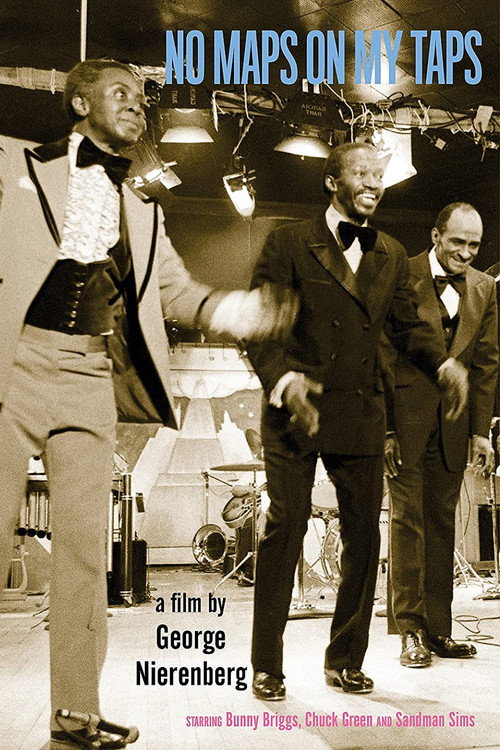
Bunny Briggs, Chuck Green, and Howard “Sandman” Sims turn interviews, rehearsals, alley jams, sand dancing, and a Harlem challenge show into an hour-long argument that African American rhythm tap is alive.
No Maps on My Taps is a 1979 dance documentary centred on Tap Dance. For dancers, it's a chance to see the style performed on screen — the phrasing, partnering, and musicality that the same dances carry onto a real floor.
Jump to the 7 indexed dance sequences ↓
Dance styles featured
Where to watch: Criterion Channel subscription; Milestone/Kino Lorber home and educational streaming (verified 2026-08-11).
The dance sequences in No Maps on My Taps
7 sequences — what is danced, by whom, and where to find it.
Bunny Briggs' Small's Paradise challenge solo
Rhythm Tap (Hoofing)Danced by Bunny Briggs
Bunny Briggs punctuating his solo with the manicured-fingernail pose he identifies as uniquely his.
Briggs folds elegance, sharply placed accents, and presentational detail into the challenge format. His solo reads as character made rhythmic, not a generic display of speed.
Stream or rental only — the timestamp is for when you have it playing.
Chuck Green explains and demonstrates floating heel quality
Rhythm Tap (Hoofing)Danced by Chuck Green
Chuck Green comparing a tap phrase to a leaf drifting from a tree.
Green links a dropped heel to a lighter, floating sound and demonstrates how touch changes tone. The scene makes technique audible as storytelling rather than merely faster footwork.
Stream or rental only — the timestamp is for when you have it playing.
Chuck Green's Small's Paradise challenge solo
Rhythm Tap (Hoofing)Danced by Chuck Green
Chuck Green answering the band with a quiet, intensely individual rhythmic voice.
Green lets sound quality and phrasing carry the challenge, giving each heel and pause narrative weight. The restrained surface makes his tonal choices feel conversational against Lionel Hampton's band.
Stream or rental only — the timestamp is for when you have it playing.
Howard “Sandman” Sims jams with a young dancer in the alley
Rhythm Tap (Hoofing)Danced by Howard “Sandman” Sims; young dancer (not identified)
Sandman Sims and a child trading hoofing phrases in a Harlem alley.
Sims turns call-and-response into transmission: the younger dancer answers patterns while the master adjusts density and swing. The exchange shows rhythm tap surviving through shared listening rather than fixed classroom counts.
Stream or rental only — the timestamp is for when you have it playing.
Howard “Sandman” Sims performs his sand dance
Rhythm Tap (Hoofing)Danced by Howard “Sandman” Sims
Sims pouring sand onto his custom amplified board before turning scrape and shuffle into music.
Sims treats the sanded board as an instrument, using friction, weight, and a tight dancing area to produce brushed rhythmic color. His boxer-derived attack and controlled shuffle texture make the specialty unmistakably personal.
Stream or rental only — the timestamp is for when you have it playing.
John Bubbles archival performance passage
Rhythm Tap (Hoofing)Danced by John Bubbles
John Bubbles appearing in the golden-age footage that frames the contemporary portraits.
Archival footage places the featured hoofers inside tap's earlier stage and screen lineage. Bubbles' presence clarifies the artistry the film's living subjects refuse to let be treated as a vanished novelty.
Stream or rental only — the timestamp is for when you have it playing.
Three-way Small's Paradise challenge finale
Rhythm Tap (Hoofing)Danced by Bunny Briggs; Chuck Green; Howard “Sandman” Sims
Three legendary hoofers trading the Small's Paradise stage as Lionel Hampton drives the challenge.
After separate showcases, the three masters share the stage without collapsing their styles into unison. Lionel Hampton's band gives them a common pulse while their contrasting attack, tone, and personality remain audible.
Stream or rental only — the timestamp is for when you have it playing.
More dance films
Poster artwork and title data from TMDB. This site uses TMDB and the TMDB APIs but is not endorsed, certified, or otherwise approved by TMDB.