Dance in Film · 1953
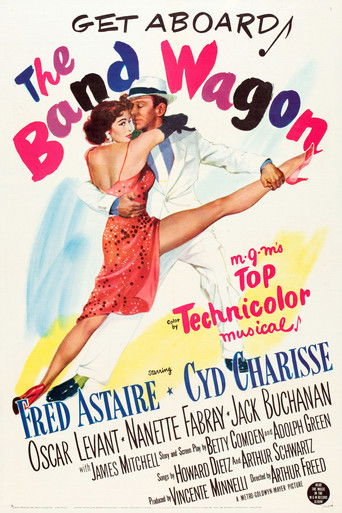
The Band Wagon (1953)
Fred Astaire and Cyd Charisse in a backstage musical that includes the smoldering "Dancing in the Dark" sequence in Central Park.
The Band Wagon is a 1953 dance musical centred on Ballet, Musical Theatre Dance, Tap Dance. For dancers, it's a chance to see these styles performed on screen — the phrasing, partnering, and musicality that the same dances carry onto a real floor.
Jump to the 11 indexed dance sequences ↓
Dance styles featured
Where to watch: Streaming (various)
The dance sequences in The Band Wagon
11 sequences, 11 with a timestamp — what is danced, by whom, and where to find it.
Danced by Fred Astaire; Leroy Daniels · Choreography Michael Kidd
Astaire balancing in the shoe-shine chair while Daniels polishes both shoes, followed by their tap duet through the penny arcade.
Tony trips over Leroy Daniels's outstretched legs in the penny arcade and converts the shoe-shine chair into dance apparatus, bracing on its arms so both freshly polished shoes kick toward the ceiling. Daniels answers with his brushes and feet before the pair tap past the Photomatic booth, rigged baseball cans and an electric mystery box that erupts in flags, steam and horns. Their return duet makes Daniels's working rhythm—not Tony's star entrance—the number's engine.
Stream or rental only — the timestamp is for when you have it playing. [Musical MC² number page (cited in source_url, fetched 2026-09-15) places the number at 00:13:20–00:17:37, 5 shot(s); MC² reference edition not stated on the page. films_tv work_item 1316.]
Danced by Fred Astaire; Jack Buchanan; Nanette Fabray; Oscar Levant · Choreography Michael Kidd
The four creators scrambling over backstage ladders and flats while introducing “That's Entertainment!”
Jeffrey Cordova begins his theatrical sermon on a backstage platform, tumbles from it and keeps singing, making his own grandiosity part of the joke. Tony, Lily and Lester join him among ladders, ropes and discarded flats, using mock tragedy and tap accents to demonstrate that Oedipus, Hamlet and a song-and-dance show all depend on the same urge to perform. Five sustained shots let the quartet's climb through the scenery become the physical proof of the lyric.
Stream or rental only — the timestamp is for when you have it playing. [Musical MC² number page (cited in source_url, fetched 2026-09-15) places the number at 00:27:32–00:30:57, 5 shot(s); MC² reference edition not stated on the page. films_tv work_item 1316.]
Danced by Cyd Charisse; James Mitchell; corps de ballet · Choreography Michael Kidd
Charisse's classical waltz emerging from the gloomy beggar pageant in the ill-fated Faust production.
Cordova's Faust rehearsal dresses Cyd Charisse and James Mitchell as suffering street figures, then gives them pointe work, supported turns and a corps arranged around them. The polished Romantic-ballet vocabulary collides with the deliberately grim beggar tableau, so the expensive solemnity of Cordova's concept becomes visible before anyone calls it a failure.
Stream or rental only — the timestamp is for when you have it playing. [films_tv audit 2026-09-13: removed the unsourced claim that the number is danced to Adam's Giselle — the cited MC² page (9a62c5d1) names the music only as waltz/ballet, orchestra; the number is Schwartz & Dietz's "The Beggar Waltz". MC² time code 34:25–36:55, 9 shots, not yet carried into timestamp_start.] [Musical MC² number page (cited in source_url, fetched 2026-09-15) places the number at 00:34:25–00:36:55, 9 shot(s); MC² reference edition not stated on the page. films_tv work_item 1316.]
- 00:59:26
Dancing in the Dark
Danced by Fred Astaire; Cyd Charisse · Choreography Michael Kidd
Astaire and Charisse gliding across the moonlit Central Park terrace before returning to the waiting carriage.
Tony and Gaby step out of a hansom cab into an empty Central Park court and begin with a side-by-side walk, allowing their disputed height and incompatible training to resolve through shared timing rather than argument. Only three shots carry them from the fountain terrace into long foxtrot glides and a quiet turn up the steps, with Charisse's white dress and Astaire's gray suit separating their bodies from the blue night. They finish by walking back to the carriage as naturally as they arrived, making the partnership feel discovered rather than announced.
Stream or rental only — the timestamp is for when you have it playing. [Musical MC² number page (cited in source_url, fetched 2026-09-15) places the number at 00:59:26–01:02:17, 3 shot(s); MC² reference edition not stated on the page. films_tv work_item 1316.]
- 01:07:34
You and the Night and the Music
Danced by Fred Astaire; Cyd Charisse · Choreography Michael Kidd
The brief Astaire–Charisse duet struggling amid the Faust set's flames and mechanical spectacle.
The New Haven rehearsal traps Tony and Gaby's duet inside Cordova's Faust machinery, with flames, platforms and damnation imagery crowding the single continuous shot. Their sweeping theatrical partnering never gets the open air that made “Dancing in the Dark” breathe; when the overwrought effects overwhelm the rehearsal, the production's artistic mismatch fails in bodily, visible terms.
Stream or rental only — the timestamp is for when you have it playing. [Musical MC² number page (cited in source_url, fetched 2026-09-15) places the number at 01:07:34–01:08:49, 1 shot(s); MC² reference edition not stated on the page. films_tv work_item 1316.]
Danced by Fred Astaire; Cyd Charisse; Nanette Fabray; Oscar Levant; company ensemble · Choreography Michael Kidd
The failed show's company reviving itself with beer, clapping and comic folk steps around the crowded hotel room.
After the Faust opening collapses, Tony, Gaby, Lily and Lester turn the company's hotel-room wake—beer, food and all—into a mock-Mittel-European drinking dance. Their accented claps, heel stamps and linked folk steps pull the surrounding performers out of postmortem gloom, while the cramped party furniture forces the celebration to remain collective. The number lands because this invented Louisa is less an escape than the first practical rehearsal for the lighter show they should have made.
Stream or rental only — the timestamp is for when you have it playing. [Musical MC² number page (cited in source_url, fetched 2026-09-15) places the number at 01:16:35–01:19:06, 2 shot(s); MC² reference edition not stated on the page. films_tv work_item 1316.]
Danced by Cyd Charisse; male dance ensemble · Choreography Michael Kidd
Charisse appearing through the giant yellow sunburst and commanding the male chorus in matching flashes of color.
Charisse bursts through a flat yellow sunburst in a sparkling yellow costume, and the male ensemble's angular responses turn her solo declaration into the revue's first clean visual hit. Two shots are enough: the frontal design holds the radiating lines around her while her kicks and turns claim the stage after Gaby has left both Paul and Cordova's prestige project. The yellow-and-red palette makes the lyric's new beginning literal without returning to Faust's cumbersome machinery.
Stream or rental only — the timestamp is for when you have it playing. [Musical MC² number page (cited in source_url, fetched 2026-09-15) places the number at 01:23:10–01:24:11, 2 shot(s); MC² reference edition not stated on the page. films_tv work_item 1316.]
Danced by Fred Astaire; Jack Buchanan · Choreography Fred Astaire (staged duet); Michael Kidd (film choreography)
Astaire and Buchanan mirroring one another in top hats and canes inside a single spotlight.
Astaire and Buchanan enter in identical tuxedos, top hats and canes against horizontal bands derived from a Paul Klee design, then share one spotlight for a deliberately understated soft-shoe. Tiny delayed echoes in their hat tilts and cane placements make two different performers look like the same disappointed idea arriving twice. The symmetry sharpens the joke in the title: every romantic plan may have changed, but neither man will surrender his immaculate show-business finish.
Stream or rental only — the timestamp is for when you have it playing. [Musical MC² number page (cited in source_url, fetched 2026-09-15) places the number at 01:24:15–01:26:04, 3 shot(s); MC² reference edition not stated on the page. films_tv work_item 1316.]
Danced by Nanette Fabray; dance ensemble · Choreography Michael Kidd
Fabray springing onto the barrel beside the enormous hay wagon—a take that injured her leg.
Nanette Fabray leads the country chorus from an oversized hay wagon and barrels, punctuating the lyric with crisp jazz-inflected folk steps instead of treating the rural props as static scenery. Her leap onto an unreinfoced barrel—the accident that injured her leg during filming—adds a startling vertical accent before the ensemble closes ranks around the wagon. Five shots keep the scale of the set readable while Fabray's attack prevents the novelty setting from swallowing the dancer.
Stream or rental only — the timestamp is for when you have it playing. [Musical MC² number page (cited in source_url, fetched 2026-09-15) places the number at 01:26:10–01:28:11, 5 shot(s); MC² reference edition not stated on the page. films_tv work_item 1316.]
Danced by Fred Astaire; Jack Buchanan; Nanette Fabray · Choreography Michael Kidd
The three stars dancing on their knees as quarrelsome babies in high chairs, complete with tiny shoes at knee level.
Astaire, Buchanan and Fabray sit in three high chairs with adult heads above padded baby bodies, then perform the number on their knees so shoes attached at knee level become the triplets' feet. Black velvet on their lower legs and across the floor erases the supporting anatomy while fifteen quick shots turn nursery jealousy into a sequence of shoves, kicks and synchronized complaints. The technical discomfort is inseparable from the gag: three elegant adults must bounce like furious toddlers without revealing how the illusion works.
Stream or rental only — the timestamp is for when you have it playing. [Musical MC² number page (cited in source_url, fetched 2026-09-15) places the number at 01:31:22–01:33:42, 15 shot(s); MC² reference edition not stated on the page. films_tv work_item 1316.]
Danced by Fred Astaire; Cyd Charisse; dance ensemble · Choreography Michael Kidd
Charisse's double identity—the ethereal blonde and the red-sequined brunette—opposite Astaire's trench-coated private eye.
A machine-gun burst tears open the pulp-book curtain, sending Astaire's fedora-wearing detective through dress-shop mirrors that multiply Charisse's blonde and into the Dem Bones café, where switchblades, a trumpet and a bottle marked nitroglycerin become choreographic clues. Charisse divides the mystery between a pale-blue blonde who melts into Astaire's arms and a red-sequined brunette who strikes through sharp hips and heels, giving the same dancer two incompatible alibis. Across fifty-seven shots and nearly twelve minutes, Kidd makes every pursuit, fight and seduction advance the detective syntax rather than pausing it for a dance break.
Stream or rental only — the timestamp is for when you have it playing. [Musical MC² number page (cited in source_url, fetched 2026-09-15) places the number at 01:35:26–01:47:23, 57 shot(s); MC² reference edition not stated on the page. films_tv work_item 1316.]
More dance films
Poster artwork from TMDB.
 This site uses TMDB and the TMDB APIs but is not endorsed, certified, or otherwise approved by TMDB.