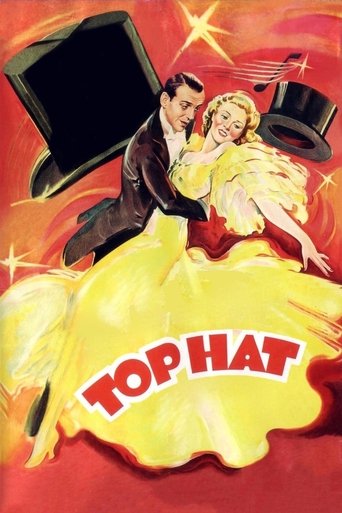
Dance in Film · 1935
Top Hat (1935)
Fred Astaire and Ginger Rogers at their peak — the gold standard for partnered elegance on film.
Top Hat is a 1935 dance musical centred on American Smooth, Musical Theatre Dance, Tap Dance. For dancers, it's a chance to see these styles performed on screen — the phrasing, partnering, and musicality that the same dances carry onto a real floor.
Jump to the 8 indexed dance sequences ↓
Dance styles featured
Where to watch: Streaming (various)
The dance sequences in Top Hat
8 sequences, 7 with a timestamp — what is danced, by whom, and where to find it.
Danced by Fred Astaire · Choreography Fred Astaire (uncredited); Hermes Pan
Astaire's supposedly carefree solo becoming an uproar loud enough to wake Ginger Rogers one floor below.
In Horace's hotel suite, Astaire turns Jerry's protest against marriage into taps that hammer the ceiling above Dale's room, circling the furniture before repeatedly landing full-footed accents on the polished floor. The number works as both a declaration of independence and the literal disturbance that sends Dale upstairs to meet him.
Stream or rental only — the timestamp is for when you have it playing. Approx. 2m34s from song entrance through the instrumental tap finish; 1080p Blu-ray timing [Scene timings were checked against a fan-made subtitle track; that track is timing provenance only, not a source about the work. films_tv 2026-09-14, legal ruling 10445.]
Danced by Fred Astaire · Choreography Fred Astaire (uncredited); Hermes Pan
Jerry appointing himself Dale's sandman and putting three people to sleep with a dance made from loose sand.
Astaire sprinkles sand from the hotel's cigarette receptacle and lets the earlier tap barrage collapse into a tiny soft-shoe while he mixes two drinks. The diminuendo is visible in his body: caressing strokes lull Dale, Horace, and finally Jerry himself to sleep, so the romantic gesture and the gag resolve on the same hush.
Stream or rental only — the timestamp is for when you have it playing. Approx. 1m25s; 1080p Blu-ray timing [Scene timings were checked against a fan-made subtitle track; that track is timing provenance only, not a source about the work. films_tv 2026-09-14, legal ruling 10445.]
Danced by Fred Astaire; Ginger Rogers · Choreography Fred Astaire (uncredited); Hermes Pan
Mock irritation melting into synchronized pleasure under the gazebo, capped by Rogers inviting the embrace herself.
Inside the rain-soaked bandstand, Rogers initially answers Astaire's steps as mockery, echoing him across the pavilion while keeping her distance. Their hops, tap spins, loping steps, and drags gradually become a cooperative exchange; only near the end does Rogers crook her elbow and invite him into a sweeping pivot around the gazebo. The closing handshake preserves the equality the duet has negotiated instead of treating flirtation as conquest.
Stream or rental only — the timestamp is for when you have it playing. Approx. 4m21s; 1080p Blu-ray timing [Scene timings were checked against a fan-made subtitle track; that track is timing provenance only, not a source about the work. films_tv 2026-09-14, legal ruling 10445.]
Danced by Fred Astaire; male chorus · Choreography Fred Astaire (uncredited); Hermes Pan
Astaire using his cane as an arsenal to dispatch an entire chorus line in white tie and tails.
A painted Paris street and a tailcoated chorus initially make Astaire look like one formal man among many, until his circular cane-tap solo begins stopping on abrupt, watchful poses. When the chorus returns as a threat, he converts the cane from gun to machine gun to rifle and finally bow and arrow, and their precisely timed collapses turn a tap number into a miniature action scene.
Stream or rental only — the timestamp is for when you have it playing. Approx. 5m07s; 1080p Blu-ray timing [Scene timings were checked against a fan-made subtitle track; that track is timing provenance only, not a source about the work. films_tv 2026-09-14, legal ruling 10445.]
Danced by Fred Astaire; Ginger Rogers · Choreography Fred Astaire (uncredited); Hermes Pan
Rogers's feathered gown, the long white bridge, and the deepest backbend held at the musical climax.
At the Lido ballroom, Astaire sings through the crowded floor and leads Rogers across the bridge into an empty white dancing space, where sustained full-body views make each deepening supported backbend legible. The choreography escalates from dodging sequential imitation to three lifts and the final held backbend while feathers drift from Rogers's gown, making the sequence's surrender both weightless and visibly hard-won.
Stream or rental only — the timestamp is for when you have it playing. Approx. 5m24s; 1080p Blu-ray timing [Scene timings were checked against a fan-made subtitle track; that track is timing provenance only, not a source about the work. films_tv 2026-09-14, legal ruling 10445.]
Danced by Fred Astaire; Ginger Rogers; dance ensemble · Choreography Fred Astaire (uncredited); Hermes Pan
The overhead chorus patterns and the stars finishing their Piccolino variations by sliding directly back into their chairs.
At the Venetian carnival, a gondola parade gives way to the chorus forming ripples in an overhead view before the camera returns to Astaire and Rogers bounding down the steps. Their two-minute one-take duet alternates the darting side-to-side Piccolino step with hopping figures from the Latin vamp. They travel sideways back to their table, sink into their chairs, and lift their glasses together, turning the gigantic production number into a precisely placed toast.
Stream or rental only — the timestamp is for when you have it playing. Approx. 6m37s from the carnival cue through the main production dance; 1080p Blu-ray timing [Scene timings were checked against a fan-made subtitle track; that track is timing provenance only, not a source about the work. films_tv 2026-09-14, legal ruling 10445.]
Danced by Fred Astaire; Ginger Rogers · Choreography Fred Astaire (uncredited); Hermes Pan
Fred and Ginger reprising the Piccolino step as they dance away into the Venetian sunset.
After Bates reveals that the clergyman was a disguise and Dale's marriage is void, Astaire and Rogers parade across the Venetian set and repeat the Piccolino step into the painted sunset. The fragment compresses reconciliation into a familiar foot pattern: instead of another spoken explanation, the reunited couple literally exits the film dancing together.
Stream or rental only — the timestamp is for when you have it playing. Brief closing reprise beginning immediately after the final dialogue; 1080p Blu-ray timing [Scene timings were checked against a fan-made subtitle track; that track is timing provenance only, not a source about the work. films_tv 2026-09-14, legal ruling 10445.]
Opening-credit feet and cane chorus
Broadway TapDanced by Fred Astaire; Ginger Rogers; male chorus · Choreography Fred Astaire (uncredited); Hermes Pan
The stars being introduced by their dancing feet before their faces appear.
After the RKO logo, the credits reveal only Astaire's lower half as he enters before a cane-carrying male chorus, timing his pause to the appearance of his own name. Rogers repeats the device, and their feet finally share the polished floor as the image dissolves into a top hat, turning star billing itself into choreography.
Stream or rental only — the timestamp is for when you have it playing. Brief opening-credit dance; precise start varies with distributor and restoration logos [Scene timings were checked against a fan-made subtitle track; that track is timing provenance only, not a source about the work. films_tv 2026-09-14, legal ruling 10445.]
More dance films
Poster artwork from TMDB.
 This site uses TMDB and the TMDB APIs but is not endorsed, certified, or otherwise approved by TMDB.