Dance in Film · 1936
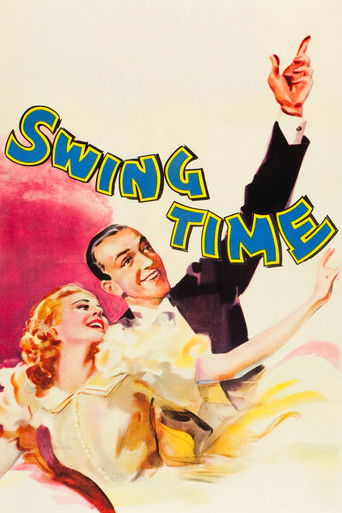
Swing Time (1936)
Astaire and Rogers in what many consider their finest film, featuring the legendary "Never Gonna Dance" sequence.
Swing Time is a 1936 dance musical centred on American Smooth, Tap Dance. For dancers, it's a chance to see these styles performed on screen — the phrasing, partnering, and musicality that the same dances carry onto a real floor.
Jump to the 4 indexed dance sequences ↓
Dance styles featured
Where to watch: Streaming (various)
The dance sequences in Swing Time
4 sequences, 4 with a timestamp — what is danced, by whom, and where to find it.
Danced by Fred Astaire; Ginger Rogers · Choreography Hermes Pan (dance director)
The fake beginner suddenly matching Rogers at full speed and the pair lifting each other over the studio rail.
Lucky's shambling right-left walk, soap-slip pratfalls, and repeated three-hop lesson seed the very step that the film recalls in later dances. After Gordon fires Penny, Astaire drops the act and draws Rogers into the real duet, where they trade rapid taps and vault each other over the Gordon Academy's low white rail. The joke lands because the supposedly hopeless pupil makes Penny look like the teacher who produced him.
Stream or rental only — the timestamp is for when you have it playing. Approx. 7m28s from Penny's first walking exercise through Gordon's praise; the main proof duet begins about 00:28:08; 1080p Blu-ray timing [Scene timings were checked against a fan-made subtitle track; that track is timing provenance only, not a source about the work. films_tv 2026-09-14, legal ruling 10445.]
Danced by Fred Astaire; Ginger Rogers · Choreography Hermes Pan (dance director)
The white gown and joined spotlight shadow, especially Astaire's leap over Rogers's outstretched leg.
On the Silver Sandal's glossy black floor, the overhead spotlight lays the couple's joined shadow beneath them while Rogers's white flounced gown bursts against the dark set at every turn. Astaire jumps cleanly over Rogers's extended leg, and their light tap flurries interrupt the three-beat sweep without breaking it. A quick return to the three-hop lesson step makes this ecstatic audition the grown-up answer to their first class.
Stream or rental only — the timestamp is for when you have it playing. Approx. 2m59s from Lucky's cue through the audition waltz; 1080p Blu-ray timing [Scene timings were checked against a fan-made subtitle track; that track is timing provenance only, not a source about the work. films_tv 2026-09-14, legal ruling 10445.]
Danced by Fred Astaire · Choreography Hermes Pan (dance director)
Astaire tap-dancing against three giant shadows that eventually stop obeying him, within the number's inescapable blackface imagery.
Astaire begins in blackface with clappers fixed to his white gloves, adding hand percussion to his shoe taps as he trades slanted poses with the chorus. Once the stage clears, Vernon Walker's optical process sets three enlarged silhouettes behind him; they first copy his accents, then lag, challenge him, and finally walk away while he is still dancing. The celebrated shadow trick cannot be separated from Astaire's only blackface appearance, which frames the professed Bill Robinson tribute in racist minstrelsy imagery.
Stream or rental only — the timestamp is for when you have it playing. Approx. 8m26s from the title card through the return to dialogue; 1080p Blu-ray timing [Scene timings were checked against a fan-made subtitle track; that track is timing provenance only, not a source about the work. films_tv 2026-09-14, legal ruling 10445.]
Danced by Fred Astaire; Ginger Rogers · Choreography Hermes Pan (dance director)
The two dancers waltzing up separate curving staircases before Rogers spins through the upper door and leaves Astaire collapsed behind her.
At the foot of the Silver Sandal's twin black staircases, Rogers passes Astaire in silence; he catches her with a small lunge, and their slow side-by-side walk snaps into rapid lateral steps as The Way You Look Tonight enters the score. Rogers freezes with her arms raised while Astaire wraps one arm around her waist and spins her, then both climb opposite curves of the staircase on the recalled waltz. At the top, her fierce spiral turns send her through the door and leave Astaire sagging alone, converting the film's earlier romantic phrases into a breakup.
Stream or rental only — the timestamp is for when you have it playing. Approx. 6m08s from the first sung phrase through Penny's exit; 1080p Blu-ray timing [Scene timings were checked against a fan-made subtitle track; that track is timing provenance only, not a source about the work. films_tv 2026-09-14, legal ruling 10445.]
More dance films
Poster artwork from TMDB.
 This site uses TMDB and the TMDB APIs but is not endorsed, certified, or otherwise approved by TMDB.