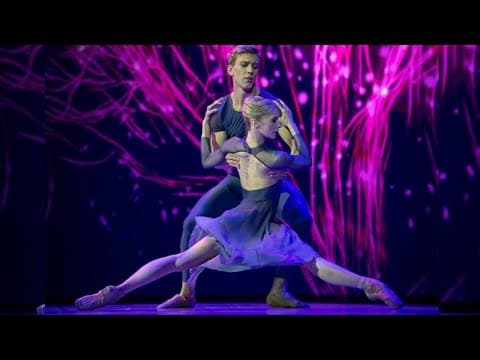
Five Movements, Three Repeats is a Christopher Wheeldon work made for the Vail International Dance Festival, first shown in a partial version in 2011 and premiered complete in August 2012. It is built around four dancers - three from New York City Ballet (Wendy Whelan, Tyler Angle, Craig Hall) and modern dancer Fang-Yi Sheu, formerly of the Martha Graham Dance Company - moving through five sections set to songs by Max Richter, with the ensemble passage repeated three times, once spatially reversed.
What it contains
- Contemporary Ballet — This Bitter Earth pas de deux · The 'This Bitter Earth' pas de deux — A partnered adagio duet danced en pointe by Whelan opposite Angle, built around sustained lines and weight-sharing to the vocal mashup; the excerpt has since been staged on other ballet-trained casts. Source: "A pas de deux originated by Whelan and Angle is set to a mashup of "This Bitter Earth", written by Clyde Otis and sung by Dinah Washington, and Richter's "On the Nature of Daylight""
- Contemporary Ballet · Across the full four-dancer piece — Whelan, an NYCB principal, dances en pointe while Sheu, a modern dancer, dances barefoot in the same work, placing pointe-based ballet vocabulary alongside unshod modern technique within one structure. Source: "Sheu danced barefoot and Whelan was in pointe shoes."
What is danced
The article gives one direct piece of movement information, but it is a load-bearing one: Sheu danced barefoot while Whelan danced en pointe, meaning the same stage, at the same time, carried two different technical bases side by side - Whelan's classical/contemporary-ballet pointe work against Sheu's unshod modern-dance line. Structurally, the piece places all four dancers in separate zones for a passage that recurs three times across the work, once mirrored spatially, which is a compositional device (repetition-with-variation across the stage picture) rather than a step vocabulary, but it shapes how the piece reads: the four bodies are rarely in unison, and the choreography is organized by return and reversal rather than narrative.
The best-known excerpt, extracted almost immediately after the premiere, is the pas de deux originally danced by Whelan and Angle to a mashup of Clyde Otis's 'This Bitter Earth' (Dinah Washington's recording) layered with Richter's 'On the Nature of Daylight'. This duet is danced by the ballet-trained pair (Whelan on pointe) and functions as a slow, sustained adagio built for partnering weight and extension against the vocal line - the kind of duet that has since traveled independently of the larger work, cast on dancers from other companies (Boylston/Royal, Mearns/Danchig-Waring) without the surrounding four-dancer structure.
Context
By 2012 Wheeldon had already left New York City Ballet as a dancer and resident choreographer to found Morphoses and was working across companies as an independent choreographer sought after for festival commissions; Vail's summer festival was one venue where he could pair NYCB-trained dancers with an outside modern-dance figure like Fang-Yi Sheu in the same cast, which the article frames as a deliberate technical juxtaposition (barefoot versus pointe) rather than a stylistic accident.
Staging history
The 'This Bitter Earth' pas de deux entered New York City Ballet's repertory within a month of the full piece's premiere, first at the company's fall 2012 gala with Whelan and Angle in Valentino costumes, later restaged on other casts in costumes by Reid Bartelme. The full Five Movements, Three Repeats was also given at the Fall for Dance Festival at New York City Center in September 2012 with the original cast, and the pas de deux was later performed by Sheu with Clifton Brown and by San Francisco Ballet's Yuan Yuan Tan and Damian Smith; Vail revived the duet in 2016 with American Ballet Theatre's Isabella Boylston and Calvin Royal III, danced to live vocals. In 2020, NYCB filmed an excerpt of the duet with Sara Mearns and Adrian Danchig-Waring as a one-shot film, and the 2016 Vail recording was streamed by the festival when its 2020 edition went digital during the pandemic.
How to watch it
Watch for the footwear contrast the article specifically flags - pointe shoes on one dancer, bare feet on another - as the clearest signal of the two technical languages sharing the stage. In the four-dancer sections, track the repeated 'separate zones' passage and notice when it returns spatially reversed rather than simply repeated. If you encounter only the 'This Bitter Earth' pas de deux, know it is a standalone extraction from a larger, differently structured work, not a self-contained duet conceived alone.
Structure
- This Bitter Earth pas de deuxA duet, originated by Whelan and Angle, set to a mashup of Clyde Otis's 'This Bitter Earth' and Richter's 'On the Nature of Daylight'; frequently performed independently of the full work.
Structure read from an encyclopaedia article, not from a libretto or score we hold. Confirm against a programme before treating the numbering as authoritative.
Credits
- composer: Clyde Otis
- composer: Max Richter
More from Christopher Wheeldon
Other staged works in the register connected to this one by author or lineage.
 Alice's Adventures in WonderlandBallet · 2011Wheeldon · video
 The Winter's TaleBallet · 2014Wheeldon · video
 An American in ParisBallet · 2005Wheeldon · video
 Like Water for ChocolateBallet · 2022Wheeldon · video
 PolyphoniaBallet · 2001Wheeldon · video
 After the RainBallet · 2005Wheeldon · video
 IvesianaBallet · 1954Same lineage · video
 The CageBallet · 1951Same lineage · video