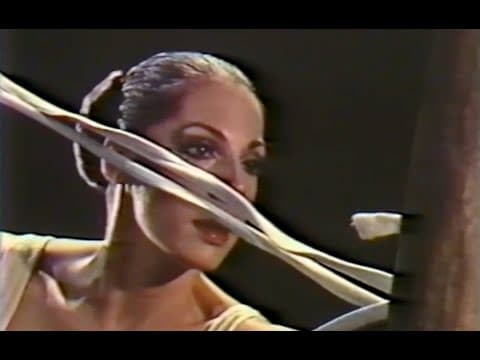
Errand into the Maze is a 1947 solo-centred ballet made by Martha Graham for her own company, based on a poem by Ben Belitt and drawing on the myth of Ariadone and the Minotaur to dramatise a woman's confrontation with inner fear, specifically fear of sexual intimacy. It was designed by Isamu Noguchi, with costumes by Graham herself, and premiered at the Ziegfeld Theatre on February 28, 1947, with Graham dancing the unnamed heroine opposite Mark Ryder as the Creature of Fear.
The work sits in the catalogue as one of Graham's best-known and most durable pieces, still performed by the Martha Graham Dance Company, and significant enough to have supplied the title of Deborah Jowitt's 2024 biography of the choreographer.
What it contains
- Graham Technique · the entire ballet, a solo-centred journey through a rope maze to a sculptural set — The heroine physically negotiates a maze and confronts an antagonist three times before dancing alone at the close; this is Graham's own choreography for her own dancing, built as weighted, dramatically-driven solo movement around Noguchi's set rather than a partnered classical duet. Source: "The heroine dances in the void between the two vertical set elements as the curtain falls."
What is danced
The article describes a compact, roughly fifteen-minute piece built almost entirely around a single female dancer, with the horned, staff-carrying Creature of Fear functioning, in its own words, 'more as a prop than an active participant.' The heroine's journey is physicalised as a literal passage: she 'weaves her way through a rope maze outlined on the stage' to reach a set with a suggestive v-shaped wooden frame, is confronted three times by the creature, and ultimately overpowers him, after which he drops his staff and sinks to the floor. The ballet closes with the heroine dancing alone 'in the void between the two vertical set elements as the curtain falls.'
The article does not itemise specific steps, holds or technical vocabulary, so no detailed step-by-step account can be drawn from it. What can be said is that the choreography is structured as a psychological solo journey through and around Noguchi's sculptural set pieces, with the antagonist used sparingly, as a recurring obstacle rather than a dance partner in the conventional sense.
Context
The article gives no direct account of the wider dance landscape in 1947, so this section draws partly on outside knowledge: the piece belongs to the period when Graham was producing a run of myth-based psychological solos and duets (alongside works like Cave of the Heart and Night Journey) that used Greek subject matter as a vehicle for exploring female interiority and sexuality, collaborating repeatedly with Noguchi on abstract, body-scaled set pieces rather than illustrative decor.
Staging history
The premiere cast was Graham and Mark Ryder in 1947; the article notes they performed a revised version the following season to better reviews. Graham returned to the role of Ariadne in 1952 opposite Stuart Hodes, and the pair performed it together over several subsequent seasons. When Graham and Baroness Batsheva de Rothschild founded the Batsheva Dance Company in Israel in 1964, the work was revived there with Rina Schenfeld and Moshe Efrati. Later twentieth-century casts named in the article include Yuriko Kimura and Tim Wengerd in the 1970s, and Terese Capucilli with Larry White, followed by Christine Dakin with Mario Comacho, in the 1980s.
How to watch it
Watch the heroine's physical negotiation of the rope maze and the two vertical set pieces as the true content of the dance — the Creature of Fear is deliberately kept as an obstacle rather than a partner, so the drama is carried almost entirely by one body in relation to the built environment. The final image, the heroine alone in the gap between the set's two vertical elements as the curtain falls, is the piece's resolution and worth attending to as the payoff of the whole journey.
Credits
- composer: Gian Carlo Menotti
More from Martha Graham
Other staged works in the register connected to this one by author or lineage.
 Appalachian SpringBallet · 1944Graham · video
- JudithJudithBallet · 1950Graham
 LamentationBallet · 1930Graham · video
 Cave of the HeartBallet · 1946Graham · video
 ClytemnestraBallet · 1958Graham · video
- Imagined WingImagined WingBallet · 1944Graham
 Maple Leaf RagBallet · 1990Graham · video
 EpisodesBallet · 1959Same lineage · video