Unknown authorUnknown author or not provided — U.S. National Archives and Records Administration · Public domain
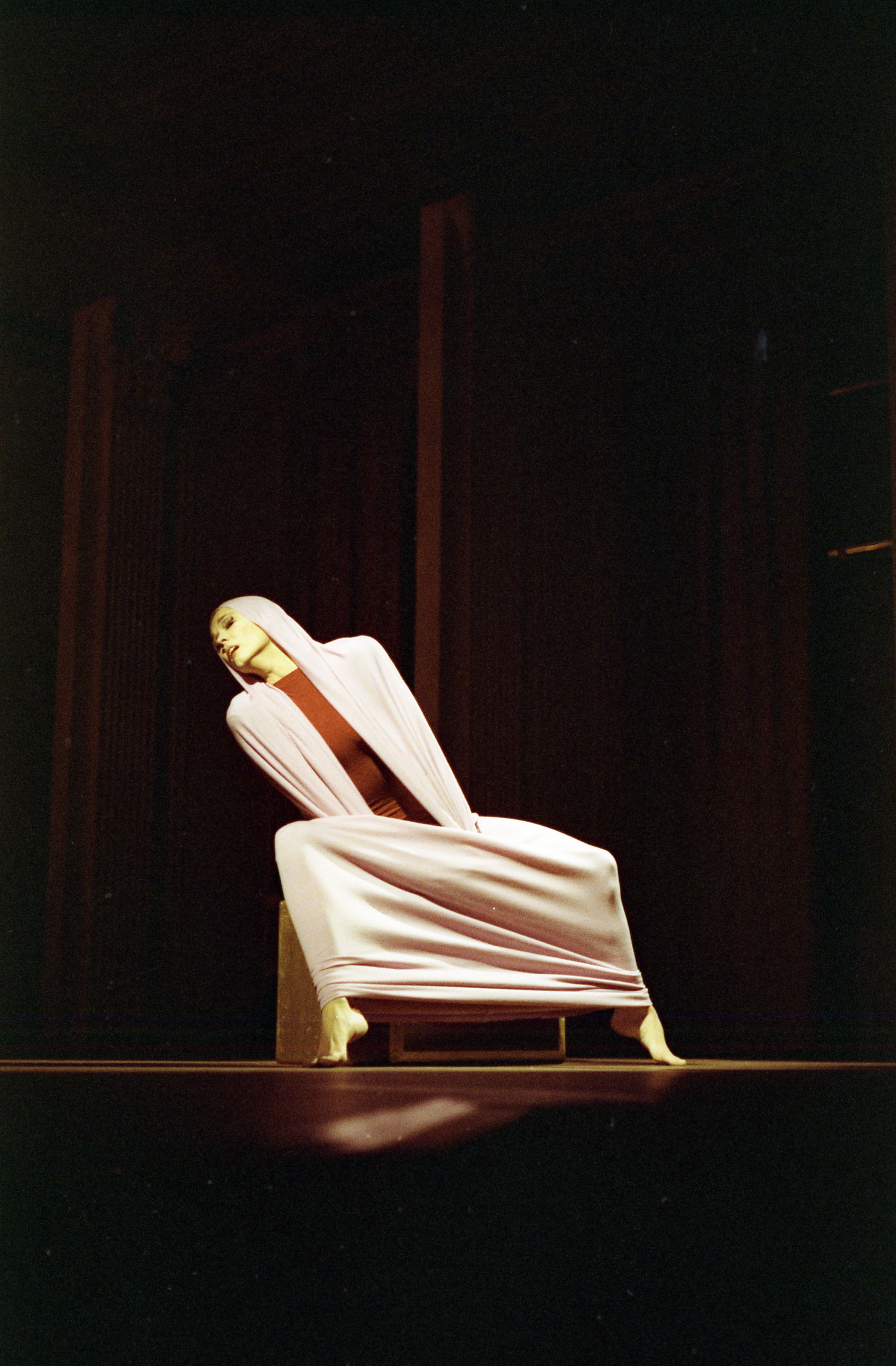
Lamentation is a solo made by Martha Graham in 1930, danced to Zoltán Kodály's 1910 Piano Piece, Op. 3, No. 2, and first shown on a Dance Repertory Theatre program that also featured Doris Humphrey, Charles Weidman and Helen Tamiris — the same evening that effectively launched a self-consciously American modern dance repertory. Our own record files it under 'ballet' and gives no composer, but the article is explicit that this is a modern dance solo built on a single seated figure, not a balletic number.
What it contains
- Graham Technique · the entire solo, from opening seated stillness to the final covered-head gesture — seated torso and arm work built on 'deep contractions,' rocking and twisting the upper body so that the jersey costume is pulled into angular shapes framing an emotionless face Source: "she rocks and twists her upper body, swinging through deep contractions"
What is danced
The entire piece is danced by one performer seated on a low bench, encased from neck to ankle in a stretch-jersey tube that leaves only head, hands and feet visible. Movement begins with a small silent head-shake, then the dancer cues the music herself with a foot and moves into rocking, twisting contractions of the torso — the article calls them 'deep contractions,' the central mechanism of what became Graham Technique. The vocabulary is almost entirely upper-body and torso-driven: angular, opposing pulls of head, arms and ribcage stretch the costume into triangles and rhomboids, converting muscular effort directly into visible geometric shape rather than into traveling steps or extension. There is no rising to full height, no use of the floor beyond the bench, and no partnering; the dancer 'struggles to an upright position' only once, before the closing gesture in which she pulls the fabric taut over her head in a raised fist and sinks back into a seated, head-bowed close. For a performer, the technical demand is almost entirely internal and isometric — sustained tension against a constraining garment, precise control of contraction and release, and a face kept 'emotionless' throughout so the costume, not the features, carries the emotional information.
Context
The 1930 Dance Repertory Theatre program on which Lamentation premiered was an organized attempt by Graham, Humphrey, Weidman and Tamiris to establish a native American concert dance separate from ballet and from the Denishawn exoticism most of them had trained in. Lamentation belongs to what Graham called her 'long woolens' period, when she and her female dancers worked in plain jersey costume, and the piece is described as breaking outright with prevailing dance convention by performing seated and by deliberately hiding the body it was ostensibly there to display. Scholars group it with Graham's later psychological works such as Night Journey and Errand into the Maze as an early instance of the expressionist, myth- and grief-driven repertoire she would build across her career.
Staging history
Lamentation is one of the small number of Graham's earliest solos still performed by the Martha Graham Dance Company, and it has passed through named dancers including Janet Eilber, Christine Dakin, Terese Capucilli, Peggy Lyman, Joyce Herring, Katherine Crockett, Natasha M. Diamond-Walker and PeiJu Chien-Pott. Graham herself was filmed dancing it in the 1930s and again in 1943; a 1976 television film pairs Peggy Lyman's performance with an introduction by Graham, and a performance by Natasha M. Diamond-Walker was streamed by New York City Center in October 2020.
How to watch it
Watch the relationship between the jersey tube and the body inside it: the shapes the fabric is pulled into are the choreography as much as the muscles making them. Note that the dancer never stands fully upright and that the face stays deliberately blank — the grief is meant to read as impersonal, 'not the sorrow of a specific person,' carried entirely through torso and limb distortion rather than facial expression or pantomime.
More from Martha Graham
Other staged works in the register connected to this one by author or lineage.
 Appalachian SpringBallet · 1944Graham · video
- JudithJudithBallet · 1950Graham
 Cave of the HeartBallet · 1946Graham · video
 ClytemnestraBallet · 1958Graham · video
 Errand into the MazeBallet · 1947Graham · video
- Imagined WingImagined WingBallet · 1944Graham
 HérodiadeBallet · 1944Same lineage · video
 EpisodesBallet · 1959Same lineage · video