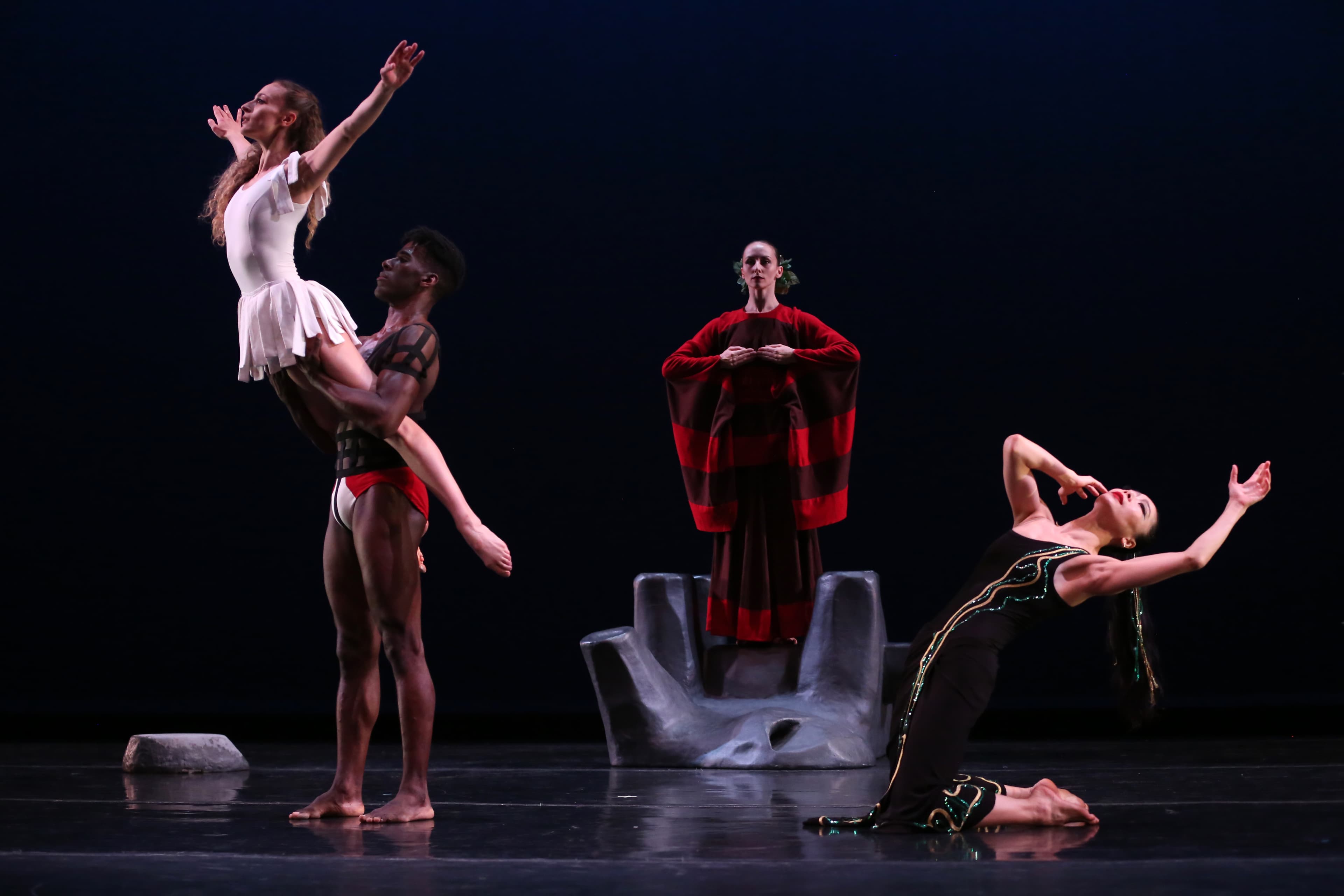
MarthaGrahamDance · CC BY-SA 4.0
Cave of the Heart is a one-act Martha Graham work set to a Medea suite arranged by Samuel Barber, built around Euripides' tragedy and filtered through Jungian symbolism as "a dance of possessive and destroying love." It was created for a four-person cast (Medea, Jason, the Princess and a Chorus figure) with sets by Isamu Noguchi and costumes by Edythe Gilfond, and forms part of Graham's so-called "Greek Cycle" alongside Night Journey, Errand into the Maze and Clytemnestra.
What it contains
- Graham Technique · Throughout the ballet, most explicitly in the 'cave turn' movement — Signature Graham vocabulary built on torso contraction; the ballet's own movement invention is a heads-down spin in arabesque penché combined with a contraction, subsequently absorbed into standard Graham technique. Source: "Graham invented one of her signature movements for the ballet, a step subsequently known as the "cave turn." The motion is a swooping heads-down spin in arabesque penché with a torso contraction."
What is danced
The piece is danced in Graham's own contraction-and-release vocabulary rather than academic ballet steps. Its best-documented movement invention is the "cave turn": a swooping, heads-down spin in arabesque penché combined with a torso contraction, created for this ballet and afterward absorbed into Graham technique generally. The article gives the ballet's seven-part musical/choreographic structure — Parados, Choros, Young Princess Dance and Dance of Jason, Choros, Medea's dance, Kanticos Agomas, and Exodus (with fanfare of trumpets) — but does not describe the specific steps within each part beyond the cave turn.
Context
The work belongs to Graham's mid-1940s turn toward Greek tragedy as source material, reworked through the psychoanalytic (specifically Jungian) frame that shaped much of her later output; it sits alongside Night Journey (Oedipus), Errand into the Maze and Clytemnestra (the Oresteia) as part of what is called her "Greek Cycle." It was made for a new-music showcase — the second annual Festival of Contemporary American Music — commissioned by the Alice M. Ditson Fund, tying it to the postwar American effort to build a native concert repertory in both music and modern dance.
Staging history
The ballet began life as Serpent Heart, premiered 10 May 1946 at the McMillin Theater, Columbia University, with a cast of Graham as One Like Medea, Erick Hawkins as One Like Jason, Yuriko as The Princess and May O'Donnell as The Chorus; John Martin's review called it more draft than finished work. Graham revised it for the following season, renaming it Cave of the Heart for its 27 February 1947 premiere at the Ziegfeld Theater in New York, keeping the same cast but renaming the roles (The Sorceress, The Adventurer, The Victim, The Chorus); Martin judged the revision "greatly strengthened" though he doubted it would rank among Graham's masterpieces. It has nonetheless remained in the Martha Graham Dance Company repertory as one of its enduring works and appears in the documentary An Evening of Conversation and Dance with Martha Graham.
How to watch it
Watch for the contraction through the spine that drives Graham's contraction-and-release technique rather than turned-out ballet lines, and for the cave turn itself — a penché arabesque spin taken with the head down and the torso pulled inward. Note Noguchi's sculptural set pieces and the metal, flame-spiked garment The Sorceress dons near the end, which stages her transformation and imprisonment visually rather than through mime.
Structure
- ParadosOpening movement of the seven-part structure named in the 1946/47 programme.
- ChorosFirst choral movement.
- Young Princess Dance and Dance of JasonPaired solo/duet sections for the Princess and Jason characters.
- ChorosSecond choral movement.
- Medea's danceCentral solo movement for the Medea/Sorceress figure.
- Kanticos AgomasNamed movement late in the structure, preceding the finale.
- ExodusClosing movement, danced with a fanfare of trumpets, in which the Sorceress dons the spiked metal garment.
Structure read from an encyclopaedia article, not from a libretto or score we hold. Confirm against a programme before treating the numbering as authoritative.
Credits
- composer: Samuel Barber
More from Martha Graham
Other staged works in the register connected to this one by author or lineage.
 Appalachian SpringBallet · 1944Graham · video
- JudithJudithBallet · 1950Graham
 LamentationBallet · 1930Graham · video
 ClytemnestraBallet · 1958Graham · video
 Errand into the MazeBallet · 1947Graham · video
- Imagined WingImagined WingBallet · 1944Graham
 Primitive MysteriesBallet · 1931Graham · video
 HérodiadeBallet · 1944Same lineage · video