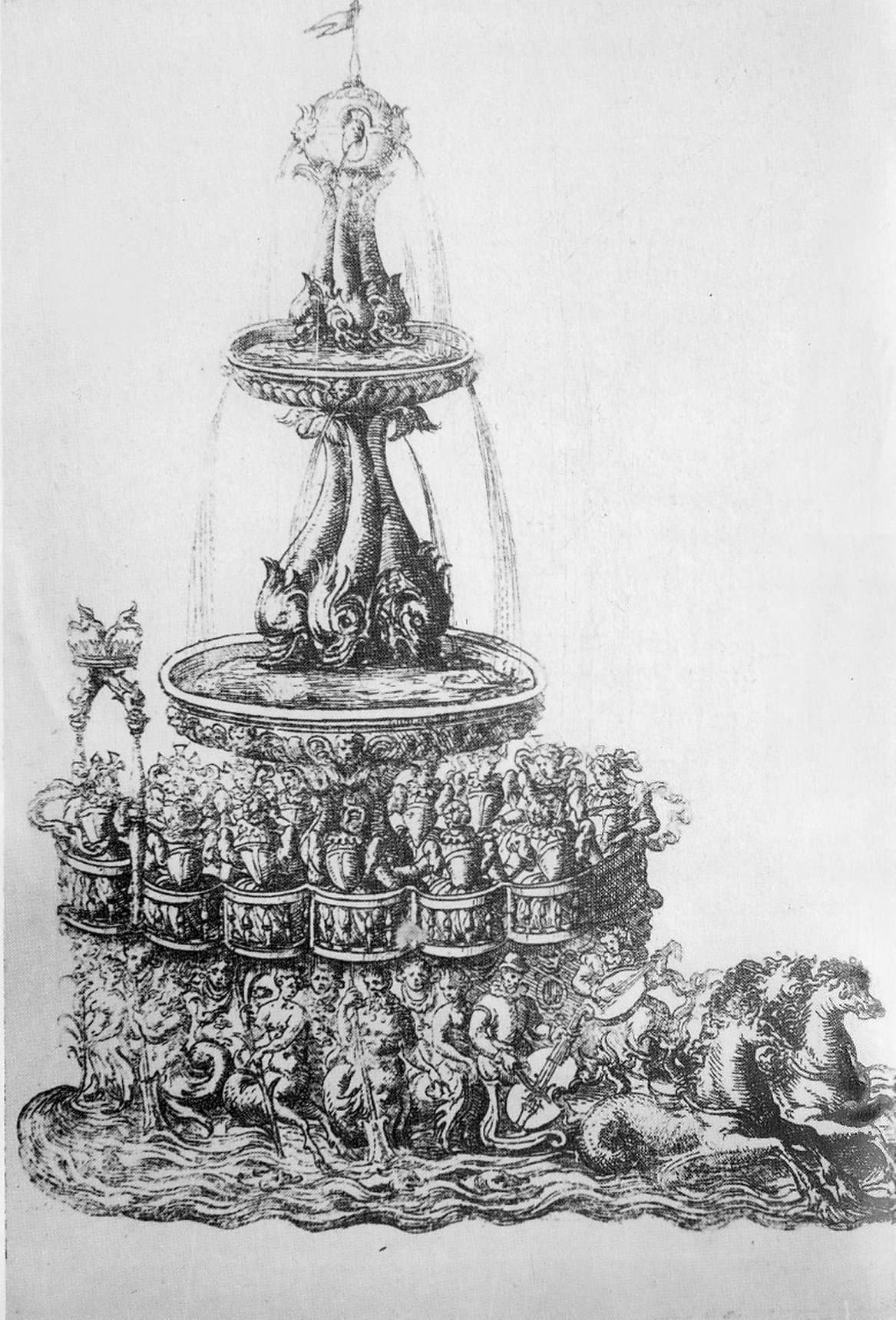
Jacques Patin — Roy Strong, Art and Power, Boydell Press, 1984, ISBN 0851152473, plate 82. · Public domain
The Ballet Comique de la Reine was a five-and-a-half-hour court spectacle staged on 15 October 1581 in the great hall of the Hôtel de Bourbon in Paris, mounted by Catherine de' Medici for the wedding festivities of the Duke de Joyeuse and Marguerite de Vaudemont, sister of Queen Louise of Lorraine — the Queen the title names. It is the work most often pointed to as the first ballet de cour, the genre that fused verse, music, scenic design and dance into a single allegorical spectacle under the theoretical program of Jean-Antoine de Baïf's Académie de Poésie et de Musique.
What it contains
- Ballet de Cour (Court Ballet) · The entire spectacle, from the Queen's fountain entrance to the closing restoration of peace — A full court spectacle combining sung verse, instrumental music, scenic design and processional/allegorical dance staged for royalty and courtiers, with the Queen and court ladies dancing as dryads and entries choreographed from both sides of the hall Source: "It is often referred to as the first ballet de cour."
What is danced
The article gives almost no step-level detail — there is no surviving choreographic notation described here, and Balthasar de Beaujoyeulx is credited as author/deviser of the whole event rather than analysed step by step. What it does establish is the staging logic: the Queen and a company of court ladies, costumed as dryads, made their entrance riding a three-tiered fountain set-piece, and dancers moved in and out from both sides of the hall rather than from a single fixed point, a break from earlier court ballet practice according to the article. The action dramatized Circe's enchantment and its undoing, meaning the dance was built around processional entries, allegorical tableaux and a climactic restoration-of-order sequence rather than a set of named divertissements.
Context
This work sits at the founding moment of French court ballet: it predates the later, more famous seventeenth-century ballets de cour and is frequently cited as the model they followed, combining sung verse, instrumental music, elaborate scenography and dance under a single unifying poetic-academic program rather than treating them as separate entertainments. The political stakes were explicit — Circe stood for the civil and religious strife dividing France, and the ballet's resolution was staged as a wish for national reconciliation, which is part of why the production received royal patronage and lavish expense.
Staging history
The article does not describe any later theatrical revival of the ballet as a staged dance work; its afterlife is musical rather than choreographic. A closing passage of the score was reused in a nineteenth-century arrangement by Henri Ghys (misattributed to an air by Louis XIII), and this arrangement was later given Japanese lyrics as "Amaryllis" on NHK television in 1968, after which it became a widely used chime melody in Japan and the completion tone for Zojirushi rice cookers — an unusual transmission history for a sixteenth-century court ballet.
How to watch it
There is no danced performance tradition to watch; approach this as a piece of dance history read through its livret and scenic description rather than through choreography. Attend to the entrances and exits described — the three-tiered fountain, the dryad costuming, dancers approaching from both sides of the hall — since these staging choices, not step vocabulary, are what the article records as innovative.
Structure
- Le Son de la clochette auquel Circé sortit de son jardinThe closing passage of the first ballet, marking the moment Circe leaves her garden at the sound of a bell.
Structure read from an encyclopaedia article, not from a libretto or score we hold. Confirm against a programme before treating the numbering as authoritative.
In the same lineage
Other staged works in the register connected to this one by author or lineage.


