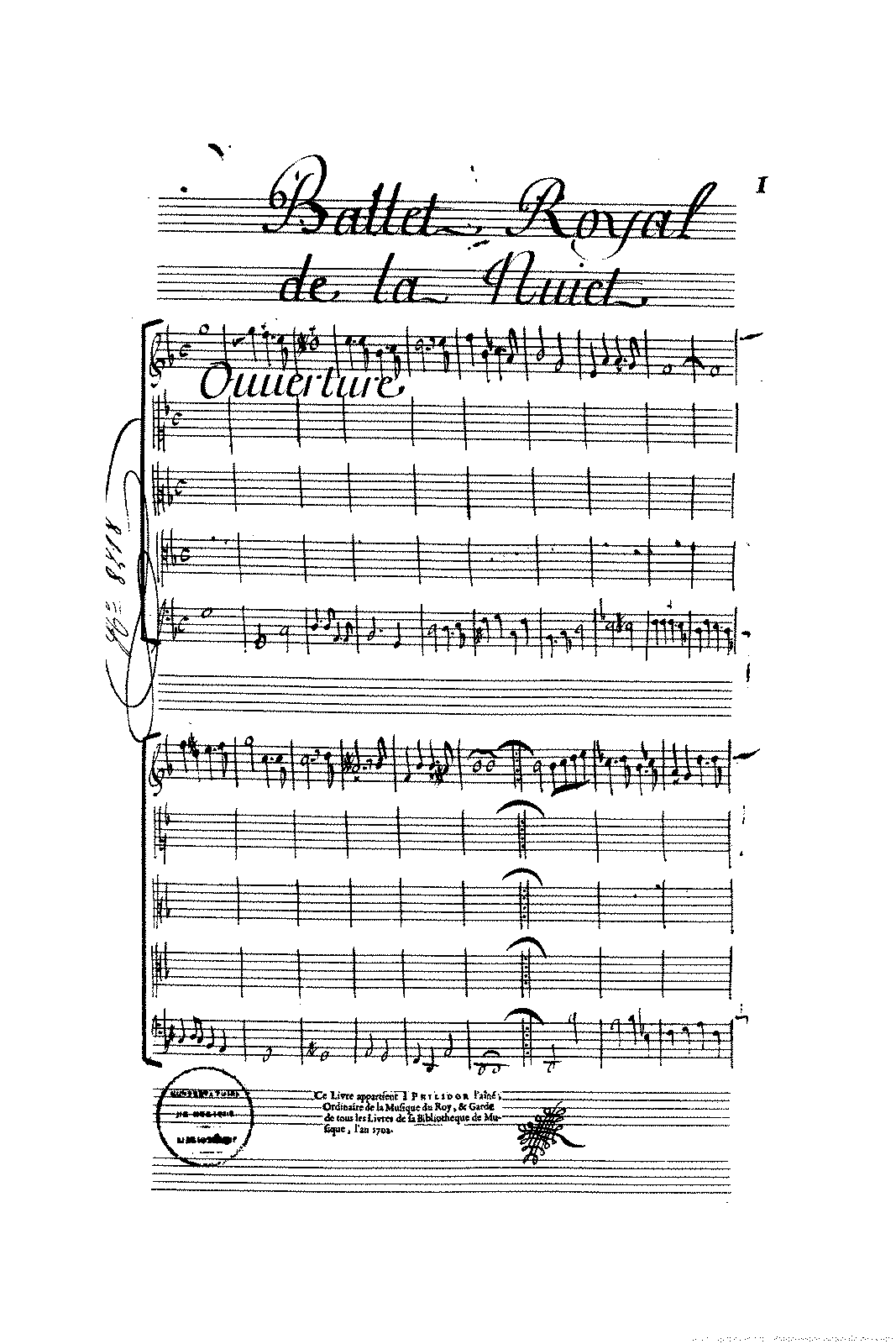
http://imslp.org/wiki/User:Squin — http://imslp.org/wiki/File:PMLP128208-Cambefort_ballet_nuit.pdf · CC BY-SA 3.0
Ballet Royal de la Nuit (1653) is a ballet de cour — a French court entertainment combining sung airs, spoken verse, spectacle and dance — staged at the Salle du Petit-Bourbon in Paris with a libretto by Isaac de Benserade and airs by Jean de Cambefort, Jean-Baptiste Boësset and Michel Lambert. It is remembered above all as the stage on which the fourteen-year-old Louis XIV first danced in public, appearing at dawn as Apollo the Rising Sun — the origin of his later epithet the Sun King.
What it contains
- Ballet de Cour (Court Ballet) · the entire work, across all four Watches and its forty-five entrées — a courtly spectacle built from forty-five discrete entrées and three ballets-within-the-ballet, performed by courtiers and professional dancers including the king himself, in the entrée-and-allegory conventions of mid-seventeenth-century French court ballet rather than later academic technique Source: "is a ballet de cour with a libretto by Isaac de Benserade and music by Jean de Cambefort, Jean-Baptiste Boësset, Michel Lambert and possibly others"
What is danced
The article does not preserve choreographic notation or named dance steps; what survives and is described is the dramaturgical and scenic structure rather than the vocabulary of the dancing itself. The ballet was organised around the four Watches of the night (sunset, evening, deep night, dawn), unfolding across forty-five entrées and containing three smaller 'ballets within a ballet', a structure typical of the genre's habit of stringing together discrete character entries — gods, witches, gypsies, thieves, lamplighters, beggars — rather than sustaining a single narrative through-line of movement.
Because this is a mid-seventeenth-century ballet de cour, danced by courtiers and professional dancers together (Louis XIV among them, in the role of Apollo), the vocabulary belongs to the courtly, entrée-based conventions that predate the codified academic ballet technique of later centuries — a dancer researching this work should not expect pointe work, turnout-driven adagio, or named steps, but a sequence of costumed processional and character entries building toward the Apollo/sunrise tableau. The article gives no further technical detail beyond this structure, so no more specific step vocabulary can be claimed from it.
Context
The work sits at the height of the ballet de cour tradition, the genre that fused music, verse, allegory and dance to stage the French monarchy's power directly through the bodies of courtiers and the king himself. Its scale — forty-five entrées and roughly thirteen hours of performance — and its use of the young Louis XIV as Apollo mark it as a deliberate piece of political theatre as much as an entertainment; the article notes this personification of the rising sun was meant to emphasise 'the power of the monarchy and its closeness to the divine.' The 2009 Burden/Thorp scholarly volume states it was the first ballet de cour to be published in complete form, underlining its unusual documentary survival compared with most works of the genre.
Staging history
The article does not describe modern staged revivals of the ballet as a danced work. It records instead the survival and study of its surviving materials: a costume-and-scenery folio attributed to Henri de Gissey, made for Louis Hesselin, now at Waddesdon Manor, and a second costume folio at the Bibliothèque de l'Institut in Paris. This material was the subject of the 2004 Oxford Dance Symposium and a subsequent scholarly facsimile edition (Burden and Thorp, Pendragon Press, 2009/2010) including a modern edition of the surviving music by Lionel Sawkins. A scene depicting the final sunrise entrée was recreated for the film Le Roi danse, and the score has been recorded complete by Ensemble Correspondances under Sébastien Daucé (Harmonia Mundi, 2020).
How to watch it
Watch for the structure rather than a single narrative: the piece moves through the four Watches of the night, stacking character entries (gods, witches, gypsies, beggars, lamplighters) before culminating in the dawn entrée where Apollo/Louis XIV appears. Because no steps survive, modern encounters with the work are usually musical or scenic reconstructions (recordings, costume-design facsimiles, or the isolated sunrise scene recreated on film) rather than full danced revivals; treat any staged version as an informed modern reconstruction of the entries described in the livret, not a preserved original choreography.
Structure
- Scene First WatchSunset watch, 6 p.m. to 9 p.m.; mythological and 'realistic' figures (shepherds, gypsies, thieves) begin to appear as night falls.
- Scene Second WatchEvening watch, 9 p.m. to midnight, continuing the procession of entrées.
- Scene Third WatchDeep night, midnight to 3 a.m., featuring werewolves, demonic creatures and witches celebrating a black Sabbath.
- Scene Fourth Watch (sunrise) · Le Roi représentant le soleil levantDawn watch, 3 a.m. to 6 a.m., in which Louis XIV appears as Apollo, the rising sun, asserting the monarchy's divine closeness.
Structure read from an encyclopaedia article, not from a libretto or score we hold. Confirm against a programme before treating the numbering as authoritative.
Credits
- composer: Jean-Baptiste Lully
More from Jean-Baptiste Lully
Other staged works in the register connected to this one by author or lineage.


