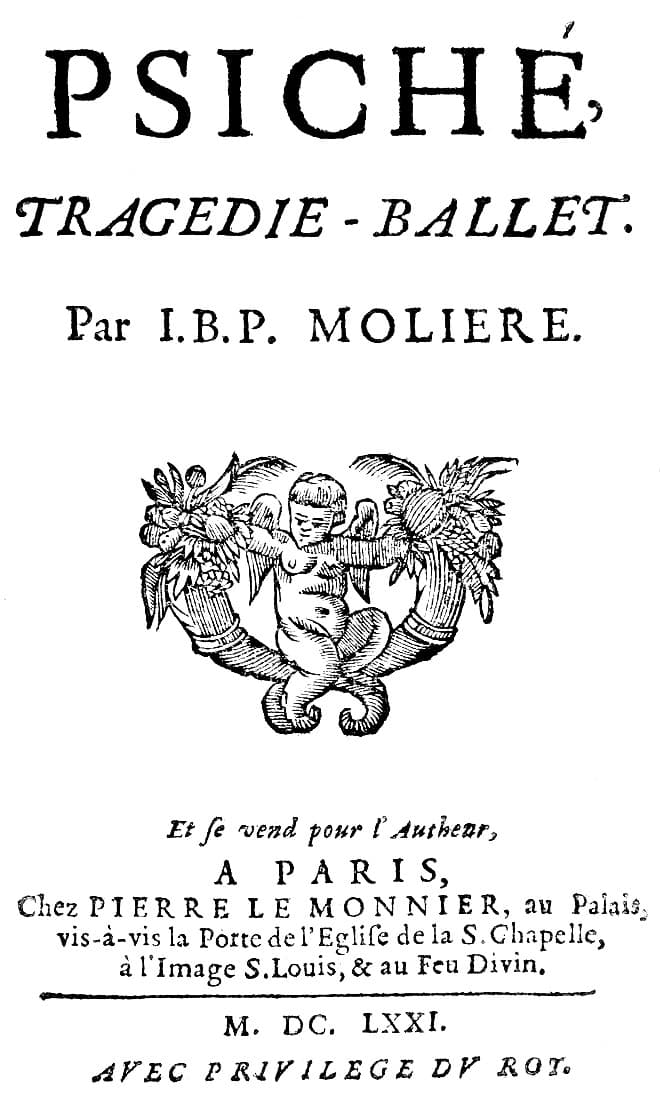
Edition-Librairie chez Pierre Le Monnier — http://pagesperso-orange.fr/jean-claude.brenac/LULLY_PSYCHE_71.htm · Public domain
Psyché (1671)
Psyché is a five-act tragédie-ballet (billed on its 1671 libretto as a "tragicomédie et ballet") created for Louis XIV's court: Molière devised the plot and outline, versified the prologue and part of the first three acts, Pierre Corneille versified the rest, and Philippe Quinault wrote all the sung verse, which Lully set to music. It premiered on 17 January 1671 at the Théâtre des Tuileries' Salle des Machines, built for Cavalli's Ercole Amante, with elaborate stage machinery by Carlo Vigarani and ballets credited to Pierre Beauchamps, Anthoine des Brosses and Nicolas Delorge.
What it contains
- Ballet de Cour (Court Ballet) · throughout the work, in the intermèdes and the closing scene — Court amateurs and professional dancers perform together within the framing intermèdes, the standard ballet de cour format of drama interrupted by danced entrées and a large closing ballet. Source: "Like the traditional ballet de cour of the time, many eminent figures at court participated in the ballets (particularly the final intermède) alongside professional musicians and dancers."
- Ballet de Cour (Court Ballet) · Act five, the finale as the scene changes from Hell to Heaven — A grand ensemble ballet is danced by figures representing the followers of Apollo, Bacchus, Momus and Mars, the customary large closing dance of a tragédie-ballet marking the resolution of the plot. Source: "The scene changes from Hell to Heaven and a great ballet is danced by the followers of Apollo, Bacchus, Momus and Mars to celebrate the union of Cupid and Psyché."
- Ballet de Cour (Court Ballet) · Act four, the fourth intermède, Psyché's descent to Hell — Eight Furies perform a danced entrée expressing fury and vengeance before Venus, an infernal character ballet typical of the era's Hell scenes. Source: "In the fourth intermède Psyché descends to hell, where eight Furies dance a ballet to celebrate the rage they have inspired in so sweet a goddess as Venus."
What is danced
The article documents dance mainly at the level of named 'intermèdes' and a closing 'grand ballet' rather than describing specific steps. Two moments are explicitly called dance: in the fourth intermède, eight Furies 'dance a ballet' in Hell to express the rage they have inspired in Venus; and the work closes in Heaven with 'a great ballet... danced by the followers of Apollo, Bacchus, Momus and Mars' to celebrate the union of Cupid and Psyché. Other intermèdes (the plainte italienne of Act I, Vulcan and his cyclops in Act II, the divertissement of a Cupid and a Zephyr in Act III) are described as sung rather than danced, though in ballet de cour practice such interludes typically combined song with entrées de ballet.
Context
Psyché belongs to the tradition of the ballet de cour, in which spoken or sung drama is interspersed with danced intermèdes performed by a mix of court amateurs and professional dancers and musicians - the article states this explicitly. It was staged as part of the prolonged 1668-71 festivities marking the peace of Aix-la-Chapelle and reused the outsized Salle des Machines, whose acoustics made most spoken drama there inaudible, pushing the production toward spectacle, machinery and dance-and-song set pieces over dialogue. The subject had already been treated in dance twice before (a 1619 ballet and Benserade's 1656 Ballet de Psyché), situating this version within an ongoing courtly dance tradition around the Cupid-and-Psyche myth.
Staging history
After its lavish court debut, Molière restaged a scaled-down version at his own Théâtre du Palais-Royal, spending over 4000 livres on stage machinery; the text and structure stayed close to the court version even though the danced and sung forces were reduced for lack of space and money. It was given 82 times during Molière's lifetime and was commercially very successful, though the article notes the expense of mounting it properly has made it rarely staged since and better known as a text to study than a work to see. A later musical version was made in 1684 with new music by Marc-Antoine Charpentier, but that score is lost.
How to watch it
Watch for the alternation between spoken or sung dramatic scenes and the self-contained danced intermèdes that punctuate each act; the convention lets courtiers and professional dancers appear side by side within the same production. The two ballet climaxes to look for are the Furies' dance in Hell (Act IV) expressing Venus's fury, and the concluding grand ballet of Apollo's, Bacchus's, Momus's and Mars's followers celebrating Cupid and Psyché's union in Heaven - the piece's largest and most consequential danced sequence.
Structure
- Act PrologueFlora and her followers summon Venus, who arrives angered and sends Cupid to punish Psyché despite his reluctance.
- Act IPsyché rejects her suitors and is condemned to sacrifice; mourners sing the first intermède, the plainte italienne.
- Act IIPsyché accepts her fate and is carried off by zephyrs to a palace being finished by Vulcan and his cyclops in the second intermède.
- Act IIICupid reveals himself as Psyché's lover; a Cupid and a Zephyr sing a divertissement honouring Love as the third intermède.
- Act IVPsyché learns Cupid's identity and loses him; condemned by Venus, she descends to Hell, where eight Furies dance a ballet in the fourth intermède.
- Act VPsyché dies and is granted immortality by Jupiter; the work closes with a grand ballet danced by followers of Apollo, Bacchus, Momus and Mars.
Structure read from an encyclopaedia article, not from a libretto or score we hold. Confirm against a programme before treating the numbering as authoritative.
Credits
- composer: Jean-Baptiste Lully
More from Jean-Baptiste Lully
Other staged works in the register connected to this one by author or lineage.


