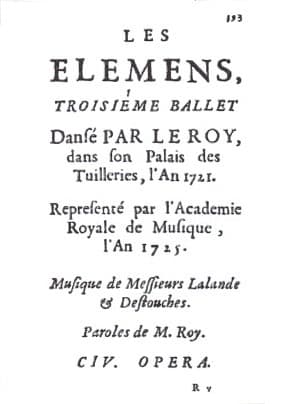
Jean-Baptiste Christophe Ballard, imprimeur-éditeur, Paris — Lionel Sawkins - Les Elémens (S153) – 2001 in Michel-Richard de Lalande (1657-1726), Versailles, Centre de Musique Baroque de Versailles; Établissement Public du musée et domaine national de Versailles, 2001, p. 59-65 · Public domain
Les élémens (1721)
Les Élémens is a French opéra-ballet with a prologue and four entrées (Air, Water, Fire, Earth), composed jointly by André Cardinal Destouches and Michel Richard Delalande to a libretto by Pierre-Charles Roy, and choreographed by Jean Balon. It was first given at the Tuileries on 31 December 1721 as a court entertainment in which the eleven-year-old Louis XV himself danced, styled 'the third ballet danced by the king.' It belongs to the courtly genre of ballet dansé par le roi and, by subject matter (gods, heroes, ancient Romans), to the related type the article calls 'ballet-héroïque.'
What it contains
- Ballet de Cour (Court Ballet) · The whole work, as staged at court in 1721 — A ballet danced by the reigning king and noble courtiers as part of an opéra-ballet structure, explicitly identified by the article as belonging to the tradition of ballets dansés par le roi and named as the last of this line. Source: "it was Lalande's final stage work, Louis XV's last stage appearance and the final French court ballet"
- Ballet de Cour (Court Ballet) — Chaos · Prologue (Chaos), 1721 court version — The king in person danced a formal divertissement alongside twelve other young noble courtiers, the hallmark court-ballet practice of royal and aristocratic amateur performers dancing set pieces within the entertainment. Source: "the king in person appeared in the prologue performing the dance divertissement along with twelve other young noble courtiers"
- Ballet de Cour (Court Ballet) · Epilogue, 1721 court version (later removed) — An allegorical closing tableau in which noblemen partnered by ballerinas personify the Sun's chariot, the zodiac signs, and the four continents, joined by the king and courtiers from the prologue. Source: "four other high noblemen each flanked by a ballerina: they were to symbolize the Sun advancing in his chariot, surrounded by the signs of the zodiac and followed by the four continents"
What is danced
The article's dance information is concentrated at the two ends of the work rather than in the four mythological entrées, whose synopses (Ixion and Junon; Leucosie and Arion; the priestess Emilie; Pomone and Vertumne) are given as plot summary with no described choreography, except that the Earth entrée is stated to end 'in a ballet and chorus celebrating Love.' The prologue and the original epilogue are the sections with explicit dance description: in the prologue the king himself performed a dance divertissement alongside twelve young noble courtiers, and in the epilogue (present in 1721, later cut) the king and the same twelve courtiers reappeared with four high noblemen each partnered by a ballerina, forming an allegorical tableau in which they personified the Sun in his chariot, the zodiac, and the four continents.
Context
This is a court ballet of the type performed by the young Louis XV himself, following L'inconnu and Les folies de Cardenio in 1720 — a genre in which noble amateurs, headed by the monarch, danced formal divertissements within an opera structure. Jean Balon, credited with the choreography, was among the leading dancers of the period. The work's own later history was described as closing several eras at once: Delalande's last stage work, Louis XV's last stage appearance as a dancer, and, per the article, 'the final French court ballet' — after which the genre's centre of gravity moved decisively to the public Paris Opéra.
Staging history
Premiered at the Tuileries on 31 December 1721 with the king dancing, it was found long and overly serious and was only lukewarmly received, though it was given four further court performances within two months. For its public premiere at the Palais-Royal on 29 May 1725, it was 'extensively rearranged,' with all passages featuring the king removed; in this form it succeeded and stayed in the Paris Opéra repertory for over fifty years, with revivals in 1727, 1734, 1742, 1767, 1771, 1776, 1778 and 1780, and it spawned three theatrical parodies. The prologue plus the Air and Fire entrées were also revived at Madame de Pompadour's private Théâtre des Petits Appartements at Versailles in 1748–49, with Pompadour herself dancing the roles of Emilie and Pomone; a modern revival took place at the Opéra Royal de Versailles on 7 October 2001 under Jérôme Corréas.
How to watch it
Watch for the split between the mythological entrées, danced and sung as independent but thematically linked episodes (a structural signature of opéra-ballet), and the framing prologue/epilogue, where the choreography is explicitly allegorical and courtier-driven — real noblemen and, originally, the king himself embodying the Sun, the zodiac and the continents. Because the surviving public version had all royal material stripped out in 1725, a performance drawing on that later text will lack the prologue-epilogue tableau that the 1721 court version foregrounded.
Structure
- Act Prologue · ChaosDestiny has the elements replace chaos; Venus is mollified by a vision of her future son Louis XV, celebrated by a chorus; in 1721 the king danced a divertissement here with twelve young courtiers.
- Act 1st entrée · AirIxion refuses to spy on Jupiter for Junon and declares his love for her instead; Jupiter condemns him to Hades.
- Act 2nd entrée · WaterLeucosie rejects Eole for the stranger Arion, who turns out to be Neptune's son; Neptune orders their marriage.
- Act 3rd entrée · FireThe priestess Emilie fears a fatal omen for her betrothed Valère when the sacred fire of Vesta goes out; Cupid relights it and blesses their marriage.
- Act 4th entrée · EarthVertumne disguises himself as a woman to approach Pomone, learns of her secret love for him, and reveals himself; the entrée ends in a ballet and chorus celebrating Love.
- Act EpilogueThe king and twelve courtiers reappear with four noblemen each partnered by a ballerina, personifying the Sun's chariot, the zodiac and the four continents, closing with a chorus praising the Sun and Louis XV.
Structure read from an encyclopaedia article, not from a libretto or score we hold. Confirm against a programme before treating the numbering as authoritative.
Credits
- composer: André Cardinal Destouches
- composer: Michel Richard Delalande
In the same lineage
Other staged works in the register connected to this one by author or lineage.


