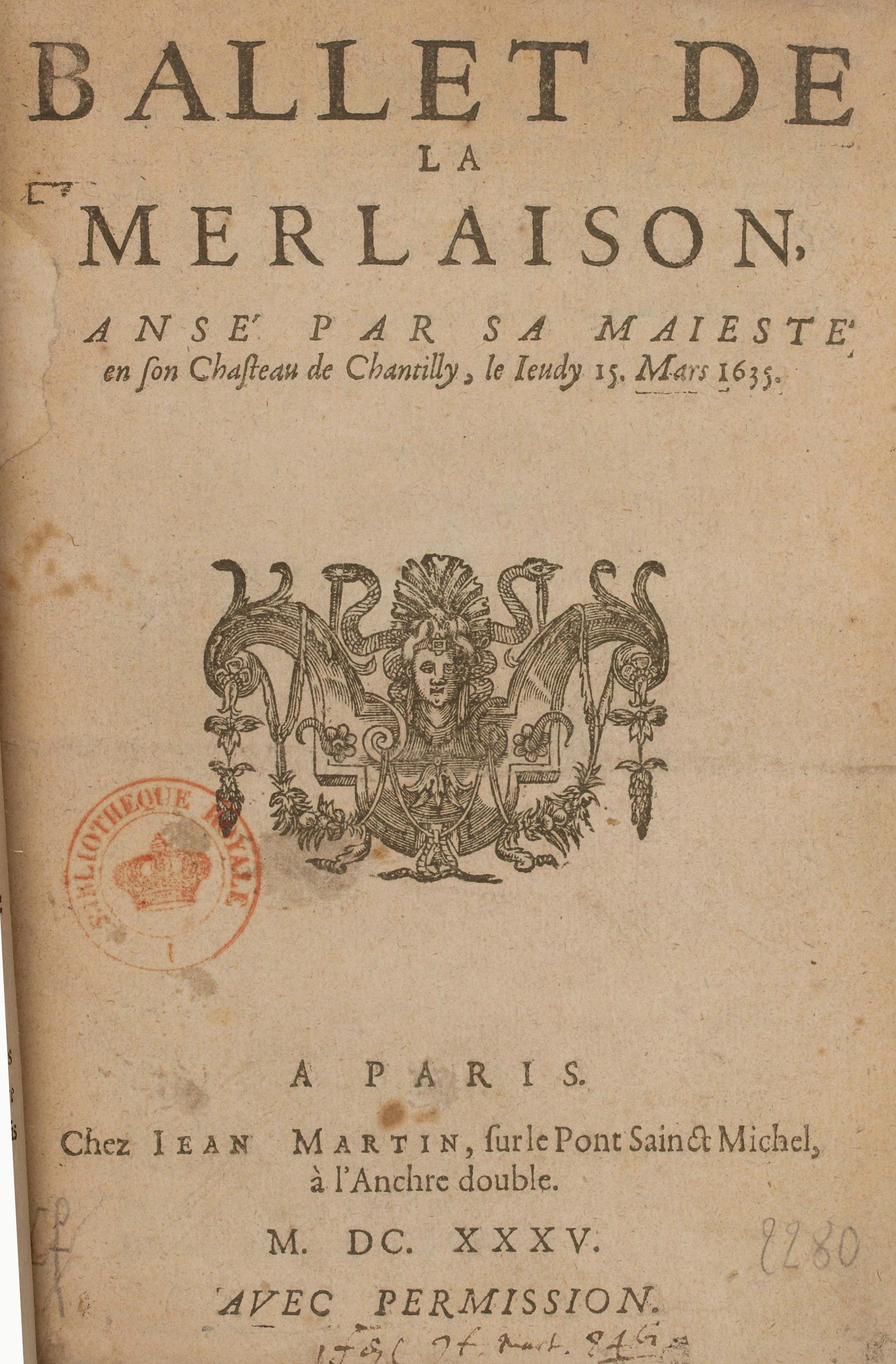
Louis XIII of France — This file comes from Gallica Digital Library and is available under the digital ID bpt6k1521017h · Public domain
The Ballet de la Merlaison is a French ballet de cour first given on 15 March 1635 at the Château de Chantilly, credited in whole to Louis XIII, who devised the scenario, composed the music, wrote the text, designed the costumes and danced several roles himself. It takes its title from a word Louis coined for the feast following a blackbird hunt ("merlaison"), and the piece is built as a ballet à entrées, the standard court-ballet format of successive dance episodes rather than a continuous narrative ballet in the later sense.
What it contains
- Ballet de Cour (Court Ballet) · The whole work, as a ballet à entrées — Structured as successive character entrées danced by courtiers and the king himself, who performed a woman, a merchant, a tax collector, and a mischievous blackbird — the defining role-based, type-driven dancing of the ballet de cour form. Source: "The Ballet de la Merlaison (Ballet of the Blackbird Hunt) is a ballet de cour first performed on 15 March 1635"
What is danced
The article does not preserve step-by-step choreographic detail — no promptbook, notation, or scene list survives in the source — but it does establish the work's formal type: a ballet à entrées, meaning the piece unfolds as a sequence of discrete danced episodes ("entrées"), each built around a character or social type, performed by courtiers and by the king in person. Louis IX is recorded as dancing four such roles: a woman, a merchant, a tax collector, and a mischievous blackbird skilled at avoiding traps. This is the defining feature of ballet de cour vocabulary of the period — character impersonation and comic or grotesque type-dancing by courtiers of high rank, including the monarch himself, rather than a technically codified step vocabulary in the classical-ballet sense that would develop later under Louis XIV.
Because the king danced a female role and an animal role within the same entrée structure, the work is a useful reference point for how cross-gender and burlesque impersonation functioned inside ballet de cour: performers moved between courtly, comic and grotesque registers within a single evening, a practice the article frames as central to the genre's identity rather than incidental to it.
Context
The article situates the ballet's music at a hinge point for musicologists, describing it as "crucial for the understanding of development from Late Renaissance to Early and High Baroque music" — placing the work at a transitional moment in French court music and, by extension, court dance, between Renaissance dance-song forms and the emerging high Baroque idiom that would flower under Louis XIV. The article states it directly: this piece "marked an important development of the ballet de cour" and was "the most popular ballet performed during the reign of Louis XIII", making it a key data point for how the genre evolved in the decades before Lully and the founding of the Académie Royale de Danse.
Staging history
The premiere is dated to 15 March 1635 at the Château de Chantilly, with a later performance at Royaumont, both under Louis XIII's reign. A full modern recording was made in 1967 by Roger Cotte and Jacques Chailley with the Groupe d'instruments anciens de Paris. The work also has an afterlife in fiction: Alexandre Dumas has it performed in The Three Musketeers at the ball where the queen recovers her diamond studs, though the article notes this staging is chronologically and formally inaccurate — Dumas's scene predates the ballet's actual 1635 premiere and depicts it as a simple ball rather than the sung, acted and danced court spectacle it actually was.
How to watch it
Watch for the entrée structure rather than a through-line: each episode presents a distinct social or fantastical type (woman, merchant, tax collector, blackbird) danced in character rather than in abstracted step vocabulary. Because the king himself performed several of these roles, the cross-gender and animal impersonations were a display of courtly wit and rank as much as of technique, a convention distinct from later narrative or classical ballet.
Credits
- composer: Louis XIII of France
In the same lineage
Other staged works in the register connected to this one by author or lineage.


