Unknown author · Public domain
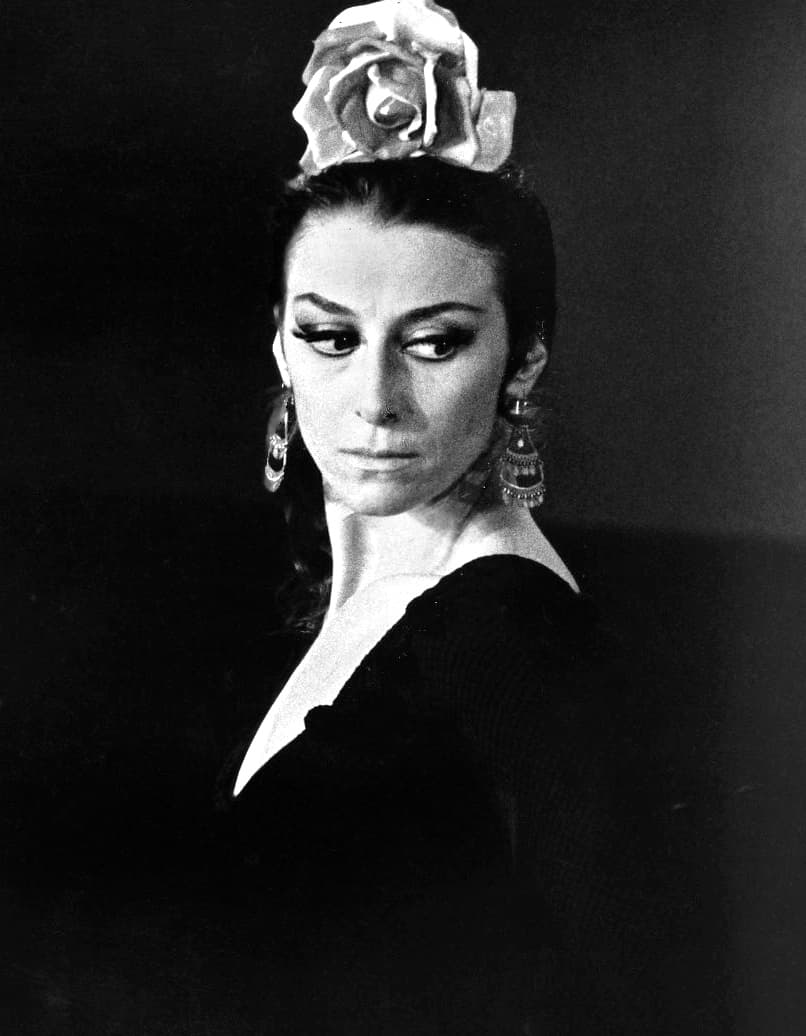
Carmen Suite is a one-act ballet made for the Bolshoi Theatre in 1967, choreographed by the Cuban Alberto Alonso to a score that the composer Rodion Shchedrin built from the melodies of Bizet's opera Carmen, rescored for strings and an enlarged percussion battery. It was created at the direct request of Shchedrin's wife, Bolshoi prima ballerina Maya Plisetskaya, who first tried to commission the piece from Shostakovich and then Khachaturian before turning to her own husband and, for the choreography, to Alonso of the Ballet Nacional de Cuba.
It belongs in a performance catalogue less for a stable, settled choreographic text than for what happened around it: banned by the Soviet Ministry of Culture within days of its premiere for being 'disrespectful' to Bizet and sexually explicit, it became a Cold War diplomatic flashpoint (a cancelled Expo 67 Canadian tour, a contentious Ministry meeting) before Shostakovich's personal intervention got the ban lifted. It went on to become one of the most frequently staged 20th-century ballet retellings of the Carmen story, still in active repertory (e.g. Mariinsky Ballet) decades later.
What it contains
- Contemporary Ballet · the ballet as a whole, as characterized in a review of a later (2011 Mariinsky) staging — Reviewer describes a drama-forward, non-classical register: characters posing emphatically for one another, and steps 'hurled flamboyantly, like stunts,' rather than being danced with classical reserve or subtlety. Source: "steps are hurled flamboyantly, like stunts."
What is danced
The article gives the scenario rather than a step-by-step choreographic record: Carmen, Don José, the bullfighter Escamillo and a fourth figure, Fate — a ballerina dressed in black who functions as Carmen's alter ego — drive the action. Fate opens the ballet reading Carmen's cards, reappears as the bull in the final bullring scene designed by Boris Messerer, and the ballet closes with a danced quartet in which Carmen 'dances alternatively with Fate, Escamillo and Don José' before being stabbed, dying 'caressing Don José's face.' Masked spectators and a uniformed judge stand in for society's disapproval, staged around a mock bullring that Messerer intended as a symbol of fate itself.
The only direct commentary on the danced vocabulary comes from a 2011 review of a Mariinsky staging: Alastair Macaulay describes the piece as turning 'the dance impulse in Bizet's music into something heavier and more clumsily expressionistic,' with characters who 'keep posing for us and one another' and steps that are 'hurled flamboyantly, like stunts' rather than danced with classical restraint. That is second-hand evidence about a later staging rather than Alonso's original 1967 production, so it should be read as a description of the ballet's dramatic register (blunt, theatrical, drama-forward) rather than a technical account of steps.
The score's structure — thirteen numbered dances including 'Carmen's Entrance and Habanera,' 'Bolero,' 'Torero,' 'Torero and Carmen,' and 'Fortune-Telling' — implies a sequence of character/genre set-pieces (entrance, love duet, bullfighter's display, fortune-telling scene, finale-quartet), and the orchestration leans on castanets, guiro, tambourine and other Spanish-associated percussion. None of this, however, is described in the article as actual step vocabulary, so no Spanish-dance or flamenco code can be responsibly attached from this source alone.
Context
Carmen Suite arrives in 1967 at a moment when the Bolshoi's narrative-ballet tradition was being tested by choreographers looking past strict socialist-realist storytelling toward more overtly theatrical, expressionistic and internationally inflected work; Alonso, trained outside the Soviet system in the Ballet Nacional de Cuba, brought an explicitly non-Russian sensibility to a Bolshoi commission built around its most famous ballerina. The piece's near-immediate ban by Minister of Culture Yekaterina Furtseva, and its rescue by a phone call from Shostakovich, is one of the better-documented Soviet ballet censorship episodes of the late 1960s, illustrating how sexual frankness and 'modernist' musical treatment of a canonical work could be read as ideological transgression even after Khrushchev-era liberalization had ostensibly passed.
Staging history
The ballet premiered 20 April 1967 at the Bolshoi Theatre, Moscow, with Plisetskaya as Carmen; it was banned immediately after the premiere and only reinstated after Shostakovich, then head of the RSFSR Composers' Union, personally intervened with Furtseva. Political interference continued afterward: the Ministry blocked its inclusion in the Bolshoi's 1967 Expo 67 tour of Canada despite advance advertising and a booked 6,000-seat venue, and it could not be shown for the 50th-anniversary October Revolution celebrations because its sets were still abroad. It resumed touring status the following year, was praised by Premier Alexei Kosygin in 1968, and was included in a Bolshoi tour of Great Britain that same year; the article also cites a 2011 New York Times review of a Mariinsky Ballet staging, indicating the work remained in international repertory well into the 21st century.
How to watch it
Watch for the four-hander at the climax — Carmen, Don José, Escamillo and Fate — where partner-changing choreography resolves the love triangle rather than a single pas de deux, and note Fate's double role as black-clad alter ego and, in the finale, as the bull in Messerer's bullring set. Listen for the absence of brass and woodwind: Shchedrin scored the ballet for strings and an unusually large percussion section (marimba, vibraphone, castanets, guiro, temple blocks, tam-tam), which gives the numbered dances (Habanera, Bolero, Torero) a spare, rhythmically pointed accompaniment very different from Bizet's original orchestration.
Structure
- Fortune-TellingFate, a ballerina in black representing Carmen's alter ego, tells Carmen's fortune with a deck of cards.
Structure read from an encyclopaedia article, not from a libretto or score we hold. Confirm against a programme before treating the numbering as authoritative.
Credits
- composer: Rodion Shchedrin
In the same lineage
Other staged works in the register connected to this one by author or lineage.
 West Side StoryMusical theatre · 1957Same lineage · video
 SylviaBallet · 1876Same lineage · video
 Swan LakeBallet · 1995Same lineage · video
 Middle DuetBallet · 1998Same lineage · video
 The Car ManBallet · 2000Same lineage · video
 Flight PatternBallet · 2017Same lineage · video
 IvesianaBallet · 1954Same lineage · video
- Carnival of the AnimalsCarnival of the AnimalsBalletSame lineage