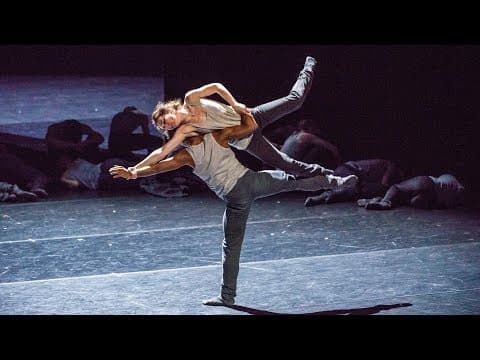
Flight Pattern is a one-act contemporary ballet made by Crystal Pite for the Royal Ballet, set to the slow first movement of Górecki's Symphony No. 3 (the Symphony of Sorrowful Songs). It premiered at the Royal Opera House on 16 March 2017, the first work by a woman on the company's main stage in eighteen years, and went on to win the 2018 Olivier Award for Best New Dance Production.
What it contains
- Contemporary Ballet · The whole ballet, from the opening ensemble through the closing pas de deux — Ensemble canon work, loose torso and grounded weight, non-narrative simultaneous vignettes, and a central duet built from realistic gesture and extreme physical states rather than classical mime. Source: "Flight Pattern is a contemporary ballet choreographed by Crystal Pite"
- Release Technique · Throughout the ensemble and duet choreography — A loose, released torso and grounded, weight-driven movement quality are used across the piece, explicitly noted as departing from classical ballet placement. Source: "The choreography incorporates a loose torso and grounded movement, which are atypical in ballet."
What is danced
The piece opens with 36 dancers packed into three rows, rocking in unison and staring into a light before moving in canon: spines extend and rotate to pull the head back and then forward into a bow. From this mass, individual vignettes break away — a fight between dancers, a frantic solo, a body left on the ground as the ensemble advances, an energetic male duet, a couple reuniting — while the rest of the cast keeps dancing separate material elsewhere on stage, so several narratives run simultaneously rather than in sequence. A recurring slow motif is repeated and elaborated across the piece, and the ensemble work speeds up mid-ballet into sharper, more percussive material including dabbing and thrusting gestures.
The choreographic language deliberately departs from classical placement: a loose torso and grounded weight are used throughout, description flags this as 'atypical in ballet.' Lines and queues of dancers are a structural device, used to build tension by contrasting waiting with moments of dancers being directed by unseen external forces; raised arms recur as an image of birds' wings and of water. The central pas de deux, created on and for Marcelino Sambé and Kristen McNally, alternates duet and solo passages and carries the piece's clearest narrative thread — a couple whose lost child is suggested through props (coats piled onto the female dancer until she collapses) and through a final image of the man's hand on her shoulder, her fate left open.
Context
The work was commissioned in 2014 as Pite's first piece for the Royal Ballet, at a moment when the company had not given its main stage to a female choreographer in eighteen years; its 2017 premiere therefore carried weight beyond its subject matter. It was made as the European migrant crisis, and especially the Syrian civil war refugee crisis, was widely covered in Western media, and Pite chose Górecki's symphony specifically because she associated its structure and mood with that crisis and her own reaction to international inaction.
Staging history
Flight Pattern premiered on 16 March 2017 at the Royal Opera House as the opening work of a triple bill alongside David Dawson's The Human Seasons and Christopher Wheeldon's After the Rain, running through 24 March 2017 with Koen Kessels conducting and Francesca Chiejina as soprano soloist. It was revived in May 2019 with Sambé and McNally reprising the central roles, this time closing a triple bill after Sidi Larbi Cherkaoui's Medusa and Wheeldon's Within the Golden Hour; that performance was filmed and sold on the Royal Ballet's website through December 2020. In 2022 Pite expanded the ballet to the rest of the Górecki symphony and released it as Light of Passage, her first full-length work for the company, with Flight Pattern retained as its first part.
How to watch it
Watch the opening unison rocking and canon resolve into competing small stories happening at once across the stage — the piece asks the eye to choose where to look rather than following one narrative. Note the loose, grounded torso work against a classical company's usual placement, the recurring slow motif that returns more elaborate each time, and the shift into sharper, faster ensemble movement partway through; in the final duet, watch how the coats piled onto the female dancer function as physical weight rather than costume.
Credits
- composer: Henryk Mikolaj Górecki
More from Crystal Pite
Other staged works in the register connected to this one by author or lineage.
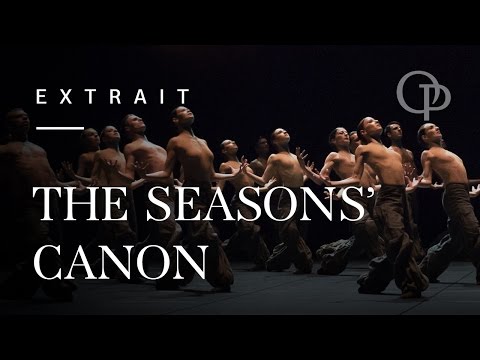 The Seasons' CanonBallet · 2016Pite · video
 West Side StoryMusical theatre · 1957Same lineage · video
 SylviaBallet · 1876Same lineage · video
 Carmen SuiteBallet · 1967Same lineage · video
 Swan LakeBallet · 1995Same lineage · video
 Middle DuetBallet · 1998Same lineage · video
 Moon WaterBallet · 1998Same lineage · video
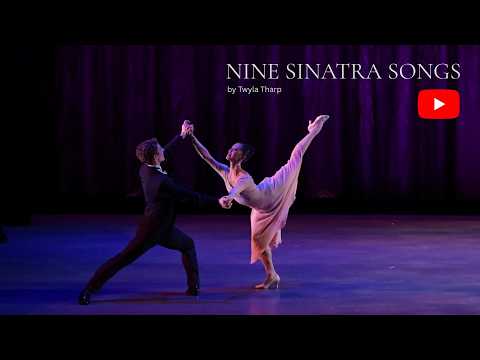 Nine Sinatra SongsBallet · 1982Same lineage · video