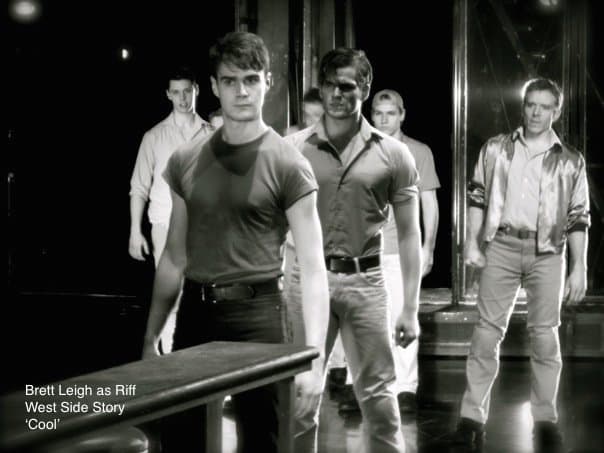
Thomaschange — Own work · CC BY-SA 4.0
West Side Story (1957) is the Jerome Robbins-conceived Broadway musical that transposed Romeo and Juliet onto rival Manhattan street gangs, with music by Leonard Bernstein, lyrics by Stephen Sondheim, and a book by Arthur Laurents. It belongs in a performance catalogue not as a play with songs but as a work in which Robbins, credited as director and choreographer and billed additionally as "conceived by," made dance carry as much narrative weight as dialogue or song, a structural choice the article says was unprecedented for the Broadway of its day.
What it contains
- Broadway / Theatrical Jazz — Cool · Act I, the number 'Cool' — A controlled, tension-driven jazz dance in which suppressed aggression is expressed physically by the Jets, later excerpted by Bernstein as the 'Cool' Fugue. Source: "When a gang leader advises his cohorts to play it "Cool", the intolerable tension between an effort at control and the instinctive drives of these potential killers is stingingly graphic."
- Contemporary Ballet · The whole production, as originally choreographed by Jerome Robbins — Original choreography described as 'balletic'; ballet-trained vocabulary used across dance sequences including the fight choreography of the rumble. Source: "The original balletic, finger snapping choreography was replaced by swaggering, hip-hop and Latin-influenced dancing."
- Contemporary Ballet — The Rumble · Act I, 'The Rumble' — Athletic, balletic staged violence choreography for the fatal knife fight, described by a contemporary critic as bodies 'flying wildly through space.' Source: "When the knives come out, and bodies begin to fly wildly through space under buttermilk clouds, the sheer visual excitement is breathtaking"
- Dream Ballet — Somewhere · Act II, the 'Somewhere' sequence — A staged fantasy escape in which the set dissolves and the lovers are shown moving together outside real time and place, the classic dream-ballet device. Source: "As the walls of Maria's bedroom disappear, they find themselves in a dreamlike world of peace ("Somewhere")."
- Golden Age Broadway Jazz · The whole 1957 production, era-defining Broadway jazz-dance idiom — Finger-snapping, gestural, character-specific jazz vocabulary layered onto balletic technique across the show's dance numbers. Source: "The original balletic, finger snapping choreography was replaced by swaggering, hip-hop and Latin-influenced dancing."
- Cha Cha — Dance at the Gym · Act I, 'Dance at the Gym' — A discrete Cha-Cha movement in the score corresponds to the gym scene's social-dance sequence preceding Tony and Maria's meeting. Source: "Mambo (Meno presto), Cha-Cha (Andantino con grazia)"
What is danced
The article's own account of the show's making states that there was 'to be more dancing in West Side Story than in any previous Broadway show,' which is why Robbins was given an eight-week dance rehearsal period against the customary four and an assistant, Peter Gennaro, to help build it. The vocabulary described by later critics and by the 2020 revival's production notes was 'balletic, finger snapping choreography' — a hybrid of theatrical ballet technique and Broadway/street-jazz gesture (finger snaps, walks, stylised aggression) built into named numbers rather than generic dance breaks: the gym mixer's challenge dance ('Dance at the Gym'), the Jets' tension-release number 'Cool,' the fight-as-dance of 'The Rumble,' and the fantasy escape of 'Somewhere.'
Contemporary reviews single out specific passages as choreographic set-pieces: Walter Kerr's description of 'Cool' as staging 'the intolerable tension between an effort at control and the instinctive drives of these potential killers,' and his account of 'The Rumble' where 'bodies begin to fly wildly through space under buttermilk clouds.' Bernstein's own 1960 concert suite, Symphonic Dances from West Side Story, preserves the show's dance structure in its movement titles — Mambo, Cha-Cha, 'Cool' Fugue, Rumble — confirming that specific social/Latin dance idioms (mambo, cha-cha) were built into the gym scene alongside the jazz-inflected 'Cool' and the violent choreography of the rumble.
'Somewhere' functions as a book-musical dream ballet: the walls of Maria's bedroom disappear and the lovers are shown in 'a dreamlike world of peace,' a convention (Rodgers and Hammerstein-era dream ballet, here compressed) rather than a simple reprise. 'Gee, Officer Krupke' is comic musical-theatre character dance rather than balletic or Latin vocabulary. Later stagings changed the vocabulary substantially: the 2020 Ivo van Hove/Anne Teresa De Keersmaeker revival explicitly replaced 'the original balletic, finger snapping choreography' with 'swaggering, hip-hop and Latin-influenced dancing,' a deliberate rupture from Robbins' idiom that the article treats as a defining and controversial feature of that production.
Context
The article frames the 1957 production as a deliberate break from the loosely integrated song-and-dance format of prior Broadway shows: Robbins insisted on treating dancers as actors with individualized 'gesture repertoire specific to their character' rather than as an interchangeable chorus, and reviewers at the time (Time magazine, Walter Kerr) framed the show's 'putting choreography foremost' as a possible 'milestone in musical-drama history.' This came directly out of Robbins' concurrent life as a ballet choreographer (he had just choreographed The King and I) and his interest, per the article's genesis account, in giving a 'Latin beat' contemporary urgency to a Romeo-and-Juliet plot about real 1950s gang violence.
Staging history
The original production (National Theatre, Washington D.C., and Philadelphia tryouts, then Winter Garden Theatre, opening September 26, 1957) ran 732 performances and won Robbins the Tony for Best Choreographer; it transferred to an even longer West End run (1,039 performances from December 1958) co-choreographed by Peter Gennaro. Robbins himself restaged the choreography for the 1980 Broadway revival (with Lee Theodore reproducing it) and it has recurred largely intact through the 2009 revival, aside from bilingual textual changes by Lin-Manuel Miranda. The 2020 Broadway revival, directed by Ivo van Hove with choreography by Anne Teresa De Keersmaeker, was the first major departure from Robbins' vocabulary, discarding the balletic/finger-snapping idiom for 'swaggering, hip-hop and Latin-influenced dancing' and cutting 'I Feel Pretty' entirely; it closed early due to the COVID-19 pandemic after only 24 regular performances. The 2021 Spielberg film used new choreography by Justin Peck that the article says 'does not attempt to replicate Robbins' choreography,' underscoring how tightly the original stage choreography is understood as Robbins' specific authorial property rather than generic Broadway convention.
How to watch it
Watch for the shift from social/Latin dance forms (the mambo and cha-cha of the gym scene) into balletic and jazz-inflected theatrical dance once the plot turns violent, especially the transition from 'Cool''s controlled tension into the unleashed, athletic choreography of 'The Rumble.' Note where dialogue gives way entirely to movement — Robbins used dance, not just song, to carry plot information (the fatal stabbings occur within a continuously danced sequence). In any given production, compare the vocabulary against Robbins' 'balletic, finger snapping' original, since major revivals (2020) have used this as a deliberate point of departure.
Structure
- Act I · Dance at the GymAt a gym mixer, teenagers dance and a challenge dance breaks out between the Jets and Sharks while Tony and Maria meet, dance together, and fall in love.
- Act I · CoolWaiting anxiously for the War Council with the Sharks, Riff leads the Jets in a number that channels their pent-up aggression.
- Act I · The RumbleThe gangs meet under the highway; a fistfight escalates into a knife fight in which Riff and Bernardo are killed.
- Act II · SomewhereAs the walls of Maria's bedroom disappear, Tony and Maria imagine escaping together into a peaceful, dreamlike world.
- Act II · Gee, Officer KrupkeHaving evaded Officer Krupke, the Jets satirize him and other adults who fail to understand them.
Structure read from an encyclopaedia article, not from a libretto or score we hold. Confirm against a programme before treating the numbering as authoritative.
More from Jerome Robbins
Other staged works in the register connected to this one by author or lineage.
 Fancy FreeBallet · 1944Robbins · video
- DybbukDybbukBallet · 1974Robbins
 The ConcertBallet · 1956Robbins · video
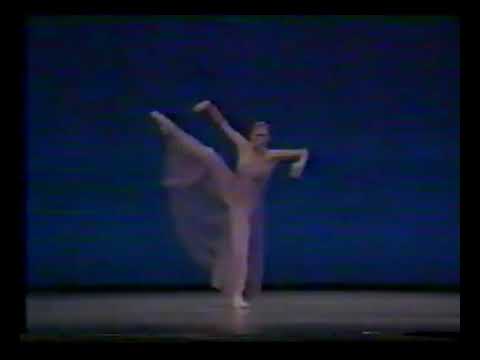 Antique EpigraphsBallet · 1984Robbins · video
 A Suite of DancesBallet · 1994Robbins · video
- AndantinoAndantinoBallet · 1981Robbins
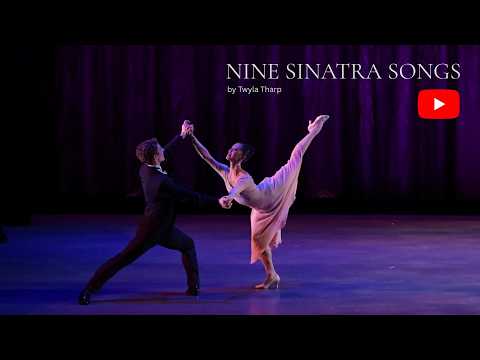 Nine Sinatra SongsBallet · 1982Same lineage · video
- In Memory Of ...In Memory Of ...Ballet · 1985Robbins