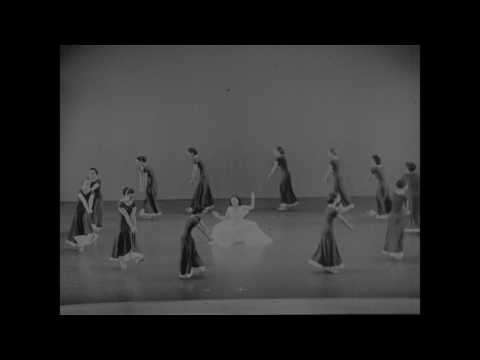
Primitive Mysteries is an early modern dance work made by Martha Graham to a score by Louis Horst, premiered on 2 February 1931 at the Craig Theatre in New York City. It is built for a solo female dancer in white (originally Graham herself as The Virgin) and an ensemble of sixteen women in blue, and its three-part structure — Hymn to the Virgin, Crucifixus, Hosannah — draws its imagery from Christian ritual filtered through Graham's response to ceremonial dances she had witnessed among Native peoples of the Southwest.
What it contains
- Graham Technique — Hymn to the Virgin · Hymn to the Virgin, the opening section — Silent, repeated whole-cast entrances/exits and a hand-built halo formation around the soloist's head — patterned group gesture and ritual formation rather than step vocabulary. Source: "All of the dancers enter and leave the stage three times in silence."
- Graham Technique — Crucifixus · Crucifixus — A single expressive gesture (cupped hands at the face) is stated by the soloist and echoed by the ensemble at a different body level, a doubling technique characteristic of Graham's early group choreography. Source: "The soloist expresses her suffering by repeatedly cupping her hands to her face."
- Graham Technique — Hosannah · Hosannah — Unison celebratory ensemble movement resolves into a sequence of held sculptural tableaus built between one dancer and the soloist, rather than sustained phrase dancing. Source: "One chorus member breaks from the group to form a succession of tableaus with the soloist."
What is danced
The piece is built from stark, repeated group actions rather than virtuosic solo display: the entire cast enters and exits the stage three times in silence in the opening section, and the choreography works through unison gesture and formation rather than steps in the conventional theatrical-ballet sense. In Hymn to the Virgin the ensemble arranges outstretched hands around the soloist's head to suggest a halo; in Crucifixus the soloist repeatedly cups her hands to her face to express suffering while the ensemble echoes the same gesture at hip level, a doubling of a single motif across bodies at different heights; in Hosannah the group moves in joyful unison before one dancer separates to build a sequence of held tableaus with the soloist, poses that the article says evoke imagery from Christianity and other religions.
Context
The work arrived in 1931, early in Graham's career, at a moment when critics were already identifying her as a major new force in American dance; the article notes it was hailed as a masterpiece from its first performance. Its frank religious and ritual staging was, per contemporary and later commentary, striking for its era — dance critic John Martin described it in terms of ritual integrity, likening its imagery to an Indigenous people's absorption of Christian iconography into their own cosmology.
Staging history
The role of the Virgin was danced by Graham herself at the premiere, with Yuriko the first dancer other than Graham to take it on; later interpreters named in the record include Takako Asakawa, Christine Dakin and Terese Capucilli. The piece remains part of the standard repertory of the Martha Graham Dance Company and was revived in 1999, at which point Graham (or her company, drawing on her own later remarks) clarified that the work was meant not as adorants worshipping the Virgin figure but as a rite of initiation performed by the group's own members.
How to watch it
Watch for the repetition-with-variation logic: the same cupping gesture appears at the soloist's face and at the ensemble's hips, and formations (the halo of hands, the encircling of the Virgin at the end of each section) recur across all three sections with small changes in meaning. There is no pointe work or turned-out ballet vocabulary; the interest is in weighted, grounded group patterning and silence used as a structural device (the triple silent entrance/exit in Hymn to the Virgin).
Structure
- Hymn to the VirginThe soloist blesses the surrounding women; the full cast enters and exits the stage three times in silence, and the ensemble forms a halo of outstretched hands around the soloist's head.
- CrucifixusTaking its cues from the crucified Christ, the soloist repeatedly cups her hands to her face to express suffering while the ensemble echoes the gesture at hip level.
- HosannahThe ensemble moves in joyful celebration; one dancer breaks away to form a succession of tableaus with the soloist evoking imagery from Christianity and other religions.
Structure read from an encyclopaedia article, not from a libretto or score we hold. Confirm against a programme before treating the numbering as authoritative.
Credits
- composer: Louis Horst
More from Martha Graham
Other staged works in the register connected to this one by author or lineage.
 Appalachian SpringBallet · 1944Graham · video
- JudithJudithBallet · 1950Graham
 LamentationBallet · 1930Graham · video
 Cave of the HeartBallet · 1946Graham · video
 ClytemnestraBallet · 1958Graham · video
 Errand into the MazeBallet · 1947Graham · video
 EpisodesBallet · 1959Same lineage · video
 Maple Leaf RagBallet · 1990Graham · video