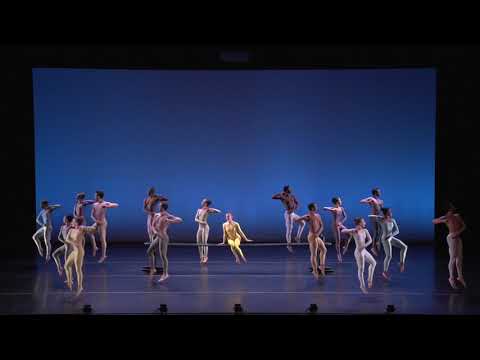
Maple Leaf Rag is a storyless, self-parodying dance made by Martha Graham in 1990, when she was 96 years old — her last completed work before her death in 1991. Set to three ragtime pieces by Scott Joplin, it turns Graham's own vocabulary and best-known repertory into an affectionate joke, staged around nothing but a grand piano and a joggling board (a springy plank bench she had discovered on tour in Charleston).
What it contains
- Graham Technique · Entire piece, from the opening piano tableau through the closing skirt-tearing gag — The choreography is built from direct quotations of Graham's own technique and repertory — the dart step, hiccupping contractions, grab-and-grimace gestures, ecstatic clapping, and kick-turn phrasing — deployed as self-parody rather than new invention. Source: "Maple Leaf Rag is a sly and playful dance that effectively employs Graham's expressive vocabulary while winking at her own cliches."
- Graham Technique — White-gowned soloist interludes · White-gowned soloist's recurring crossings (interludes between the rag sections) — A soloist executes swirling turns and, per one critic, 'exalted kick turns' lifted directly from the Graham solo Letter to the World, performed in white gown with chignon as a direct surrogate for Graham herself. Source: "the exalted kick turns from the white-clad Graham solo Letter to the World, ending in a sobering yet giggle-worthy frozen pose"
What is danced
The piece opens in near-silence: a musician strikes a single foreboding chord repeatedly while dancers enter — a couple in an overhead lift, then a circle that leaps and lands hard to the piano's pounding. A female dancer peels off to bounce rhythmically on the joggling board, which stays onstage as a prop/set piece for the rest of the work. Once Graham's recorded voice calls for the rag, the lighting brightens and six couples dance in a joyful ensemble around the board; the piano periodically drops back into the ominous opening chord to accompany a solo white-gowned, chignoned figure who crosses the stage in swirling turns — a running Graham surrogate.
The real content, though, is quotation: the article reports specific parodic references identified by critics — the "dart" step from Errand into the Maze, the "hiccupping" Furies of Night Journey, foot-to-foot patterns from Acrobats of God, the "grabs and grimaces" of Clytemnestra, the "ecstatic clapping" of Appalachian Spring's acolytes, and the white-clad soloist's kick turns lifted from Letter to the World. The piece also spoofs the overt eroticism of Graham's rep directly: a couple's final embrace ends with the man tearing off the woman's skirt just before a blackout. Structurally the choreography rides three Joplin numbers — the title rag opens and (in reprise) closes the piece, bracketing the waltz Bethena and Elite Syncopations — in a tight fifteen minutes.
Context
By 1990 Graham was in her tenth decade, working on what the article notes was her 180th choreographic work, decades after the mythic and psychologically intense pieces (Night Journey, Clytemnestra, Letter to the World) that had defined modern dance's dramatic register. Maple Leaf Rag is Graham turning that entire body of signature vocabulary back on itself as comedy rather than extending it, and doing so as a specific tribute to Louis Horst, her longtime musical director, who used to play her the rag to break her creative blocks. It stands apart from the rest of her catalogue as a late, lighthearted self-commentary rather than a new dramatic statement.
Staging history
The work premiered on October 2, 1990 at New York City Center and has remained an audience favorite and repertory staple for the Martha Graham Dance Company since. It was also filmed for the PBS program Three Dances by Martha Graham (produced by WNET), with Terese Capucilli dancing the white-gowned Graham surrogate role and narration by Kathleen Turner.
How to watch it
Watch for the recurring white-clad soloist: each of her crossings quotes a different earlier Graham work, and the piano's return to its opening ominous chord cues each appearance before the rag resumes. Track how the joggling board, the only set piece, moves from a private bouncing solo to a communal focal point for the six couples. The final skirt-tearing gag is the clearest tell that the piece is commenting on, not repeating, the overwrought romantic/erotic tone of her serious repertory.
Structure
- Opening (piano and joggling board)The musician enters and strikes a foreboding chord; dancers enter with an overhead lift and a leaping circle, and a solo female dancer bounces on the joggling board.
- Maple Leaf Rag (main ensemble)At Graham's recorded cue the lights brighten and six couples dance joyfully around the board on which the lone female reclines.
- White-gowned soloist interludesThe piano periodically reverts to the ominous opening chord as a somber white-gowned, chignoned figure crosses the stage in swirling turns, a Graham surrogate quoting earlier repertory.
- FinaleThe dance ends with a couple alone onstage; just before darkness, the man tears off the woman's skirt.
Structure read from an encyclopaedia article, not from a libretto or score we hold. Confirm against a programme before treating the numbering as authoritative.
More from Martha Graham
Other staged works in the register connected to this one by author or lineage.
 Appalachian SpringBallet · 1944Graham · video
- JudithJudithBallet · 1950Graham
 LamentationBallet · 1930Graham · video
 Cave of the HeartBallet · 1946Graham · video
 ClytemnestraBallet · 1958Graham · video
 Errand into the MazeBallet · 1947Graham · video
 EpisodesBallet · 1959Same lineage · video
- Imagined WingImagined WingBallet · 1944Graham