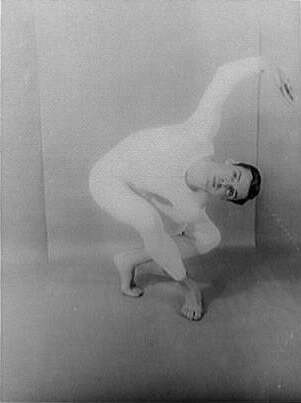
Carl Van Vechten — Library of Congress Catalog: http://lccn.loc.gov/2004663616 Image download: http://cdn.loc.gov/master/pnp/van/5a52000/5a52600/5a52682r.jpg Original url: https://www.loc.gov/pictures/item/2004663616/ · Public domain
Episodes was a 1959 co-production between the Martha Graham Dance Company and George Balanchine's New York City Ballet, danced entirely to the orchestral music of Anton Webern. It was conceived as a joint work between Graham, the leading figure of American modern dance, and Balanchine, the leading figure of neoclassical ballet, but the two ended up choreographing separate halves rather than collaborating scene by scene: Graham made Episodes I, a narrative piece about Mary, Queen of Scots, and Balanchine made Episodes II, a plotless suite using all four of Webern's twelve-tone orchestral works plus his arrangement of Bach's Musical Offering.
The complete two-part ballet was performed only briefly, in 1959, and has not been revived as a whole since. Balanchine's half went on to have an independent life as a repertory staple under the title Episodes, while Graham's half was revived only once, in heavily revised form, in 1980. The work sits in the catalogue as much for what it says about the relationship between modern dance and ballet as for its choreography: it is a rare instance of the two idioms sharing a stage, a program, and a score, then visibly refusing to merge.
What it contains
- Graham Technique — Episodes I · Episodes I, Graham's half of the ballet — Graham's own choreography for her company, developed in her studio to Webern's Passacaglia and Six Pieces, described as heavy with kneeling and floorwork, which reportedly caused friction when Balanchine observed a rehearsal. Source: "they clashed over what she had choreographed, with many instances of dancers on their knees and floorwork"
- Neoclassical Ballet — Episodes II · Episodes II, Balanchine's plotless half of the ballet — Plotless, music-driven ensemble and pas de deux choreography for NYCB dancers in practice clothes, built to mirror the structure of Webern's serial scores and Webern's Bach arrangement, with dancers described as flexing feet and arms rather than dancing a story. Source: "leading choreographers in modern dance and neoclassical ballet respectively"
What is danced
Episodes II, Balanchine's half, is built number by number on specific Webern scores. It opens with the Symphony, op. 21, for two lead dancers and three couples, danced in practice clothes with the corps reacting to shifting instrumentation rather than following a lead couple throughout — Balanchine described trying to 'paint or design time with bodies' to mirror the sound. A pas de deux to the Five Pieces, op. 10, is danced under isolated spotlights with, per dance historian Jennifer Homans, 'hieratic, angular' shapes, splayed and trapped positions, and an extreme lift in which the woman is inverted with her legs split around the man's head. A second pas de deux, to the Concerto, op. 24, is framed by four women and treats the male partner as an instrumentalist 'moving' the female dancer. The ballet closes with the Ricercata (Webern's orchestration of a Bach ricercar), danced by two principals and a corps of thirteen women in fugal, contrapuntal groupings where blocks of dancers restate short phrases in imitation of the musical material.
A now-detachable solo, to the Variations, op. 30, was made for Graham dancer Paul Taylor rather than a company member, and is markedly outside classical vocabulary: barefoot, with knotted, self-clutching shapes and flex-footed or inverted versions of occasional ballet steps, built around the image of a fly trapped in milk. Episodes I, Graham's half, is described as a 'dramatic fantasia' on Mary Stuart's last moments, performed by dancers in full sixteenth-century dress rather than Graham's usual bare feet and practice clothes, and its rehearsal process reportedly involved extensive floorwork and kneeling positions that caused friction with Balanchine when he observed it. Overall vocabulary contrast is explicitly noted in the article by dancer Ethel Winter: Graham's dancers performed in shoes and full costume while Balanchine's NYCB dancers worked in tights, flexing feet and arms — an inversion of the usual modern-dance/ballet costume convention that contemporaries found confusing.
Context
By 1959 Balanchine was well established as the country's leading neoclassical choreographer and Graham as the leading modern-dance choreographer, with a documented history of mutual institutional suspicion — Kirstein, NYCB's general director, had attacked Graham in print in 1934. Episodes was framed in the press as a historic meeting of the two camps, staged during Webern's postwar rediscovery as a composer whose sparse, atonal, serial scores were considered close to undanceable. Balanchine had come to Webern through Stravinsky and believed the music's lack of built-in emotional narrative left choreographers free to make dance 'about the music' rather than about a program the listener had already imagined.
Staging history
The complete two-part Episodes was given at its 1959 premiere and again in NYCB's 1959 winter season, the last time the full ballet with both choreographers' halves was performed together. From 1960 Balanchine's half was detached and given on its own as Episodes II, then simply as Episodes; Paul Taylor continued to guest-perform his solo for two more seasons before it was cut in 1961. Balanchine's Episodes has since been staged by companies including the Dutch National Ballet, Scottish Ballet, Berlin Opera Ballet, National Ballet of Canada, Boston Ballet, Miami City Ballet, Suzanne Farrell Ballet and Les Grands Ballets Canadiens. Graham's half was revived only once, by her own company at the Met in 1980, with substantially rewritten choreography and new costumes by Halston (though the original Karinska costumes and David Hays set were also used). Taylor's solo, never filmed or notated in its original form, went unperformed from 1961 until 1986, when Taylor reconstructed it from memory and photographs for NYCB soloist Peter Frame; it resurfaced again at Miami City Ballet in 2014 and at NYCB in 2020, with small discrepancies between reconstructions traced back to differing videos of Frame's own performances.
How to watch it
Watch Episodes II for how closely the choreography tracks Webern's structure — couples entering and reacting individually rather than in unison, and a fugal finale where different groups of dancers restate the same short phrase at different times, mirroring the score's counterpoint. If Graham's Episodes I is ever revived, note the reversal of costume convention the article flags: her dancers appear in full period dress rather than bare feet, while the ballet dancers around them work in tights with flexed feet and arms. If Taylor's solo is included, it stands apart from the rest of the ballet in vocabulary — barefoot, knotted, and deliberately outside classical ballet steps.
Structure
- Act I · Episodes IGraham's narrative half: a 'dramatic fantasia' set at the scaffold on the last minutes of Mary, Queen of Scots, with figures from her past — Bothwell, Darnley, Rizzio, Chastelard, the four Marys, and Elizabeth of England — appearing as she remembers them.
- Act II · Episodes IIBalanchine's plotless half, set to four of Webern's serial orchestral works and Webern's orchestration of a Bach ricercar, comprising an ensemble opening, two pas de deux, a solo, and a fugal finale.
- Act II · Symphony, op. 21Two lead dancers and three couples begin in unison, then diverge as the orchestration shifts, described by Balanchine as an attempt to make the dance's structure mirror the music's.
- Act II · Five Pieces, op. 10 (pas de deux)A pas de deux danced under separate spotlights in near-darkness, angular and hieratic, including an inverted lift with the woman's legs split around the man's head.
- Act II · Concerto, op. 24 (pas de deux)A second pas de deux, framed by four women, in which the male partner manipulates the female dancer in a manner Balanchine likened to a composer moving an instrument.
- Act II · Variations, op. 30 (solo)A barefoot solo made for Paul Taylor, built from knotted, self-enclosing shapes largely outside classical ballet vocabulary, framed around the image of a fly trapped in milk.
- Act II · Ricercata (finale)Two principals and a corps of thirteen women perform in fugal, contrapuntal groupings, restating short phrases across the ensemble in imitation of Webern's orchestration of Bach.
Structure read from an encyclopaedia article, not from a libretto or score we hold. Confirm against a programme before treating the numbering as authoritative.
Credits
- composer: Anton Webern
More from George Balanchine
Other staged works in the register connected to this one by author or lineage.
 CoppéliaBallet · 1870Balanchine · video
 ApolloBallet · 1928Balanchine · video
 AgonBallet · 1957Balanchine · video
 Le chant du rossignolBallet · 1920Balanchine · video
 The Prodigal SonBallet · 1929Balanchine · video
 The Seven Deadly SinsBallet · 1933Balanchine · video
- Metastaseis and PithopraktaMetastaseis and PithopraktaBallet · 1968Balanchine
 Piano PiecesBallet · 1981Same lineage · video