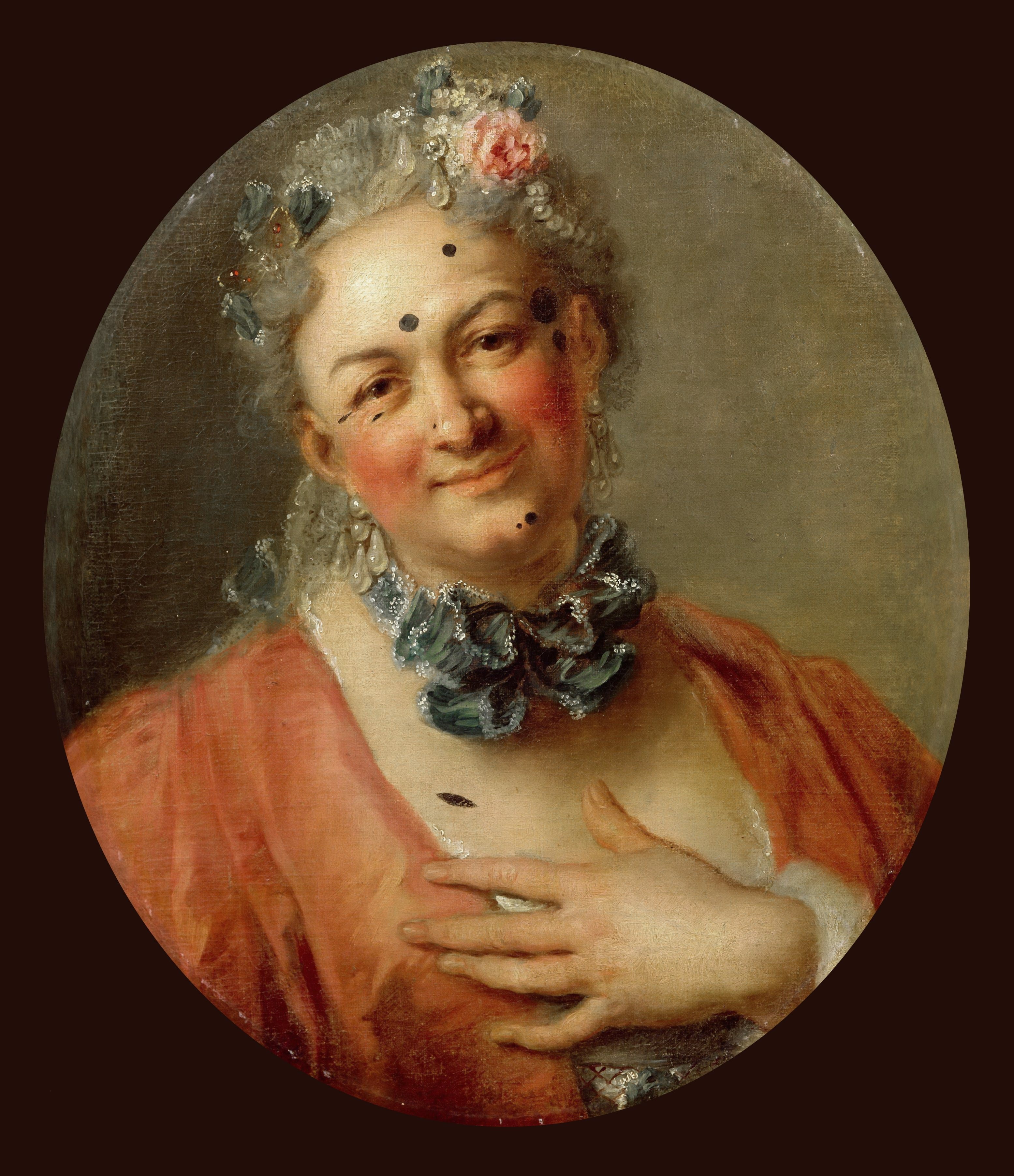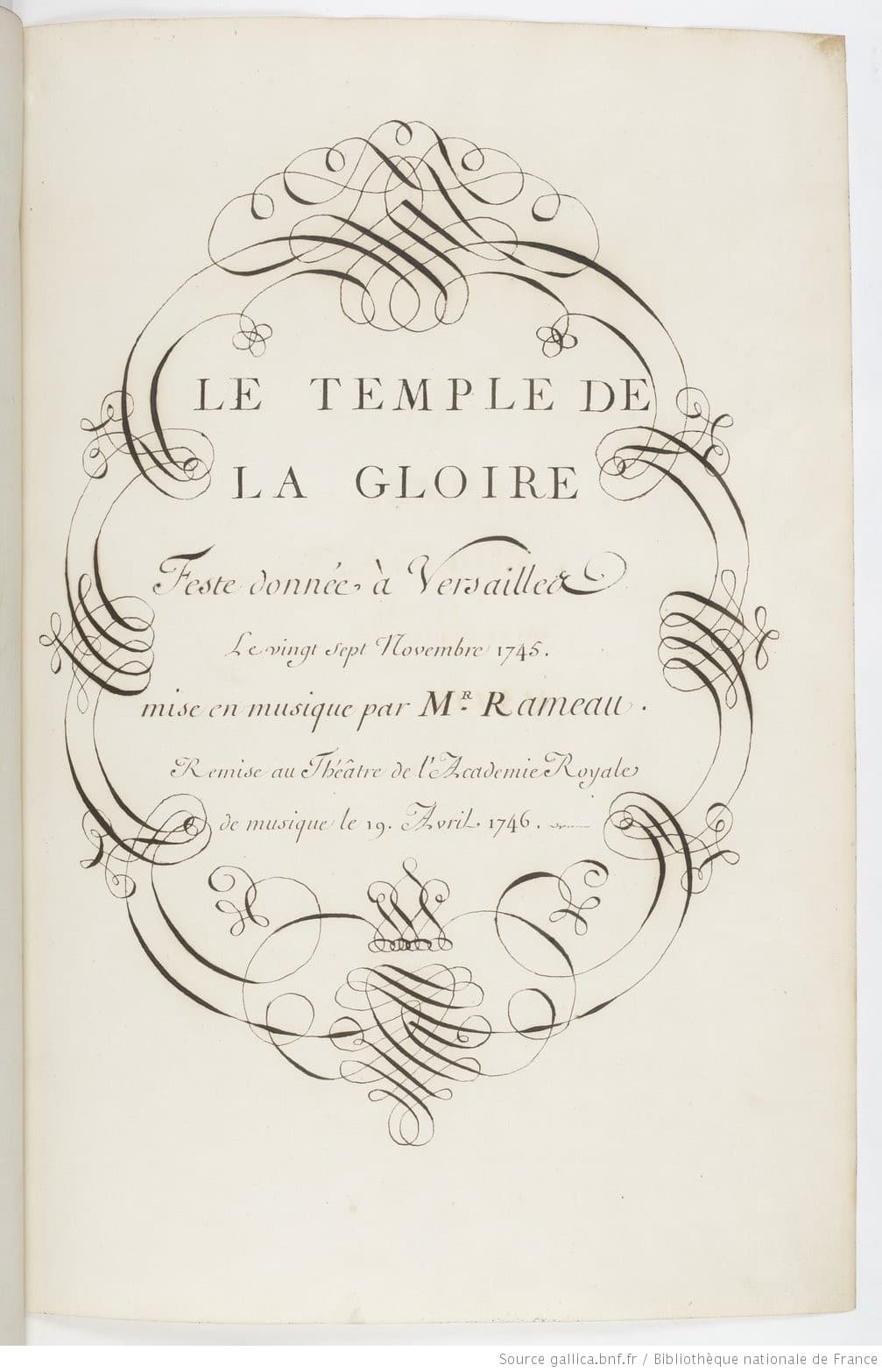
Jean-Philippe Rameau — Gallica (https://gallica.bnf.fr/ark:/12148/btv1b8455804d/f9.item) · Public domain
Le temple de la Gloire (1745)
Le temple de la Gloire is a French opéra-ballet composed by Jean-Philippe Rameau to a libretto by Voltaire, written to celebrate the French victory at the Battle of Fontenoy. It was first given in a five-act version at the Grande Écurie, Versailles on 27 November 1745, then failed in transfer to the Paris Opéra two weeks later; a shorter, revised version in a prologue and three acts opened at the Opéra on 19 April 1746. It sits in the catalogue as an opéra-ballet — a hybrid genre that intersperses sung drama with choral and danced divertissements built around mythological and allegorical figures (Apollo, the Muses, Envy, Glory) rather than as a standalone danced ballet.
What is danced
The article's synopsis is written for the 1746 prologue-plus-three-acts version and names only one dance episode explicitly: in Act 1, the shepherds and shepherdesses of the grove of the Muses dance to console the abandoned princess Lydie, a pastoral divertissement typical of the genre. The Prologue's closing 'celebration of peace and the arts' and Act 2's Bacchic followers celebrating their conqueror's return strongly imply choreographed divertissements — opéra-ballet of this period regularly built such scenes around corps dances of shepherds, bacchantes, priests and priestesses — but the source text does not name the dances performed, describe steps, or credit a choreographer, so no specific vocabulary can be verified from it.
Context
Rameau's opéra-ballets sit at the height of the French Baroque tragédie-lyrique and divertissement tradition inherited from Lully, in which sung drama alternates with entrées de ballet performed by the Paris Opéra's dancers. This work is unusual for being commissioned as court propaganda — a celebration of a specific military victory, Fontenoy — and for pairing Rameau with Voltaire as librettist, a collaboration between the era's leading composer and its leading man of letters. Its failure at the Paris Opéra and subsequent compression into a shorter prologue-and-three-act structure for the 1746 revival reflects the routine practice of the period of substantially reworking a piece after a poor public reception.
Staging history
The work had its first performance in a five-act version at the Grande Écurie, Versailles on 27 November 1745 as a court féte marking the Fontenoy victory; it moved to the Paris Opéra on 7 December 1745 but did not succeed there. Voltaire and Rameau then revised it into a prologue and three acts, which opened at the Opéra on 19 April 1746. The article records no subsequent staged revivals, only modern audio recordings of both the 1745 version (Philharmonia Baroque Orchestra & Chorale under Nicholas McGegan, 2018) and the 1746 version (Les Agrémens under Guy Van Waas, 2015; La Grande Écurie et la Chambre du Roy under Jean-Claude Malgoire, 1982 LP).
How to watch it
Watch for the alternation of allegorical framing (Envy versus Apollo/Glory in the Prologue) with three self-contained acts each built around a historical or mythological figure — Bélus, Bacchus, Trajan — whose claim to the Temple of Glory is tested and resolved through a pastoral or triumphal divertissement. The genre convention at work is opéra-ballet: expect the danced content to cluster in choral/festive scenes (the shepherds' consoling dances, Bacchic revelry, triumphal entries) rather than in continuous narrative choreography.
Structure
- Act PrologueEnvy and her followers attempt to destroy the Temple of Glory but are thwarted by Apollo, the Muses, demi-gods and heroes; the prologue closes with a celebration of peace and the arts.
- Act I · BélusAbandoned by King Bélus for the pursuit of martial glory, the princess Lydie is comforted by the Muses and by dances from local shepherds and shepherdesses; Bélus is ultimately persuaded that a true king spreads happiness rather than waging war.
- Act II · BacchusBacchus's followers celebrate his conquest of Asia outside the Temple of Glory, but the High Priest denies Bacchus entry, judging drunken conquest insufficient for lasting glory.
- Act III · TrajanTrajan returns victorious from Armenia, forgives the conquered kings, and, offered a laurel wreath by Glory, asks instead that the temple be transformed into a Temple of Happiness for all the world.
Structure read from an encyclopaedia article, not from a libretto or score we hold. Confirm against a programme before treating the numbering as authoritative.
Credits
- composer: Jean-Philippe Rameau
More from Jean-Philippe Rameau
Other staged works in the register connected to this one by author or lineage.