Jean-Philippe Rameau — Bibliothèque nationale de France · Public domain
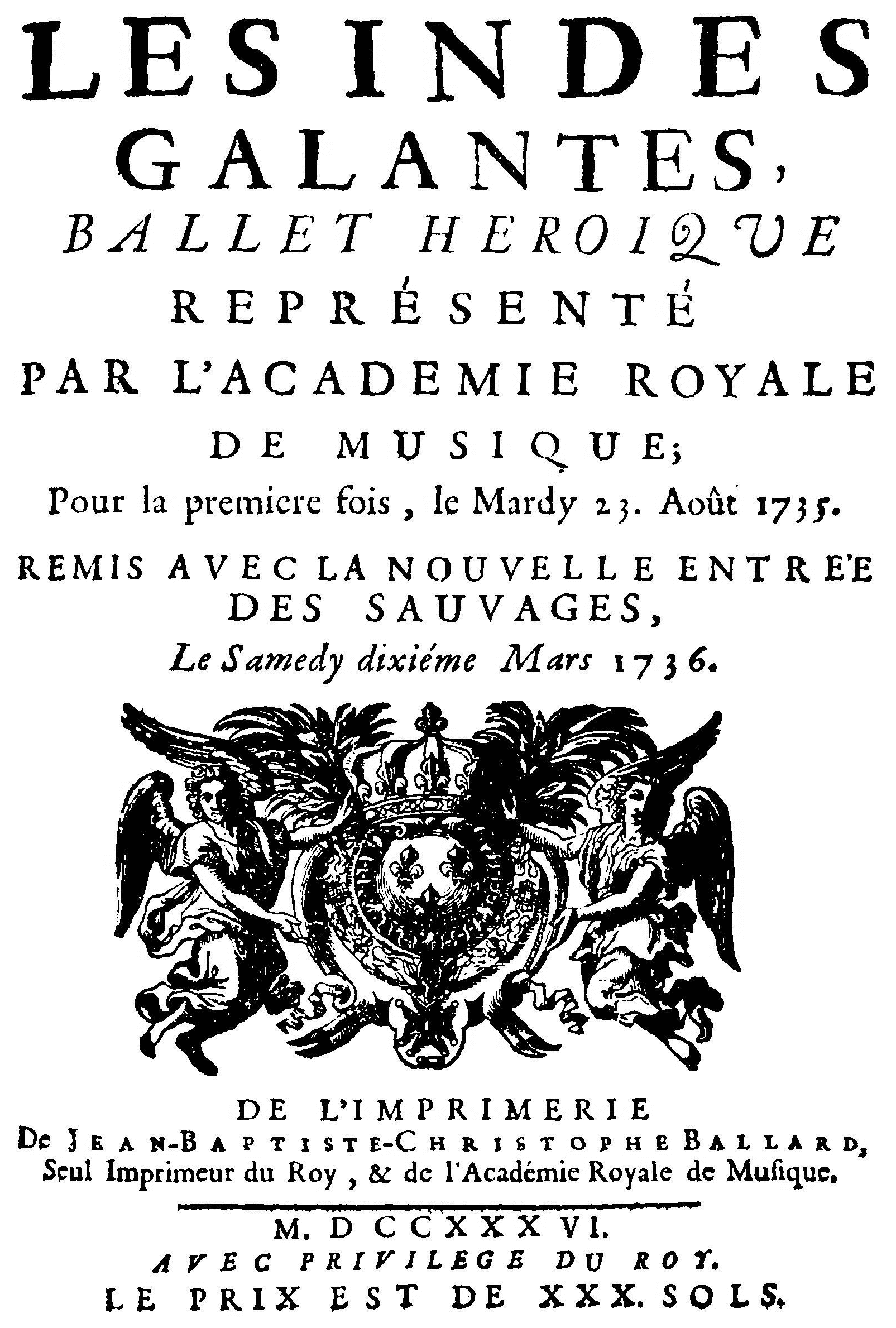
Les Indes galantes (1735)
Les Indes galantes is a ballet héroïque — a French Baroque opera-ballet combining sung drama, chorus and dance — composed by Jean-Philippe Rameau to a libretto by Louis Fuzelier. It premiered at the Académie Royale de Musique (Paris Opera) on 23 August 1735 with an allegorical prologue and two entrées, gained a third entrée within weeks and a fourth (Les sauvages) the following year, and reached what is now treated as its definitive four-part shape — Prologue, Le turc généreux, Les incas du Pérou, Les sauvages — when Rameau dropped the entrée Les fleurs in 1761.
What it contains
- Chaconne — Les sauvages · Entrée IV, Les sauvages, closing divertissement — A stately triple-metre closing dance for the assembled company, named among the work's most celebrated pieces and paired with the Dance of the Peace Pipe as the entrée's finale. Source: "Famous pieces from Les Indes galantes include the Dance of the Peace Pipe and the Chaconne, both from The Savages of North America."
- Minuet · Unspecified number in the score, referred to only as 'the work's first minuet' — A minuet from the score, of unstated placement within the ballet, was extracted and used as standalone dance music in a later film soundtrack. Source: "The work's first minuet was used in the soundtrack of the 2006 film Marie Antoinette."
What is danced
The work is built as a sequence of independent divertissements rather than a through-danced ballet: each entrée pairs a sung plot with a closing suite of dances performed by the corps and named dancers of the Académie Royale de Musique. The Prologue's celebration for Hebe's followers is explicitly described as 'a series of dances, including a musette' performed by young French, Spanish, Italian and Polish revellers before Bellona's warriors interrupt with martial music. The article singles out two other set pieces by name: the Dance of the Peace Pipe and the Chaconne, both closing Entrée IV (Les sauvages), where Europeans and Native Americans dance together as a ceremony of peace after the sung duet between Zima and Adario. A minuet from the score — identified only as 'the work's first minuet' — was later lifted for the 2006 film Marie Antoinette, confirming that minuet movements were part of the original musical fabric even though the article does not say where in the ballet it falls.
Context
Rameau composed within the tradition of the tragédie en musique and opera-ballet established by Lully, in which danced divertissements are structurally load-bearing rather than decorative interludes; the 1735 premiere used the Opera's leading dancers, Marie Sallé and Louis Dupré, choreographed by Michel Blondy, at a moment when French theatrical dance was still governed by the noble style (belle danse) rather than by codified classical technique. The 'Air des Sauvages' at the heart of Entrée IV had its own prior life: Rameau wrote it after watching Native American chiefs from Illinois — brought to Paris in 1725 to meet Louis XV — dance at the Théâtre-Italien, and reused it from his 1728 harpsichord suites, making the final entrée an early instance of European theatrical dance directly citing an observed non-European dance practice.
Staging history
The premiere run struggled commercially (as little as 281 livres at one performance) despite twenty-eight showings, and the disguise plot of the original Les fleurs entrée provoked complaints of indecency and had to be rewritten twice before the work found its full four-entrée form in March 1736; it then held the stage at the Opera for decades, accumulating 185 further billings through revivals into 1761 and living on afterward as excerpted 'fragments' well into the 1770s. It vanished from the Opera's repertoire after 1773 and was not revived until the Opéra-Comique staged the Dukas-orchestrated Entrée des Fleurs in 1925; the Paris Opera's own 1952 Palais Garnier production, choreographed separately by Albert Aveline, Serge Lifar and Harald Lander for different entrées, ran to 236 performances by 1961 and is the staging the article documents in the most choreographic detail (though only by naming choreographers and lead dancers, not describing their steps). A 2019 production directed by Clément Cogitore with choreography by Bintou Dembélé and the Compagnie Rualité is listed among the complete recordings but is not described in movement terms in this article.
How to watch it
Watch each entrée as sung drama followed by a self-contained danced divertissement — the plot resolves in song, and the dance closes the act as a communal or ceremonial gesture (a peace pipe rite, a wedding celebration, a festival of flowers) rather than advancing narrative itself. In Entrée IV in particular, note that the choreography stages a diplomatic reconciliation between European and Native characters through shared dance, which is the moment the article flags as containing the score's most celebrated dance music, the Chaconne.
Structure
- Act PrologueHebe summons her followers to a festival of dances, including a musette, until Bellona's warriors interrupt; Cupid then abandons Europe for the 'Indies'.
- Act I · Le turc généreuxOsman Pasha frees his slave Émilie and her fiancé Valère, ending with celebratory dances as the couple prepare to sail.
- Act II · Les incas du PérouThe Inca priest Huascar's jealous scheme against the lovers Phani and Carlos ends with his death in a volcanic eruption during the Festival of the Sun ceremony.
- Act III · Les fleursIn two differing versions, disguise plots among Tacmas, Zaïre, Fatime/Fatima and Ali are resolved and the act closes with the Persian Festival of Flowers.
- Act IV · Les sauvagesAdario and Zima's union is celebrated alongside a ceremony of the Peace Pipe joining Native Americans, French and Spanish colonists, closing with the Dance of the Peace Pipe and the Chaconne.
Structure read from an encyclopaedia article, not from a libretto or score we hold. Confirm against a programme before treating the numbering as authoritative.
Credits
- composer: Jean-Philippe Rameau
More from Jean-Philippe Rameau
Other staged works in the register connected to this one by author or lineage.
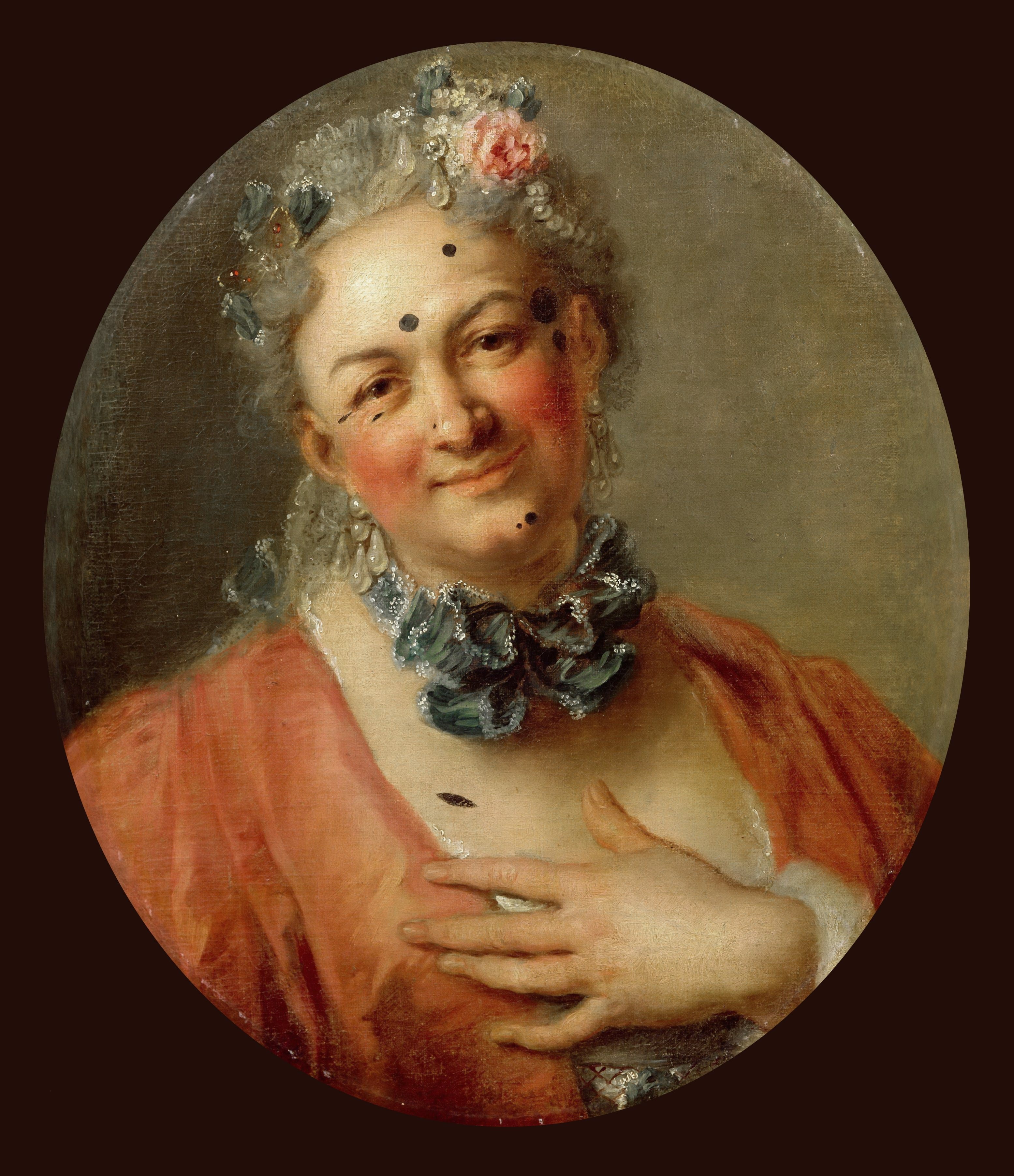 PlatéeBallet · 1745Music by Rameau · video
 Le temple de la GloireBallet · 1745Music by Rameau · video
 Les surprises de l'AmourBallet · 1748Music by Rameau
 Les fêtes d'HébéBallet · 1739Music by Rameau · video
 Les fêtes de PolymnieBallet · 1745Music by Rameau
 Don QuixoteBallet · 1869Same lineage · video
 ChaconneBallet · 1976Same lineage · video
- The Incredible FlutistThe Incredible FlutistBallet · 1938Same lineage