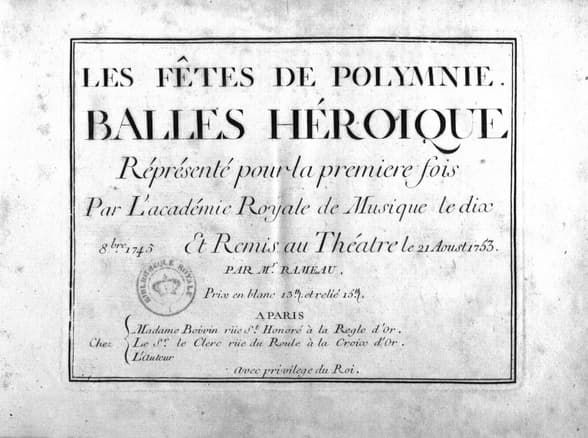
Unknown authorUnknown author — http://gallica.bnf.fr/ark:/12148/bpt6k398018b.r=Rameau%2C%20Jean-Philippe%20Polymnie?rk=42918;4 · Public domain
Les fêtes de Polymnie (1745)
Les fêtes de Polymnie is an opéra-ballet by Jean-Philippe Rameau in a prologue and three entrées, set to a libretto by Louis de Cahusac, first given at the Paris Opéra on 12 October 1745. It was an occasional work, commissioned to mark the French victory at the Battle of Fontenoy, and its prologue treats that victory allegorically before the three entrées move through mythological, historical and fairy-tale subject matter.
What is danced
The article does not describe any specific choreography, dance numbers, or named divertissements within the prologue or the three entrées. It gives only the plot of each section (the marriage of Hercules and Hebe; the renunciation story of Seleucus, Stratonice and Antiochus; and the fairy-tale rescue of Zimès by Argélie from the fairy Alcina). As an opéra-ballet in the French tradition this structure would conventionally carry a danced divertissement within or between the sung scenes, but nothing in the source names what was danced, by whom, or in what style, so no movement vocabulary can be documented from this article.
Context
The work belongs to Rameau's mature output for the Paris Opéra in the 1740s, written as a topical, celebratory piece tied to a specific military event (Fontenoy) rather than as a purely mythological entertainment. Commentators cited in the article (Girdlestone, and Sadler in the New Penguin Guide) single out the overture as a genuine musical departure from the standard French overture pattern established by Lully, even while judging the work as a whole not among Rameau's strongest.
Staging history
The opéra-ballet premiered at the Opéra, Paris, on 12 October 1745 and was revived at the same house on 21 August 1753. The article records no other stagings; the only later documented presentation is a 2015 studio recording (Glossa, two CDs) conducted by György Vashegyi with the Purcell Choir and Orfeo Orchestra, which is a musical recording rather than a staged production.
How to watch it
Listen for the overture's departure from the standard Lullian slow-fast-dance pattern, which is the feature scholarship most consistently praises in this work. Beyond that, follow the piece as three self-contained entrées of contrasting tone (heroic myth, dynastic renunciation, oriental fairy tale) framed by an allegorical prologue on Fontenoy; the article gives no basis for anticipating particular set dances within these sections.
Structure
- Act Prologue · Le temple de MémoireDescribes the victory of Fontenoy in allegorical fashion.
- Act 1 · La fableDepicts the marriage of Hercules and Hebe, the goddess of youth.
- Act 2 · L'histoireTells the story of Seleucus I Nicator giving up his fiancée Stratonice when he learns his son Antiochus I Soter loves her.
- Act 3 · La féerieSet in the Middle East; through her love for him, Argélie redeems Zimès from the power of the evil fairy Alcina.
Structure read from an encyclopaedia article, not from a libretto or score we hold. Confirm against a programme before treating the numbering as authoritative.
Credits
- composer: Jean-Philippe Rameau
More from Jean-Philippe Rameau
Other staged works in the register connected to this one by author or lineage.