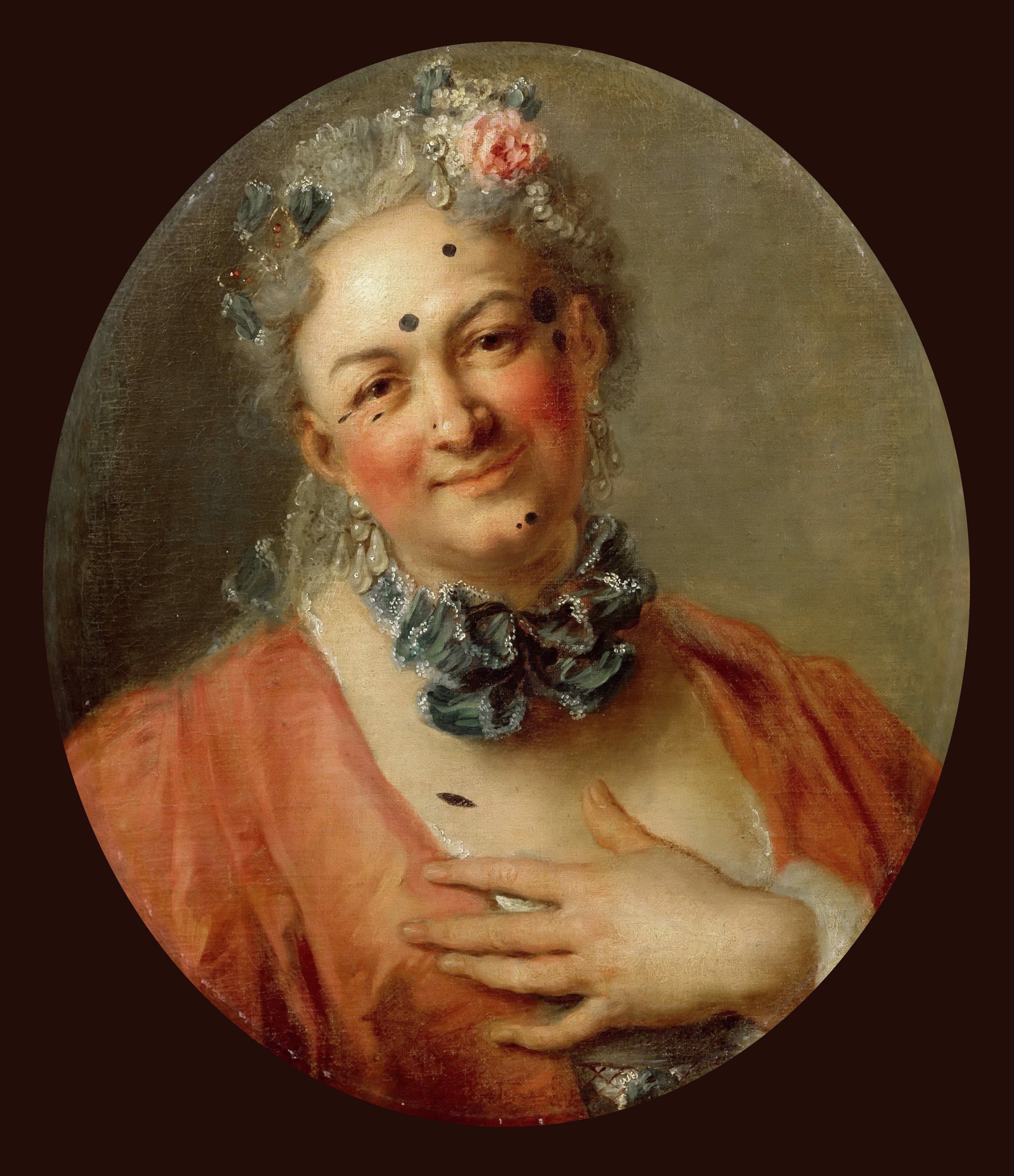
Charles-Antoine Coypel — http://www.1st-art-gallery.com/Charles-Antoine-Coypel/Charles-Antoine-Coypel-oil-paintings.html · Public domain
Platée (1745)
Platée is Jean-Philippe Rameau's first comic opera, a work in a prologue and three acts to a libretto by Adrien-Joseph Le Valois d'Orville (after Jacques Autreau), first given on 31 March 1745 at the Grande Écurie, Versailles, as part of the wedding festivities for the Dauphin. It was designated at its premiere a 'ballet bouffon' and only later restyled a 'comédie lyrique' — the same category the article gives for Rameau's Les Paladins — which is the reason it sits in a dance catalogue rather than purely an opera one.
What is danced
The article does not give a choreographic account of the work — no named divertissement titles, step vocabulary, or technique are described beyond the fact that dance was structurally present. It records only that Act 2 contains 'an extended divertissment' built around La Folie's set-piece narration of Apollo and Daphne, during which 'Dancers and singers alternately praise and mock Platée.' That single sentence confirms dancers took an active, characterful role in mocking the title figure, but supplies no detail on what steps or forms they used, so no specific style can be attached to it from this source.
Context
Comic opera was uncommon in French court entertainment of the period; the article notes that Rameau may have taken his cue from a 1742 revival of Jean-Joseph Mouret's Les amours de Ragonde or from Joseph Bodin de Boismortier's 1743 comic opera-ballet Don Quichotte chez la Duchesse. Platée later became a touchstone in the Querelle des Bouffons, cited by critics on the French side (Grimm, even the hostile Rousseau) as proof that French opera could achieve the lightness Italian opera buffa partisans favoured, while Voltaire, present at the premiere, dismissed it as 'the height of indecency, boredom, and impertinence.'
Staging history
The opera had one court performance in 1745, was revised with librettist Ballot de Sauvot for a successful public run at the Paris Opéra in 1749, and was revived in 1750, 1754 (again amid the Querelle des Bouffons) and 1759, after which it disappeared from the stage until a heavily adapted German version surfaced in Munich in 1901; the French version did not return to France until Aix-en-Provence in 1956. Later notable productions include Laurent Pelly's 1999 Palais Garnier staging (released on DVD, conducted by Marc Minkowski), the 1997 co-production of New York City Opera and the Mark Morris Dance Group directed by Mark Morris for the Edinburgh Festival (later touring to London and the USA), Robert Carsen's 2014 production for Theater an der Wien and Opéra-Comique, the Australian premiere by Pinchgut Opera, and a 2023 Zürich Opera production by Jetske Mijnssen.
How to watch it
Watch for the Act 2 divertissement, where the article specifies dancers and singers work in tandem to alternately flatter and ridicule Platée — a structural cue that the dance material there is characterful and satirical rather than decorative. Because the piece was written as a 'ballet bouffon' for a court wedding, expect the period convention of interpolated dance numbers framing vocal set-pieces (such as La Folie's Apollo and Daphne narration) rather than a continuous danced narrative.
Structure
- Act PrologueThespis, Thalie, Momus and Cupid plan the entertainment that will recreate Jupiter's old scheme to cure Juno's jealousy.
- Act 1Mercury and Cithéron devise the plan to have Jupiter feign love for the marsh nymph Platée; Platée is introduced amid a storm raised by Juno.
- Act 2Jupiter appears to Platée first as a donkey, then an owl, then in person; an extended divertissement follows including La Folie's Apollo and Daphne narration, with dancers and singers alternately praising and mocking Platée.
- Act 3The mock wedding of Jupiter and Platée is interrupted when Juno unveils and exposes the trick; the gods depart and Platée returns to her pond.
Structure read from an encyclopaedia article, not from a libretto or score we hold. Confirm against a programme before treating the numbering as authoritative.
Credits
- composer: Jean-Philippe Rameau
More from Jean-Philippe Rameau
Other staged works in the register connected to this one by author or lineage.


