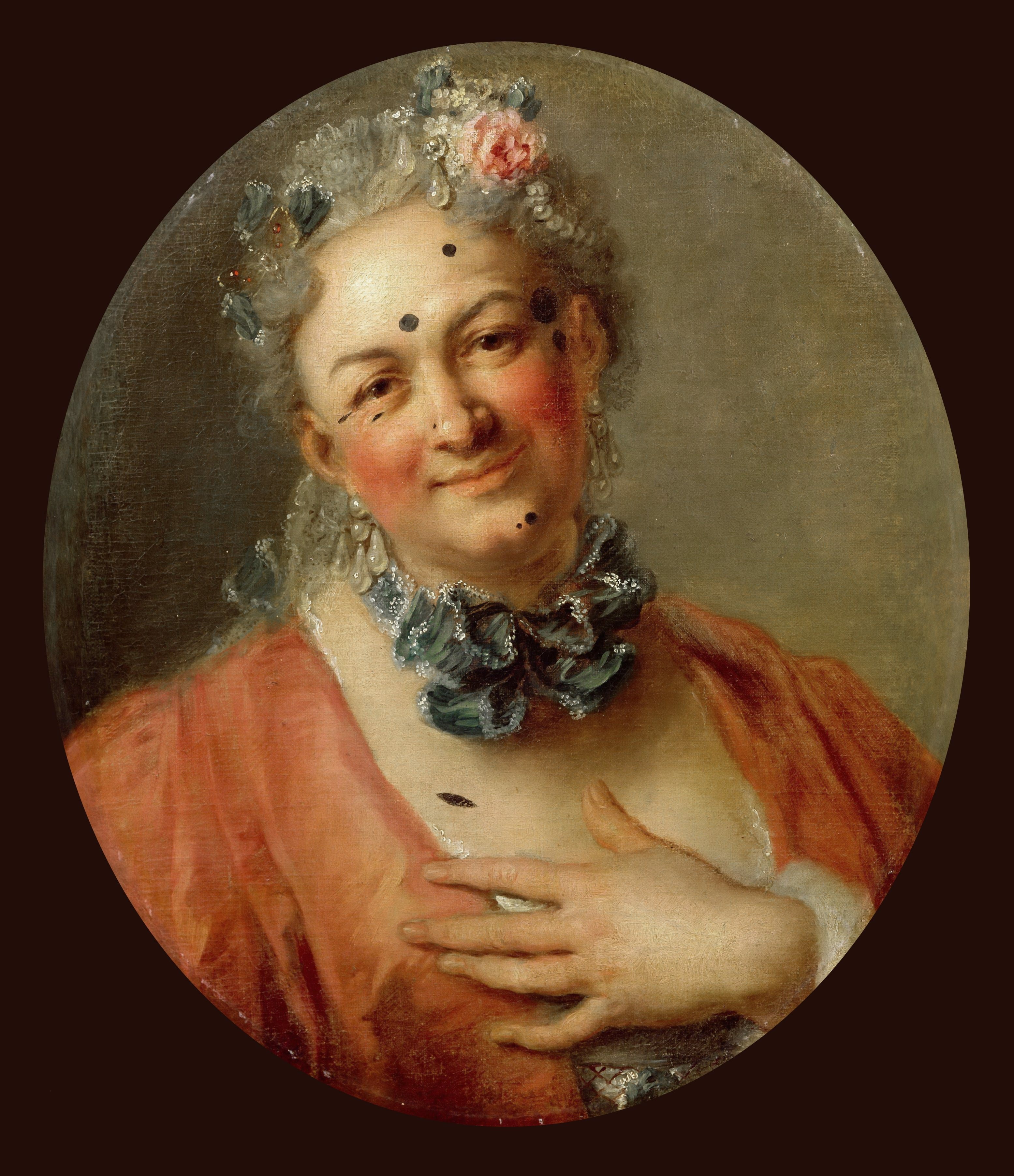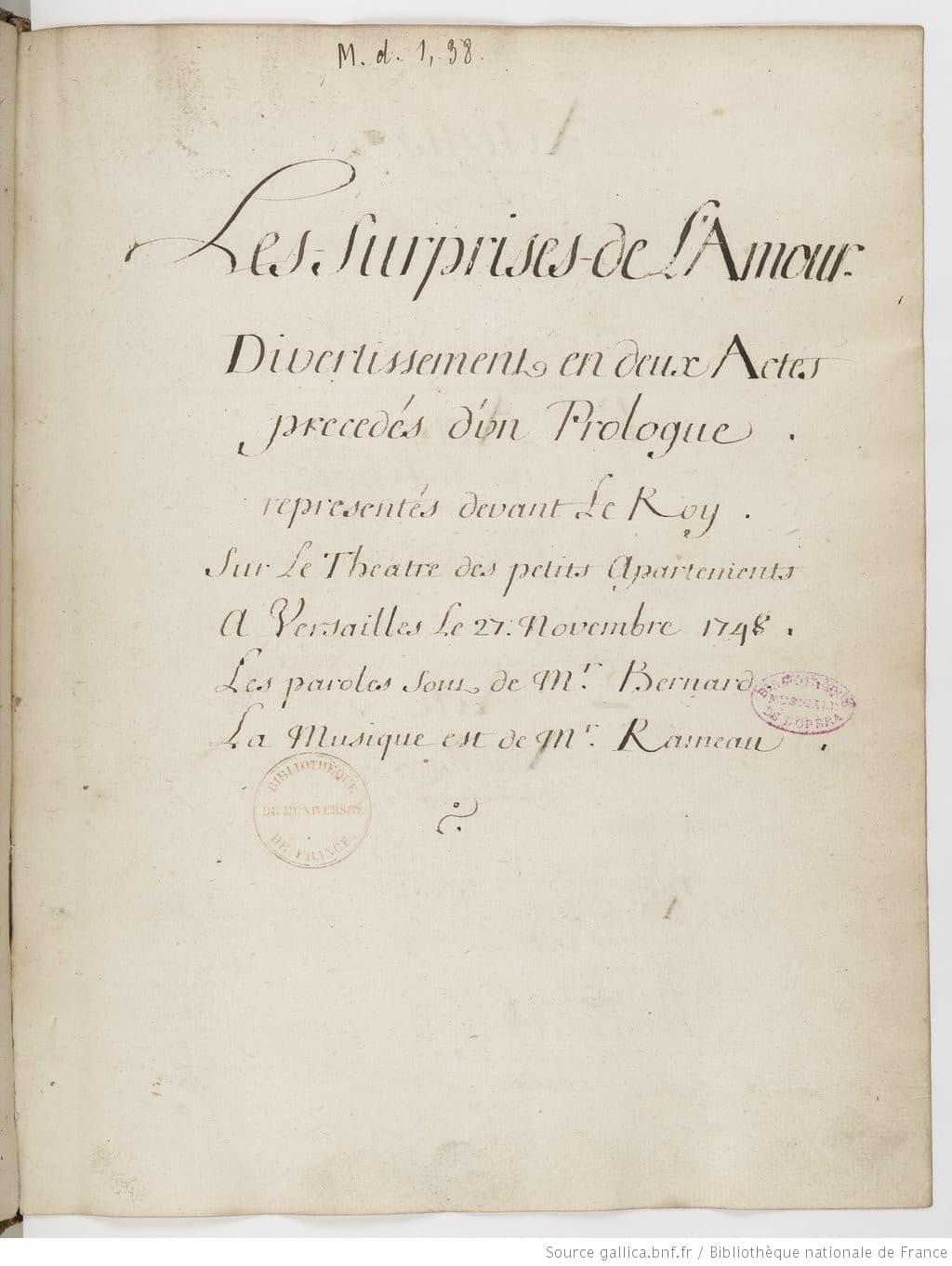
Jean-Philippe Rameau — Gallica (https://gallica.bnf.fr/ark:/12148/btv1b8495645r) · Public domain
Les surprises de l'Amour (1748)
Les surprises de l'Amour is a Jean-Philippe Rameau opéra-ballet (originally billed simply as a "ballet", and arguably closer in content to the ballet héroïque genre) first given at Versailles on 27 November 1748, commissioned by Madame de Pompadour for the opening of her Théâtre des Petits Appartements. It survives in two distinct forms: the 1748 original of a prologue and two entrées ("La lyre enchantée", "Adonis"), and a heavily revised 1757 version for the Paris Opéra that dropped the prologue and added a third entrée, "Anacréon".
What is danced
The article documents dance mainly through cast lists and synopsis, not choreographic detail. Each entrée is built as sung drama that resolves into a formal danced sequence: "L'enlèvement d'Adonis" moves from the Venus/Adonis/Diana plot into 'a ballet celebrating the coming wedding of Venus and Adonis' and 'further more elaborate ballets' miming Diana's falling for the sleeping Endymion, danced by named ballet roles (ballerina, male dancer, ballerina en travesti) rather than the singing principals, closing in 'a festive chorus accompanied by a general dance.' "La lyre enchantée" closes with 'a ballet performed by the Muses and Sirens under the guidance of Terpsichore (ballerina).' "Anacréon" includes a mimed 'confrontation between Anacreon's suite and Bacchus' followers' and ends in 'a chorus and in a contredanse accompanied by sistrums and "other Bacchic instruments".'
This is the standard architecture of mid-18th-century French opera-ballet: pantomimed mythological action performed by dedicated dancers (several roles are explicitly cast 'en travesti' or as 'ballerina'/'male dancer' rather than sung), building to a closing ensemble divertissement. But the article gives no step vocabulary, no named baroque dance types (no gavotte, minuet, passepied etc. are mentioned for this particular score), and no choreographer credit, so nothing more specific than 'ballet' and 'contredanse' can be verified from this source.
Context
The work sits at the tail end of the great age of French court ballet-opera, staged for a private royal theatre rather than the public Opéra, with the king's own mistress singing two of the soprano leads. Rameau was by 1748 the dominant composer for the genre, and the commission shows the form still being used for occasional, courtly purposes (celebrating the Treaty of Aix-la-Chapelle) even as the public Opéra was moving toward a more fixed repertory. The 1757 revision, made for new Opéra directors and reusing/renaming entrées (and briefly splicing in music from Rameau's earlier acte de ballet Les sibarites), reflects the era's practice of treating self-contained entrées as modular material — the article notes this 'self-sufficiency of each portion... made the tripartite work a likely source of material for the programs of fragments growing popular in the years before the Revolution.'
Staging history
Premiered 27 November 1748 at the Théâtre des Petits Appartements, Versailles, for the inauguration of its new stage on the Grand Escalier des Ambassadeurs; the king reportedly yawned and said he'd prefer a comedy. Revived at the Paris Opéra in 1757 to mark the arrival of new directors François Francœur and François Rebel, with the prologue cut, a new overture, 'Adonis' retitled 'L'enlèvement d'Adonis', and a new third entrée, 'Anacréon', added; after 10 July 1757 only the second and third entrées were given, the original 'La lyre enchantée' having been swapped for a version of Rameau's Les sibarites. The complete 1757 version was not recorded until Sébastien d'Hérin's 2013 Glossa recording; the 'Anacréon' entrée alone had been recorded separately by William Christie (1982) and Marc Minkowski (1996), reflecting how the entrées circulated independently of the whole.
How to watch it
Watch for the structural pivot in each entrée: sung dramatic action among the principals gives way to a wordless danced sequence performed by separately cast dancers, often re-enacting or extending the plot in mime (Diana falling for the sleeping Endymion, the confrontation of Anacreon's and Bacchus's followers) before a closing 'general dance' or contredanse pulls the full company together. Note which roles are marked 'ballerina', 'male dancer' or 'en travesti' danced doubles of a sung character (e.g. Cupid, Adonis) — this doubling of a role between singer and dancer is characteristic of the genre's staging conventions.
Structure
- Act 1st entrée · L'enlèvement d'Adonis (The rape of Adonis)Venus and Cupid win Adonis from Diana's cult; the entrée closes with a wedding ballet for Venus and Adonis and further mimed ballets showing Diana falling for the sleeping Endymion, ending in a festive chorus with a general dance.
- Act 2nd entrée · La lyre enchantée (The enchanted lyre)The siren Parthenope enchants the Muse Urania into loving the musician Linus via a magic lyre; Apollo resolves the conflict, and the entrée closes with a ballet for the Muses and Sirens led by Terpsichore.
- Act 3rd entrée · AnacréonA feast for Bacchus at Anacreon's house is interrupted by Bacchus's priestess and Maenads; a mimed confrontation between Anacreon's suite and Bacchus's followers follows, then a sleep scene, Cupid's intervention, and a closing chorus with contredanse.
Structure read from an encyclopaedia article, not from a libretto or score we hold. Confirm against a programme before treating the numbering as authoritative.
Credits
- composer: Jean-Philippe Rameau
More from Jean-Philippe Rameau
Other staged works in the register connected to this one by author or lineage.