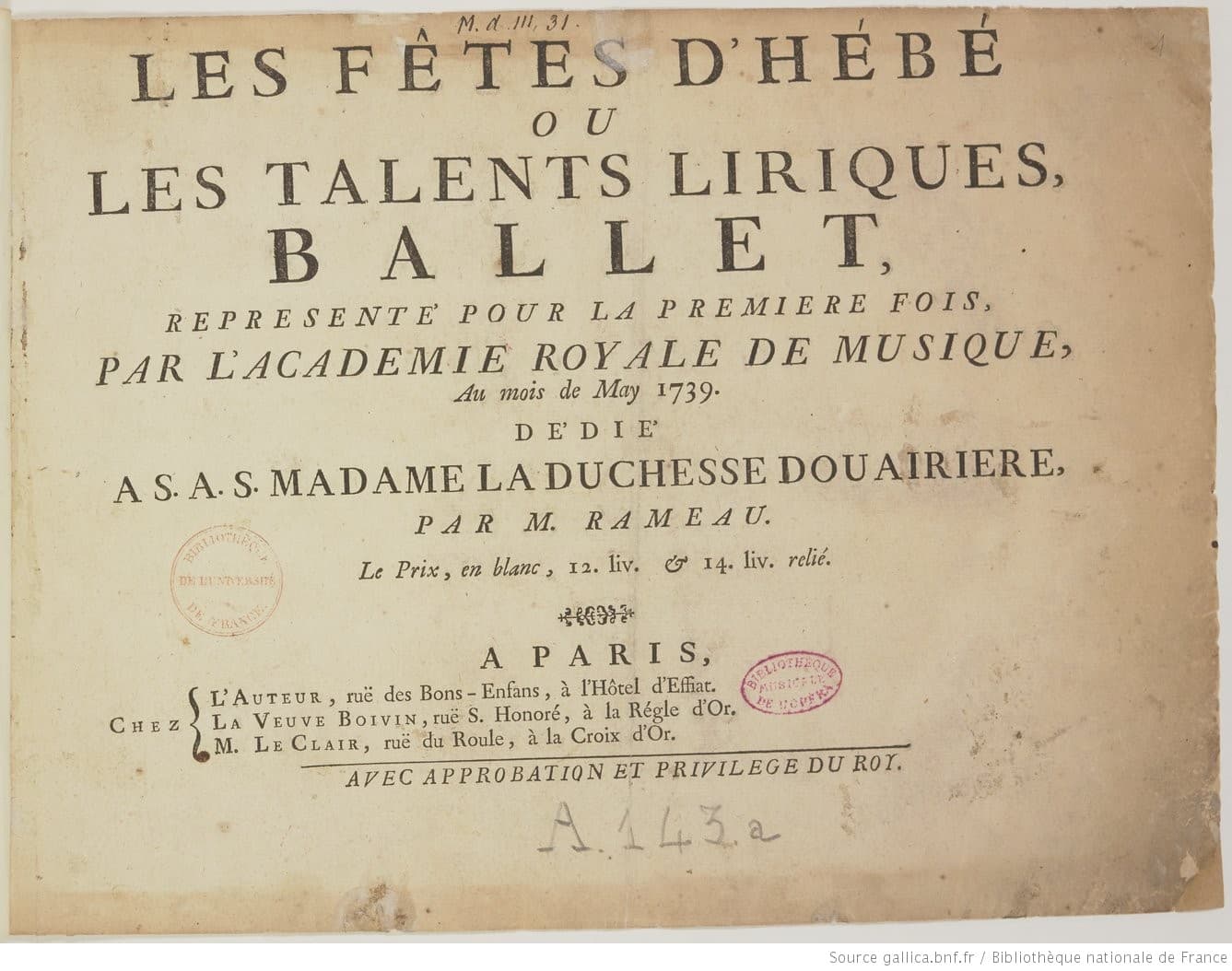
Jean-Philippe Rameau — Gallica (https://gallica.bnf.fr/ark:/12148/btv1b10501693q) · Public domain
Les fêtes d'Hébé (1739)
Les fêtes d'Hébé, ou Les talens lyriques is an opéra-ballet by Jean-Philippe Rameau, first given by the Académie royale de musique in Paris on 21 May 1739. It is built as a prologue plus three self-contained entrées — Poetry, Music, and Dance — loosely unified by the theme of the 'lyric arts', a structure typical of the genre Rameau had inaugurated four years earlier with Les Indes galantes.
What it contains
- Bourrée · Prologue — A Bourrée, a quick duple-metre French Baroque theatrical dance, was set as an instrumental number in the Prologue and was distinctive enough to be excerpted for the film Vatel. Source: "The Bourrée from the Prologue was used in the soundtrack of Vatel."
What is danced
The article's dance evidence is sparse and mostly indirect. What is explicit: the third entrée is titled 'Dance' and turns on Eglé, a shepherdess 'well known for her skill at dancing', and on Terpsichore, muse of dance, who appears with her followers to celebrate Eglé's choice of husband — the dancer Marie Sallé created the role of Terpsichore at the 1739 premiere. The second entrée contains a danced interlude within the plot: Iphise 'views the action in the form of a ballet provided by the oracle', i.e. a divertissement staged as a vision rather than a diegetic celebration.
The score names specific dance types used as instrumental numbers: a Bourrée in the Prologue (distinctive enough to be extracted for the film Vatel's soundtrack), and, in the third entrée, a musette and a tambourin drawn from Rameau's own 1724 harpsichord suite in E minor. These are court-derived character dances with fixed metric and rhythmic profiles rather than free choreographic invention, consistent with the danced divertissements of the Académie royale de musique repertoire of the period.
No choreographer, dance notation, or step-level description survives in this account. The article gives no indication of how the third entrée's celebratory dancing, or the second entrée's 'oracle's ballet', were actually built — only that named period dance forms furnished the music for them.
Context
By 1739 Rameau was, per the sources quoted in the article, 'at the height of his powers'; Les fêtes d'Hébé was his second opéra-ballet after Les Indes galantes (1735), a genre that structurally depended on integrated dance entrées rather than the continuous dramatic action of tragédie en musique. The presence of Marie Sallé — one of the most significant reforming dancers of the eighteenth century, known for pursuing expressive, naturalistic movement over pure virtuosity — as Terpsichore in the third entrée places the work inside the same moment of ballet history in which Sallé was pushing against the ornamental conventions of the Paris Opéra's danced divertissements.
Staging history
The work was an immediate success, receiving 80 performances in its first year despite a libretto criticised heavily enough that the second entrée had to be revised with help from Simon-Joseph Pellegrin. It was revived in 1747, 1756, and 1764, the last with sets supervised by François Boucher and Sophie Arnould as Iphise; after that, eighteenth-century productions gave only partial versions. The article records no staging, choreographer, or company beyond the original 1739 production and these revivals — modern activity cited is confined to complete and partial audio recordings (Christie/Les Arts Florissants, 1997; Vashegyi, 2022; Gardiner's 'La danse' excerpt of the third entrée alone, 1977).
How to watch it
Treat the three entrées as independent short works joined only by theme, not plot — each has its own resolution and its own balance of song, spectacle, and dance. Listen for the named dance forms embedded in the score (bourrée, musette, tambourin) as the points where courtly dance vocabulary of fixed rhythm and meter is most likely staged, and watch the third entrée in particular, where the muse of dance and her followers close the whole work.
Structure
- Act PrologueHebe, harassed by Momus, is invited by Cupid to witness festivities on the Seine celebrating poetry, music and dance.
- Act First entrée · PoetryOn Lesbos, the poets Sappho and Alcaeus are reunited after Sappho stages an allegorical play to reveal the truth to King Hymas.
- Act Second entrée · MusicIphise must marry the victor over the Messenians; she watches the battle 'in the form of a ballet provided by the oracle', and her betrothed Tyrtaeus wins.
- Act Third entrée · DanceThe dancing shepherdess Eglé chooses the disguised god Mercury as husband, and the couple celebrate with Terpsichore, muse of dance, and her followers.
Structure read from an encyclopaedia article, not from a libretto or score we hold. Confirm against a programme before treating the numbering as authoritative.
Credits
- composer: Jean-Philippe Rameau
More from Jean-Philippe Rameau
Other staged works in the register connected to this one by author or lineage.
 Les Indes galantesBallet · 1735Music by Rameau · video
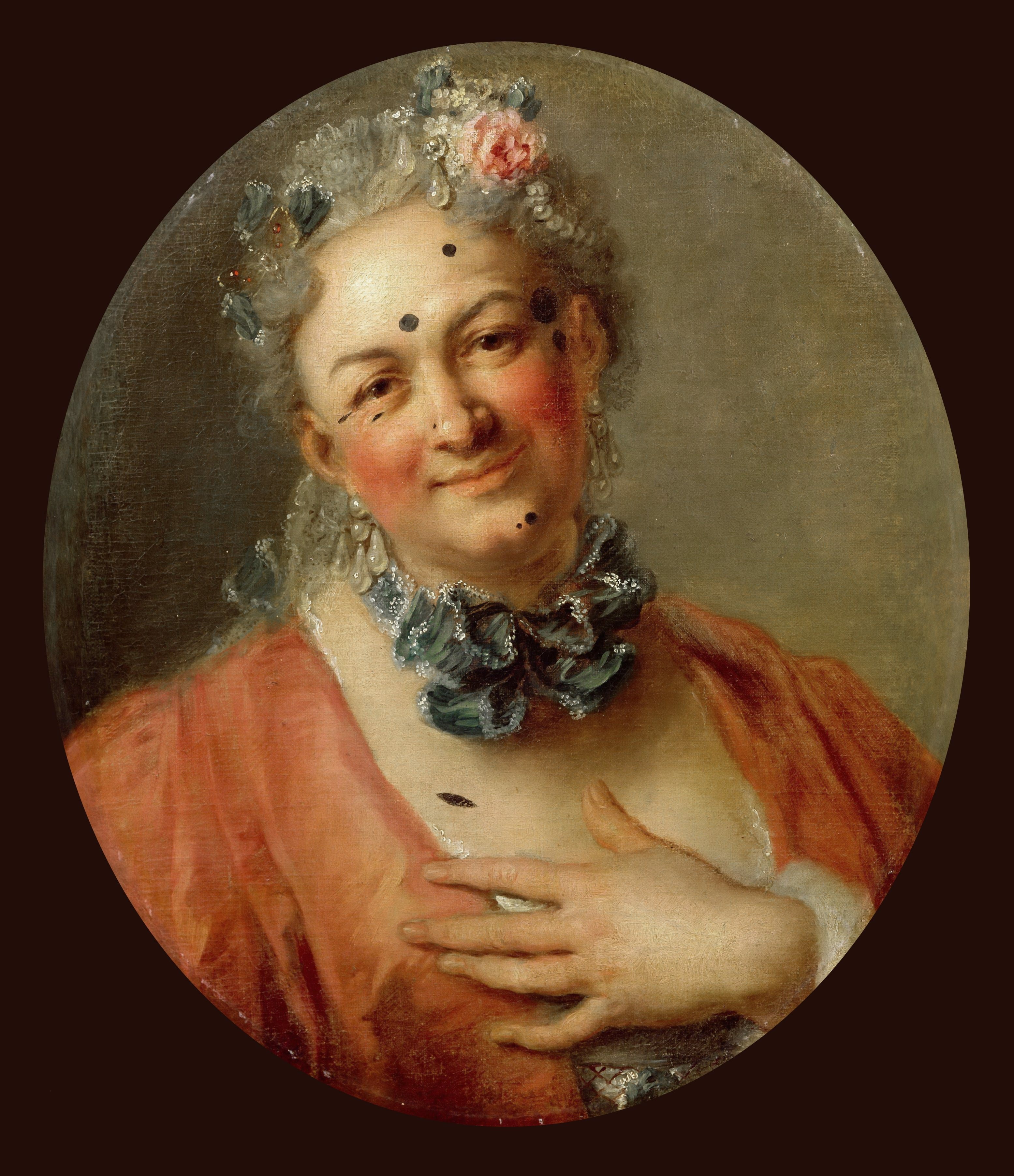 PlatéeBallet · 1745Music by Rameau · video
 Le temple de la GloireBallet · 1745Music by Rameau · video
 Les surprises de l'AmourBallet · 1748Music by Rameau
 Les fêtes de PolymnieBallet · 1745Music by Rameau
 L'éventail de JeanneBallet · 1929Same lineage