Unknown · Public domain
The Enchanted Forest (1887)
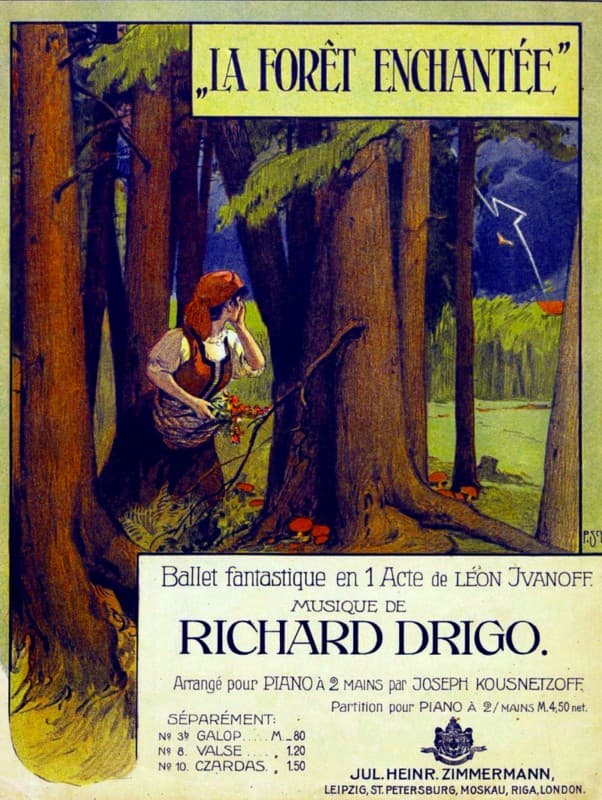
La Forêt enchantée (The Enchanted Forest) is a one-act "ballet fantastique" made for the Imperial Ballet School's 1887 graduation performance and quickly absorbed into the regular Mariinsky repertory, where it played on and off until 1907. The article credits the choreography to Lev Ivanov and identifies the score as Riccardo Drigo's first complete full-length ballet composition — our own record holds only the composer credit, so the choreographer, company and premiere date given here should be treated as a lead for the catalogue rather than settled fact.
What is danced
The article does not describe steps, holds or technique directly; what survives is a synopsis and a numbered list of dances taken from the 1909 published score and Drigo's memoirs: Danse des Dryads, Danse scènique, Danse des petits Génies, Pas d'action, Variation de la Première danseuse, Coda-valse, and Csárdás. That sequence maps onto standard divertissement architecture of the period — supernatural corps numbers (dryads, forest genies), a mimed pas d'action carrying the Genie's courtship of the mortal Ilka, a set solo variation for the leading dancer, a waltz coda, and a concluding Hungarian national dance for the peasant characters who close the story.
Beyond that skeleton, the article gives no technical detail — no mention of pointe work, mime conventions, or the character-dance vocabulary the csárdás would require. A dancer or repetiteur relying on this source alone would know the running order of the ballet but not how any of it was actually built or danced; that has to come from the score, any surviving notation, or comparison with Ivanov's better-documented later work.
Context
1887 sits just before Lev Ivanov's canonical works (the Nutcracker and Swan Lake's white acts of the early 1890s), and the article states this was his first original ballet after being appointed second maître de ballet to the Imperial Theatres — making it a debut work rather than a mature statement. It was also Riccardo Drigo's first complete score for a full-length ballet, before he became the Mariinsky's house composer and conductor of choice for Petipa. The work therefore belongs to the graduation-performance tradition of the Imperial Ballet School, a pipeline that regularly tried out young choreographic and compositional talent before promoting successful pieces into the main company repertory.
Staging history
First given by students at the Imperial Ballet School's own theatre on 5 April [O.S. 24 March] 1887, the ballet transferred within weeks to the Imperial Mariinsky Theatre (15 May [O.S. 3 May] 1887), sharing a bill with Jules Perrot's La Naïade et le Pêcheur. It remained in repertory into the early 1900s, described as a favourite among turn-of-the-century ballerinas, before its last recorded performance during the Imperial Ballet's summer season at Krasnoe Selo on 15 June [O.S. 2 June] 1907. The score outlived the choreography in one specific way: music from it was later reused for the Bolshoi Ballet's "Grand pas des Éventails" in Le Corsaire.
How to watch it
Treat it as a period piece of Imperial-era divertissement construction: watch for the contrast between the fantastical, supernatural ensembles (dryads, forest genies) built around a mimed pas d'action and set ballerina variation, and the grounded, national-character csárdás that closes the ballet among the mortal peasants. That supernatural-versus-national contrast was a stock device of the period and is really the only structural clue this source gives you to look for.
Structure
- Danse des DryadsEnsemble number for the dryads and forest creatures who discover the fainted Ilka.
- Danse scèniqueA staged dance number; the article does not specify its dramatic placement.
- Danse des petits GéniesDance of the small forest spirits attending the Genie of the Forest.
- Pas d'actionLikely the dramatic centrepiece in which the Genie courts and then threatens Ilka.
- Variation de la Première danseuseSolo variation for the leading ballerina dancing Ilka.
- Coda-valseWaltz coda closing the fantastical, supernatural sequence.
- CsárdásHungarian national dance, likely corresponding to the closing peasant celebration described as "rejoicing and dances."
Structure read from an encyclopaedia article, not from a libretto or score we hold. Confirm against a programme before treating the numbering as authoritative.
Credits
- composer: Riccardo Drigo
More from Riccardo Drigo
Other staged works in the register connected to this one by author or lineage.