46 works in this view — arrow keys or swipe to move between them.
Dance in Art
The celebrated polka dances
Unknown artist
- Medium:
- Lithograph
- Dance:
- Polka
- Era:
- Late 1800s (Victorian Ballroom)
- Source:
- New York Public Library
- Rights:
- Public domain — free to use, share and adapt.
- Recorded as:
- public_domain
This print is an invaluable record of polka as it was actually danced and marketed in the 19th century. For dance historians and performers, it provides concrete visual evidence of the dance's characteristic frame, footwork, and social function—proof of how the polka appeared to its contemporaries and how it was celebrated in popular visual culture. The survival of such prints in collections like the New York Public Library shows how dance imagery circulated and shaped public taste during a pivotal moment in ballroom history.
What you are looking at
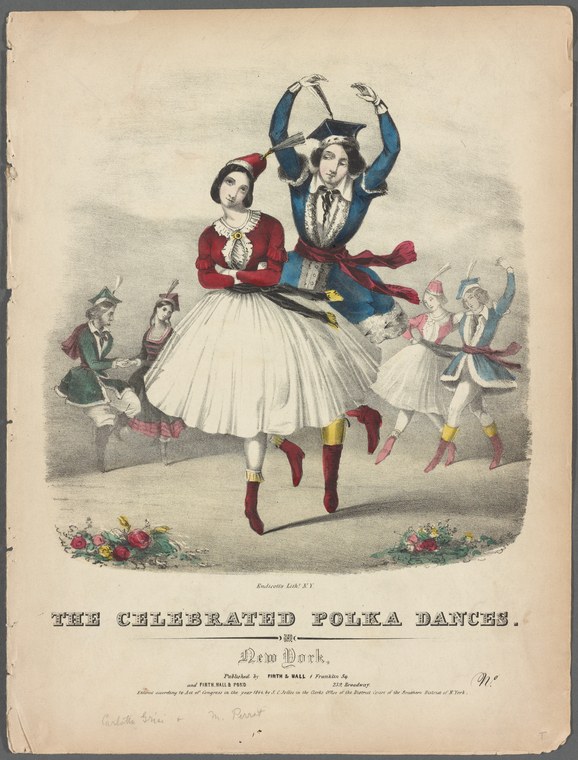
A lively lithograph in hand-colored style shows a polka scene from the mid-to-late 19th century. In the center, a couple dances vigorously: the man wears a bright blue jacket with a red collar, holding his arms high and outspread, while the woman in a striking red jacket and white full skirt lifts her leg in an energetic kick or high step. Both figures lean into the movement with clear forward momentum. The woman's blonde hair and the man's dark hair and cap are rendered with attention to detail. Around them, smaller figures in period dress look on—some standing, some appearing to gesture or dance themselves—creating a sense of animated social energy. Floral garlands frame the bottom of the composition. The title and publication information appear below in ornate typography. The palette is warm, with strong reds, blues, and flesh tones set against a pale, slightly mottled background typical of period lithography.
The dancing
The central couple displays the vigorous, bouncing quality characteristic of polka dancing. The man's raised arms and open frame, combined with his forward lean, suggest the rhythmic rise-and-fall of the polka step. The woman's lifted knee and extended leg indicate a high, kicking action—the polka kick—while her body remains upright and engaged. Both dancers show significant knee bend and weight transfer, typical of the dance's fast-paced, springy footwork. The couple occupies nearly the full height of the composition, dominating the scene and emphasizing the spectacle and vigor of the dance.
The dance depicted
This is a polka, as confirmed by the title *The Celebrated Polka Dances*. The polka was a hugely popular social dance of the mid-19th century, having spread rapidly from its likely Bohemian origins across Europe and to America by the 1840s. The energetic, bouncing quality visible here—the high knees, the forward momentum, the animated arms—matches contemporary descriptions of the polka's characteristic hopping step performed to fast 2/4 time music. The lithograph captures what made the polka so thrilling to its audience: its vigor, accessibility as a couple dance, and departure from the more controlled restraint of earlier ballroom dances. This particular print presents the dance as spectacle, with onlookers as part of the scene of excitement.
How it was made
This is a hand-colored lithograph, a mass-production technique that allowed popular dance imagery to reach a broad middle-class audience in the mid-19th century. Lithography's ability to capture rapid movement and expressive gesture—visible here in the dynamic postures and the gestural quality of the surrounding figures—made it ideal for recording social dance. The hand coloring, applied after printing, adds immediacy and appeal to the black stone-printed base. The technique also allowed for serial production and distribution, making such prints affordable ephemera that both documented and promoted the polka craze as it swept through urban social centers in Europe and North America.
About this work
This is a printed advertisement and documentary record of the polka, one of the most transformative social dances of the 19th century. The print celebrates the dance's vigor, accessibility, and appeal to a fashionable public audience. It captures a specific moment in dance history—the polka's meteoric rise to popularity—and communicates both how the dance looked and how it was understood: as energetic, modern, and thrilling. The lithograph format and hand coloring signal that this was a commercial product aimed at a broad public, not an elite art commission. As such, it is both a visual document of period movement practice and evidence of how dance was consumed, promoted, and imagined in the public imagination of the mid-Victorian era.
How to look at it
Observe the moment the artist chose to freeze: the man at the peak of his jump or spring, his arms thrown wide, and the woman executing a high kick—both at the height of their energy. This is not a static pose but a snapshot of explosive, rhythmic movement. Note how the composition emphasizes verticality and forward momentum, contrasting with the more linear, processional quality of earlier ballroom dances visible in contemporary prints. The surrounding onlookers, though smaller, are integral to reading the scene: they mark this as a social spectacle, not a private or formal moment. The bright, even color and the precision of the lithographic outline give the figures a clarity that speaks to the dance's new visibility and accessibility in urban public culture.
The period
The polka emerged in Bohemia in the 1830s and became a pan-European and transatlantic phenomenon by the 1840s-1850s, arriving in America around 1844. It represented a dramatic break from earlier ballroom conventions: faster-paced, more exuberant, and equally available to middle-class dancers as to aristocrats. The dance coincided with the rise of commercial dance halls, the expansion of a publishing industry devoted to popular prints, and the emergence of the middle class as a cultural force. Lithography, a relatively new and affordable technology, was perfectly suited to capturing and disseminating images of popular dances. This print belongs to a large body of mid-Victorian dance imagery that both documented social practice and actively promoted specific dances to a consumer public.
Where it lives
This lithograph is held in the New York Public Library collection, where it is catalogued as a record of Victorian-era ballroom practice. Such prints were produced commercially for sale and distribution, making them ephemeral but important evidence of 19th-century dance culture. The NYPL's holdings include many similar polka prints and dance imagery from the same period.
Dance in this work
Questions about this work
How do we know this is a polka and not another 19th-century dance?
The title states it directly: *The Celebrated Polka Dances*. But the visual evidence reinforces this: the high, energetic kicks, the bouncy forward momentum, the couple frame, and the overall vigor all match contemporary descriptions and other visual records of the polka. The polka's characteristic rise-and-fall action and knee bend are visible in both dancers' postures.
Why was the polka so popular?
The polka was fast, energetic, accessible, and novel. Unlike earlier ballroom dances, it did not require years of training or aristocratic bearing. It was danced in public halls by middle-class urbanites and became a symbol of modernity and social change. Its arrival in America in the 1840s sparked a genuine craze, with polka-themed music, fashion, and merchandise flooding the market.
Who would have bought a print like this?
Middle-class urban dwellers curious about fashionable social dances, dance teachers promoting the polka to their students, and people who attended or wanted to attend polka halls. The affordable price of lithographs meant these prints could reach a much broader audience than earlier hand-painted dance scenes. They were both documentation and advertisement.
Is the footwork visible in this print accurate?
The high knees, the bouncing quality, and the energetic kicks match other visual sources and written descriptions of polka technique from the period. While the print simplifies and dramatizes for effect, it captures the essential character of the dance—its springiness and vigor—accurately enough that it is a valuable reference for historians and dancers studying 19th-century practice.
More Polka artwork