27 works in this view — arrow keys or swipe to move between them.
Dance in Art
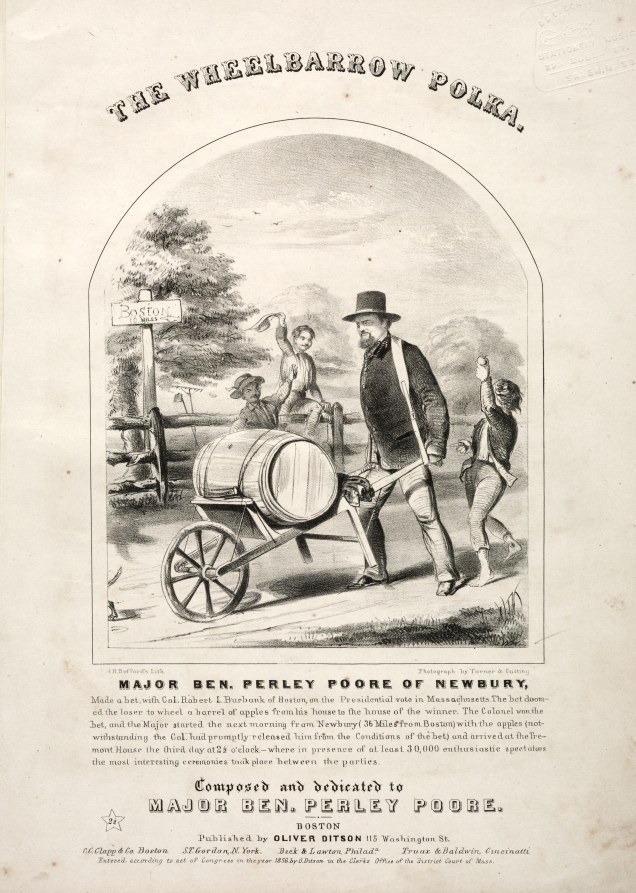
The Wheelbarrow Polka - Sheet Music Cover
Winslow Homer (American, 1836–1910)
- Dance:
- Polka
- Source:
- Cleveland Museum of Art
- Rights:
- Public domain — free to use, share and adapt.
- Recorded as:
- CC0 (Public Domain)
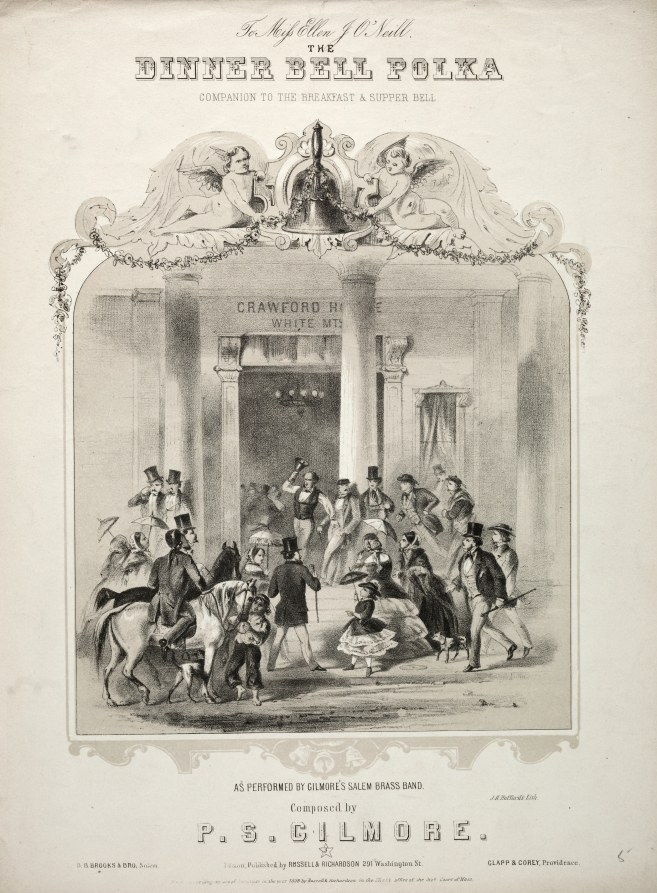
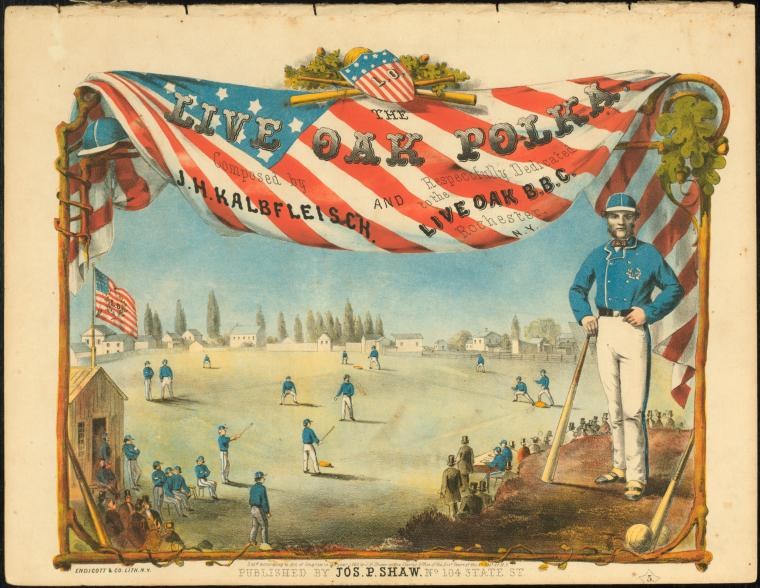
The polka was a democratic revolution in dance: it broke the formal patterns of the quadrille and minuet, moved decisively away from the court and into the street and garden, and was danced by everyone. This image documents that transition in real time, showing the dance not in a formal setting but as casual public entertainment. For historians of social dance, this cover is evidence of how fast the polka was absorbed into popular culture and of how dance imagery circulated in 19th-century America.
What you are looking at
This is a sheet music cover depicting a scene of social dancing outdoors, probably in a public garden or promenade. A gentleman in top hat and dark coat stands at the center-right, observing or about to join the dance. To his left, a woman in a full skirt and bonnet is caught mid-movement, her body angled and arm raised in an energetic gesture. Two other figures—a man in lighter dress on the left and a boy on the right—complete the group, all positioned around a large wooden barrel or drum mounted on a wheeled frame. The scene is set against trees and open sky, with a signpost visible at left. The engraving technique creates sharp contrasts between light and shadow, giving the figures and landscape dimensional form. The composition suggests a moment of spontaneous gaiety, with the wheelbarrow-mounted barrel as the focus of attention and source of musical accompaniment.
The dancing
The principal female dancer occupies the dynamic center of the composition, her body in a pronounced tilt or lean, one arm elevated and the other extended, knees slightly bent in a posture suggesting active footwork. The gentleman observes with formal stance and posture, suggesting he may be about to participate or is directing the activity. The other two figures appear lighter and more casual in their bearing, positioned as participants or audience members. The overall frame is loose and social rather than formally partnered; the dancers do not appear to be in a closed hold or structured couple position, which is characteristic of the informal street or garden setting.
The dance depicted
The title identifies this as a polka, one of the most popular ballroom and social dances of the mid-19th century. The polka originated in Bohemia in the 1830s and became a sensation across Europe and America by the 1840s-1850s, spreading rapidly through dance halls, gardens, and social events of all classes. This image captures the polka in an outdoor, informal setting rather than a ballroom, suggesting its penetration into popular and street culture. The energetic posture of the woman—the lifted arm, the bent knees, the forward tilt—aligns with the polka's characteristic quick, bouncing step and lively demeanor. The presence of the barrel-organ or street musician's instrument suggests this is not a formal ballroom dance but rather an improvised public performance or street party.
How it was made
This is a wood or steel engraving, a reproductive medium well-suited to sheet music covers of the period. The fine parallel lines (hatching and cross-hatching) and crisp blacks create tonal depth and definition. Engraving allowed for wide distribution of popular music and imagery in the mid-19th century; sheet music covers with engraved images reached middle-class households and music rooms across the English-speaking world. The dedication to 'Major Ben. Perley Poore of Newbury' and the Boston imprint confirm this is a commercial American publication. The technique's precision and the cover's prominent placement suggest this work was intended to appeal to amateur musicians and dancers in domestic and public settings.
About this work
This is a sheet music cover for a polka, one of the dominant social dances of the 1840s-1860s. The engraving depicts the dance in an informal outdoor setting—a garden or public space—showing a woman in mid-step with raised arm and tilted frame, a gentleman in formal dress, and other spectators gathered around a wheeled barrel-organ. The image captures the polka not as a refined ballroom dance but as a popular street entertainment and spontaneous social activity, reflecting the dance's rapid adoption across all social classes. The engraving technique allowed this image to circulate widely on sheet music covers, sheet by sheet, into American homes and music rooms.
How to look at it
Attend to the woman's posture and the moment the artist has chosen: she is not gliding or walking, but actively bounding or stepping, her upper body angled forward and her arm lifted in an exuberant gesture. This captures the characteristic energy and vertical spring of the polka, which demanded quick, bouncy steps quite unlike the smooth glide of earlier waltzes. Notice also the informal, outdoor setting and the presence of a street musician or barrel-organ player: this is not a ballroom moment but a democratic, public one. The artist understood the polka as a social release and a popular entertainment, not a formal exercise.
The artist
The artist is not recorded in the catalogue. The engraving carries publication information for Boston publishers G. C. Hopp & Co., E. Fardon & Co. (New York), Black & Livingston (Philadelphia), and Horace & Baldwin (Cincinnati), indicating this was a well-distributed commercial product. The style is consistent with mid-19th-century American popular printmaking for sheet music covers.
The period
The polka emerged in Bohemia in the 1830s and became a European craze in the 1840s, reaching America by the mid-1840s with extraordinary speed. By 1850, it had largely displaced the quadrille as the dominant social dance and was danced at all levels of society—in grand ballrooms, small assembly rooms, and public gardens. The mid-19th century saw an explosion of polka music publishing in the United States; hundreds of polkas were composed, arranged, and circulated on sheet music. At the same time, the visual arts were beginning to capture dance in informal and street settings, reflecting the democratization of dance itself. This image participates in that shift: it shows the polka not as a refined, regulated ballroom activity but as spontaneous, bodily, public entertainment.
Where it lives
This is a sheet music cover from the Cleveland Museum of Art's dance-related collection. It is a commercial engraved print intended for mass circulation on polka sheet music in mid-19th-century America.
Dance in this work
Questions about this work
What is a wheelbarrow polka?
A wheelbarrow polka is a polka composed for or associated with the imagery and novelty of a barrel-organ or street musician's cart. The title refers to the wheeled barrel-organ visible in the image, which would have been a familiar sight at public gatherings, gardens, and street parties. There were several polkas with this name in the 19th century; this cover is dedicated to Major Ben. Perley Poore of Newbury, suggesting it may have commemorated a specific event or entertainer.
Why is this scene outdoors rather than in a ballroom?
The polka was a genuinely popular dance that spread rapidly through all social classes and settings. While it was certainly danced in ballrooms, it was equally at home in gardens, public squares, and street fairs, where street musicians and barrel-organs provided the music. This image reflects the polka's democratic character: it was not confined to the wealthy or the formally trained, but was embraced as a public, spontaneous pleasure.
What can we tell from the woman's posture?
The woman's raised arm, bent knees, and forward-tilted torso indicate active, bouncy footwork—not the smooth glide of a waltz or the structured patterns of a quadrille. The polka was known for its quick, springing steps and its energetic, sometimes even abandoned character. This image captures that liveliness and distinguishes the polka visually from other dances of the period.
Who was Major Ben. Perley Poore?
Major Ben. Perley Poore (1820–1887) was an American journalist, editor, and author based in Newbury, Massachusetts. The dedication on this cover suggests he was either a patron of the composer or music publisher, or possibly the entertainer associated with this particular performance or event. He was a prominent figure in 19th-century American letters.
More Polka artwork