25 works in this view — arrow keys or swipe to move between them.
Dance in Art
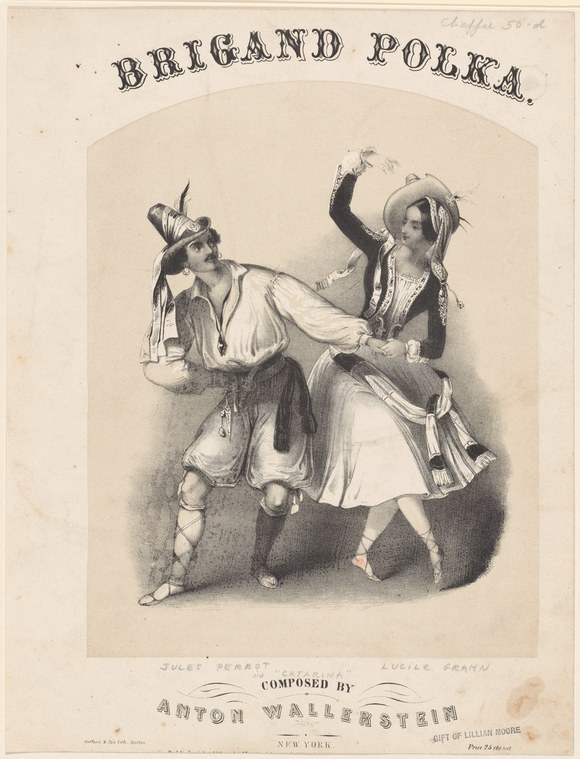
Brigand polka.
Unknown artist
- Medium:
- Lithograph
- Dance:
- Polka
- Era:
- Late 1800s (Victorian Ballroom)
- Source:
- New York Public Library
- Rights:
- Public domain — free to use, share and adapt.
- Recorded as:
- public_domain
The *Brigand Polka* illustrates the theatrical expansion of ballroom dance in the 19th century, when polkas were reimagined as vehicles for costume drama and character performance. For historians of social dance, it shows the permeability between amateur ballroom dance and professional stage entertainment—the same dance form could be both. For those interested in dance imagery, it demonstrates the lithograph's role as the primary medium for circulating knowledge of new dances to a mass audience of dancers and music-lovers.
What you are looking at
A lithographed title page for a polka composition depicts two figures in romanticised brigand costume performing an animated dance. The male figure on the left, dressed in a loosely billowing white shirt with dark vest and draped fabric accessories, leans forward dynamically with one arm extended upward and back. The female figure on the right, in a white chemise with dark corseted bodice and a tall, decoratively plumed headdress, mirrors his energy with raised arm and tilted posture. Both figures are caught in an exuberant mid-movement moment, their bodies angled toward each other in a spirited interaction. The composition is set against a plain background that allows the figures and their costume details to dominate. The theatrical styling and the title *Brigand Polka* suggest a dance inspired by the exotic appeal of outlaw figures popular in 19th-century European entertainment.
The dancing
Both dancers are shown in an open, energetic frame rather than a closed ballroom hold. The man's weight appears to shift forward onto his left leg, with his right arm raised and extended; the woman responds with complementary upper-body lift and arm extension. Their postures are upright but animated, with the exaggeration of theatrical movement rather than the refined restraint of strict ballroom technique. The costume details—the man's loose shirting and draped sash, the woman's high headdress and voluminous skirt—read as costume rather than standard dance-wear, marking this as a theatrical or character dance rather than a formal social dance.
The dance depicted
The *Brigand Polka* is a character polka, a theatrical variation on the ballroom polka that was popular in the mid-to-late 19th century, particularly in Europe and North America. Polkas were typically danced in closed couples' position with a characteristic hop-step in 2/4 time, but character polkas allowed for more elaborate costume, narrative framing, and expressive movement. The brigand theme—outlaws or rebels—was a stock romantic motif in stage entertainment of the period. The image does not show the technical footwork of the polka itself, but rather the performative spirit: the dynamism, the costume drama, and the flirtation between partners that would have animated such a piece. This was a commercial dance, created for theatrical performance or ballroom spectacle rather than folk tradition.
How it was made
This is a lithograph, a print technique that allowed for fine tonal gradation and theatrical imagery to be reproduced affordably and in quantity. Lithography was the dominant print medium for commercial sheet music covers in the 19th century, and this page served as the cover or title page for a musical composition. The technique permitted the soft shading and atmospheric quality seen here—the figures emerge from a pale background with careful modulation of gray tones. As a sheet music cover, it was designed to circulate widely among amateur musicians and dancers, making it a window into the entertainment culture available to the middle-class household. The presence of the publisher credit (New York) and the composers' names anchors it in the commercial music publishing world of the mid-1800s.
About this work
This is a promotional lithograph for a character dance composition titled *Brigand Polka*, attributed to composer Anton Wallerstein and created for publication in New York. It represents the mid-to-late 19th-century vogue for exotic, theatrical polkas—dances that retained the polka's ballroom structure and tempo but layered on narrative costume, character work, and performative gesture. The image captures the spirit of this entertainment culture: the joyful theatricality, the appeal of romanticised outlaw figures, and the energy of dancers engaged in social pleasure and display.
The work belongs in the Gallery of Dance in Art because it documents a specific and important strand of 19th-century dance practice: the commercial theatrical polka that occupied the space between ballroom dance and stage spectacle. It also demonstrates how visual imagery—particularly lithographic prints—shaped public understanding of dance at a time when most people encountered dance through images and descriptions rather than live performance. The figure of the brigand, the costume, and the movement vocabulary all tell us about what captivated audiences in the ballrooms and stages of the Victorian era.
How to look at it
Notice the moment the artist chose: not a static pose but a peak of energy and mutual engagement. The raised arms, the forward lean, the tilt of the headdress all suggest a turn or a hop, frozen at the moment of greatest animation. Observe how the costume—the plumes, the draped fabrics, the loose shirting—is drawn with attention to movement and volume; these details signal that this is a *theatrical* polka, not a drawing-room dance. The positioning of the figures slightly apart but engaged with each other is typical of character dances, which often play with the spatial relationship between partners. Finally, note the contrast between the careful rendering of facial expression and the looser, more gestural treatment of the bodies—the lithographer prioritised the dancers' faces and eyes, reflecting 19th-century taste for emotional legibility.
The artist
The composer is credited as Anton Wallerstein, a music publisher and composer active in New York in the mid-19th century. The lithograph itself is unsigned; it may have been created by an in-house artist for the publisher. Wallerstein appears to have specialised in polkas and popular dance music for the American market. Little detailed biographical information is readily available, but his output reflects the commercial vernacular music business of the period, supplying the parlour music and dance compositions that amateur musicians purchased and performed.
The period
The polka became an international ballroom craze beginning in the 1840s, spreading rapidly from Prague across Europe and to North America. By the 1850s–1870s, the polka had spawned numerous character and theatrical variants—the *Brigand Polka* is one of many thematic polkas created for commercial publication. This was also the era of the lithographed sheet music cover as a major art form; composers and publishers competed for dancers' and musicians' attention through elaborate, colourful printed covers that often featured fashionable couples in costume. The figure of the brigand was part of a broader Romantic appeal to wildness, exoticism, and rebellion—visible also in opera, theatre, and literature of the period. Dance instruction books and sheet music covers were primary means by which new dances and styles were taught and disseminated before the age of photography or film.
Where it lives
The lithograph is held by the New York Public Library and is identified as part of their collection of sheet music and dance-related imagery. It represents the type of commercial printed material that documented and promoted social dances in the 19th century. The publisher's address (New York) indicates it was produced for the American market, likely as a cover or promotional sheet for the published musical score.
Dance in this work
Questions about this work
What is a character polka?
A character polka is a polka adapted for theatrical performance or costume spectacle, retaining the musical form and basic steps of the ballroom polka but adding narrative elements, expressive movement, and often elaborate dress. Popular character polkas included the *Brigand*, *Redowa*, and *Mazurka* polkas. They were common in mid-to-late 19th-century ballrooms and stages, blurring the line between social dance and theatrical entertainment.
Who would have danced this?
The *Brigand Polka* would have been performed by both amateur dancers in ballrooms and semi-professional or professional dancers on stages and in concert halls. Sheet music covers like this one were sold to amateur musicians and dancers, suggesting that educated, middle-class people purchased the music and learned the dance from instruction books or experienced dancers, then performed it at private social events or in amateur theatrical productions.
How was this image used?
This lithograph served as the cover or title page of a published musical score. It was printed in quantity and bound with the sheet music, so it would have circulated to music shops, dancers, and amateur musicians throughout the United States. The image functioned as both advertisement and visual instruction—showing people what the dance looked like and signalling the theatrical, romantic character of the piece.
Why are they dressed as brigands?
The brigand—a romanticised outlaw figure—was a popular subject in 19th-century theatre, opera, and literature. Dressing dancers as brigands gave the dance an aura of wildness, danger, and exotic appeal, which was part of the Romantic era's taste for subjects outside ordinary bourgeois life. It also made the dance more theatrical and visually interesting than a standard ballroom performance would be.
More Polka artwork