44 works in this view — arrow keys or swipe to move between them.
Dance in Art · 2021
Live Oak polka
Unknown artist
- Medium:
- Lithograph
- Dance:
- Polka
- Era:
- Late 1800s (Victorian Ballroom)
- Source:
- New York Public Library
- Rights:
- Public domain — free to use, share and adapt.
- Recorded as:
- public_domain
This work is important as evidence of how 19th-century commercial lithography could appropriate or repurpose dance names for non-dance subjects, and as a test case for how dance archives classify borderline material. It also documents the early visual culture of American baseball and the patriotic framing of sport.
What you are looking at
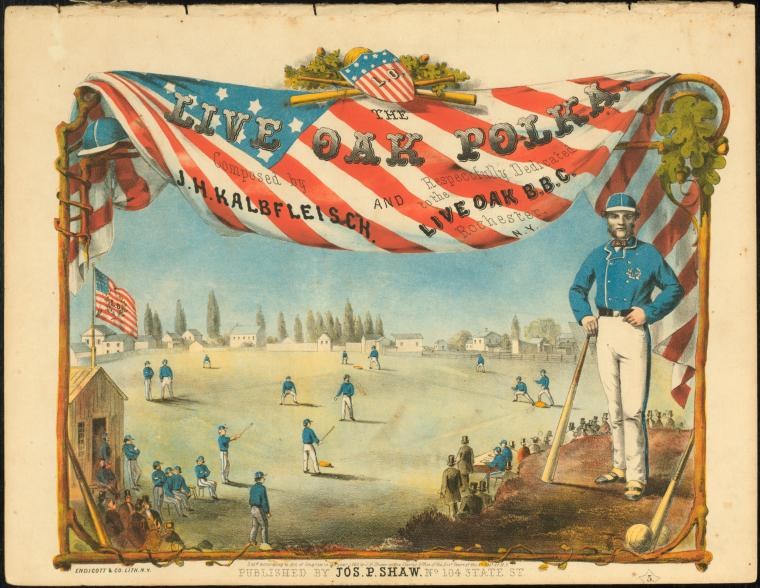
This lithograph depicts a baseball game in progress, not a dance scene. A vast open field with cypress trees lining the horizon stretches across the composition. Multiple players in blue uniforms are scattered across the diamond and outfield in various positions of play. A small grandstand with spectators occupies the left foreground, while a monumental figure of a man in a blue military-style jacket and white trousers stands at right, holding a baseball bat. The figure is so oversized relative to the field that he dominates the composition, appearing almost as a deity or mascot presiding over the game. A decorative ribbon banner at the top of the frame reads "Live Oak Polka" and references to "Kalbfleisch" and "Live Oak Polka" are visible, along with patriotic American imagery including flags and heraldic emblems.
The dancing
The colossal figure at right is rendered in a static, monumental pose: weight centered, legs apart, one arm holding the bat in a relaxed grip. His stance suggests authority and spectation rather than active participation in play. The players on the field are in varied postures — some batting, some fielding, others running — but they are rendered small and distant, emphasizing the symbolic dominance of the giant figure.
The dance depicted
This image does not depict dance. The title 'Live Oak Polka' is misleading; it appears to be a decorative banner or caption applied to a baseball scene, possibly indicating a musical accompaniment, a social event, or a commercial product name. The composition, figures, and activities are entirely devoted to the sport of baseball, not ballroom or folk dance.
How it was made
This is a hand-colored lithograph, a widely circulated commercial print medium of the 19th century. The technique allowed for bright color, moderate detail, and relatively inexpensive mass production, making it ideal for commemorative or promotional sports imagery. The inclusion of decorative heraldic and patriotic elements suggests this was a popular print, possibly commissioned as promotional material or as a souvenir.
About this work
This is a 19th-century lithograph of a baseball game, not a dance work. It has been catalogued in a dance collection, apparently on the basis of its title 'Live Oak Polka,' but the image itself shows no dance activity whatsoever. The work is a valuable document of American baseball culture and sports imagery of the period, with strong patriotic and civic overtones signaled by the flags, heraldry, and monumental figure presiding over the scene. Its presence in a dance archive suggests either a cataloguing error or an intentional gesture toward the polka's cultural place in 19th-century American social life — though no evidence of that connection appears in the image.
How to look at it
Observe the extreme scale disparity between the colossal figure at right and the baseball players, which creates a surreal or allegorical effect. Notice the careful documentation of the game itself — the field layout, player positions, and crowd — rendered in miniature beneath the towering figure. The decorative banner and heraldic elements frame the scene as a civic or patriotic spectacle rather than a simple sports record.
The artist
The artist is not recorded. The print is credited to Jos. P. Shaw, a 19th-century publisher and lithographer associated with American popular prints. The style is consistent with mid-to-late 19th-century American commercial lithography.
The period
This print dates to the late 19th century, a period of rapid expansion in American baseball as a popular sport and in chromolithography as a mass medium. The polka itself was a popular social dance of the era, particularly among German and Central European immigrant communities in America. The incongruity of pairing a polka title with a baseball scene may reflect the commercial mixing of popular cultural forms, or the use of musical or dance names as generic labels for festive or celebratory occasions.
Where it lives
The work is held in the New York Public Library collection. It is catalogued as a lithograph from the late 19th century, though the specific date of publication, printer's marks, and artist attribution remain unclear. The attribution to Jos. P. Shaw appears on the print itself.
Questions about this work
Why is a baseball image in a dance collection?
The title 'Live Oak Polka' suggests it was catalogued on the basis of that phrase, which references a dance genre. However, the image itself depicts baseball, not dance. This may indicate a cataloguing error, or it may reflect how 19th-century commercial prints repurposed or mixed cultural references. The polka was a popular social dance of the period, so the title may have been applied for commercial or associative reasons rather than because the image shows dancing.
Is this a known work by a named artist?
The catalogue record does not attribute authorship. The print shows a credit to Jos. P. Shaw, a 19th-century publisher and lithographer. Without further research, the designer or artist of the composition cannot be confirmed.
What does the giant figure represent?
The colossal man in military dress, holding a bat and dominating the composition, likely represents an allegory of American sport, civic pride, or a specific public figure of the period. His monumental scale and heraldic context suggest he is meant as a symbol or protector of the game, rather than a realistic depiction of a participant.
More Polka artwork