26 works in this view — arrow keys or swipe to move between them.
Dance in Art
Three Bells Polka
Unknown artist
- Dance:
- Polka
- Source:
- Cleveland Museum of Art
- Rights:
- Public domain — free to use, share and adapt.
- Recorded as:
- CC0 (Public Domain)
This object documents the material culture surrounding social dance in the 19th century—specifically, how polka music was packaged, distributed, and consumed in domestic and semi-public settings. The coupling of a pure dance form (the polka) with an entirely unrelated visual narrative (a ship in storm) reveals how music publishing operated as both utilitarian and decorative commerce, with no expectation that cover imagery needed to correspond to the dance itself.
What you are looking at
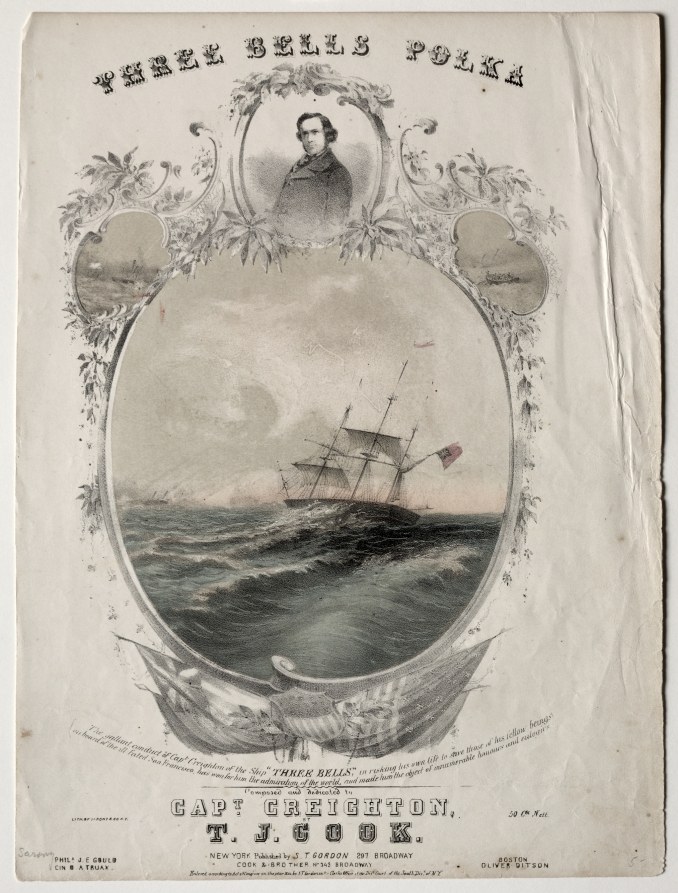
This is a decorative title page or cover for a polka composition, engraved and hand-colored. The central image is framed by an ornate oval border of foliate scrollwork. Within that frame, a full-rigged sailing ship pitches dramatically in rough seas, tilted at a severe angle with waves cresting around its hull. The ship's sails are full but its masts strain against the wind. Above the oval, in the upper margin, sits a small portrait medallion of a man in 19th-century dress—presumably the composer. To either side of the portrait are smaller oval vignettes also depicting maritime scenes: one showing calmer waters, the other a distant shoreline or harbor. The entire composition is rendered in the style of mid-19th-century commercial music publishing, with engraved line work and subtle hand-coloring in grays and blues for the seascape elements. The title "THREE BELLS POLKA" appears prominently at the top in large serif capitals, with credits to the composer "CAPT CRUCHTON, T.S.N." and publication details at the bottom.
The dancing
This work contains no human figures or dancers. The only animate subject is the ship itself, which is rendered as if in violent motion—heeling over dramatically with sails billowed. The composition is entirely architectural and maritime rather than choreographic.
The dance depicted
Despite the title's identification as a polka, this image depicts no dance whatsoever. It is a maritime-themed decorative cover for a musical score. The polka referred to is a ballroom social dance popular in the 19th century, but the visual content has been subordinated entirely to a patriotic or romantic maritime theme, presumably chosen to appeal to audiences interested in naval subjects or seafaring narratives. The connection between the polka as a dance form and this image is purely nominal—the music itself, not shown here, would have contained the dance structure.
How it was made
This is a steel or copper engraving, hand-colored with watercolor or tinted wash, typical of mid-19th-century music publishing. The fine line-work of the engraving provides precise detail in the ship's rigging and the ornamental border, while the hand-coloring adds atmospheric depth to the seascape. This technique was standard for decorative sheet-music covers intended for the parlor market—affordable enough for middle-class domestic consumption yet carrying enough visual authority to appeal to refined taste. The combination of engraving and hand-coloring suggests a print run of some scale, with color applied either stencil-fashion or by hand after printing.
About this work
This is a decorative engraved and hand-colored title page for a polka composition published in the mid-19th century, credited to Captain Cruchton. The polka was a social ballroom dance of enormous popularity during this period, particularly in urban middle-class parlors and dance halls across Europe and America. While the image itself contains no dancers or dance content, it represents an important category of dance-related material: the commercial music publishing industry that sustained the dance culture of the era. Sheet-music covers like this one were visual artifacts of the dance world, circulating through homes and social venues, often chosen for their decorative appeal rather than their literal relevance to the music's content. The maritime theme may have reflected the composer's naval background or simply the tastes of the intended audience.
How to look at it
Observe the compositional logic: the ship is positioned as the dominant visual subject, centrally framed and rendered with technical precision, while the dance form named in the title is entirely absent from the image. This disconnect is characteristic of mid-19th-century commercial publishing, where cover design operated independently of musical content. The ornate border and the inserted portrait medallion follow conventions of sheet-music design intended to confer dignity and collectibility on an otherwise ephemeral commodity. The hand-coloring, if done by different hands, may vary slightly from copy to copy, adding individuality to what was mechanically printed.
The artist
The composer is identified as Captain Cruchton, T.S.N. (likely standing for a naval designation). No other biographical information is provided in the catalogue record. The engraver and colorist are not credited on the visible portions of the image reproduced here.
The period
The polka emerged in Bohemia in the 1830s and spread rapidly across Europe and North America, becoming the dominant ballroom dance of the mid-19th century. Its popularity coincided with the expansion of the music publishing industry and the growth of the middle-class parlor as a site of social dancing. Sheet-music publication became a major commercial enterprise, with millions of copies of polkas, waltzes, and quadrilles printed and distributed. Cover art ranged from simple typography to elaborate allegorical or narrative scenes, often chosen more for general visual appeal than for thematic connection to the music. Maritime and patriotic themes were particularly popular during this period, reflecting Victorian fascination with naval power and exploration.
Where it lives
The work is held in the Cleveland Museum of Art's collection of dance-related art. It is sourced from the collection identified as 'cma' in the catalogue record. As a sheet-music cover, it represents the type of ephemeral printed material that museums have increasingly recognized as important to the visual and material history of dance.
Questions about this work
Why does a polka cover show a ship instead of dancers?
Sheet-music covers in the 19th century were often chosen for decorative appeal rather than thematic relevance to the dance. Publishers selected engaging or fashionable imagery to attract buyers. Maritime scenes were popular motifs during the Victorian era, reflecting public interest in naval affairs, exploration, and Romanticism. The cover would have been judged by its visual appeal in a shop window or parlor, not by literal correspondence to the polka as a ballroom dance.
What was a polka?
The polka is a lively couple dance in duple meter (2/4 time) that originated in Bohemia in the 1830s and became wildly popular in European and American ballrooms from the 1840s onward. It is faster and more energetic than the waltz, characterized by a distinctive hop-step pattern and close partner hold. Millions of polkas were composed and published in the 19th century, making it one of the dominant social dances of the era.
Who was Captain Cruchton?
The catalogue record provides no biographical information beyond the composer's name and apparent naval rank (T.S.N.). Without additional research, his identity and career remain unclear. Many 19th-century composers of popular dances are now obscure, and composers of sheet-music pieces often achieved wide distribution during their lifetime while leaving little historical trace.
How was this printed?
This is an engraving—a metal plate was incised with fine lines to create the image, then inked and printed on paper. The color was then applied by hand or with stencils. Engraving allowed fine detail and was well-suited to the intricate ornamentation and precise lettering required for music-publishing covers. This technique was standard in the mid-19th century before chromolithography became dominant later in the century.
More Polka artwork