49 works in this view — arrow keys or swipe to move between them.
Dance in Art · 2019
Washerwomen dancing
Unknown artist
- Medium:
- Source:
- New York Public Library
- Rights:
- Public domain — free to use, share and adapt.
- Recorded as:
- public_domain
This image is rare evidence of how working-class women actually danced in the 19th century, outside the ballroom or theater. It documents the informal, physical, and communal character of folk dance as lived experience, not as staged performance. For historians of dance, gender, and labor, it offers a visual account of leisure and embodied culture among a population whose movement practices are otherwise poorly documented.
What you are looking at
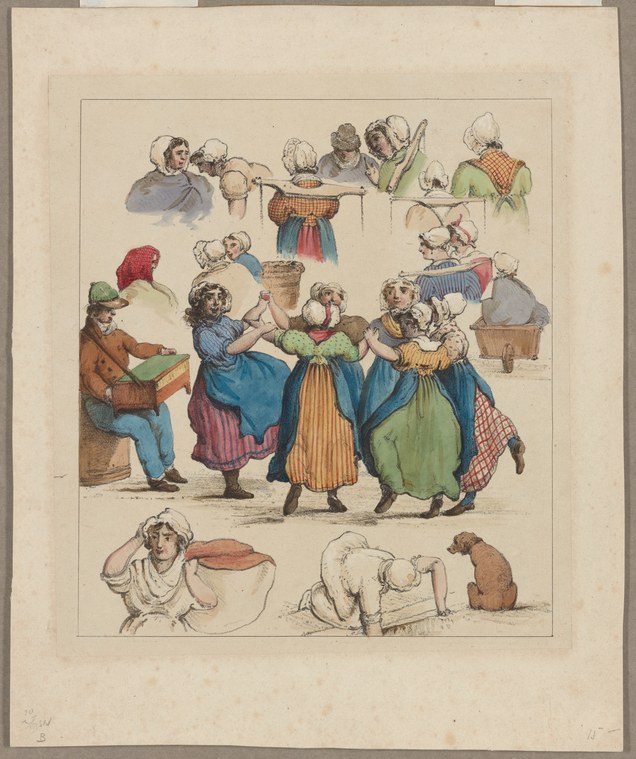
This hand-colored print depicts a lively scene of washerwomen engaged in social dance and play. In the center, four women in full skirts and white caps form the focus: two dance together in animated posture while a third woman (in blue) holds aloft what appears to be a large basket or vessel, and a fourth supports the composition. Around them, additional figures occupy the composition—at top, five women's heads in various white caps and bonnets suggest an audience or participants; at left, a seated man in brown coat and red cap appears to play an instrument or conduct the action; at bottom left, a figure in white drapes gestures expressively; at bottom right, a woman bends forward with a dog beside her. The setting is undefined—no interior walls or landscape details anchor the scene, making this an idealized or generic representation of working-class leisure rather than a specific place. The composition is crowded and joyful, with overlapping figures and a sense of simultaneous activity typical of prints documenting popular customs.
The dancing
The four central dancers show informal, energetic movement. The two dancing women face each other with raised arms and bent knees, their bodies leaning into the motion; their full skirts billow, indicating rapid turning or stamping. No formal ballroom hold is present—this is social, unstructured movement. The woman holding the basket stands with arms raised and extended, her posture emphatic and celebratory rather than graceful. The surrounding figures adopt various attitudes of observation, participation, or expressive gesture, suggesting a moment of collective joy rather than synchronized or trained dance.
The dance depicted
This depicts folk or vernacular social dance among working-class women, most likely German or Northern European in origin based on the costume (white caps, full skirts, the overall aesthetic). The title identifies the dancers as washerwomen—a laboring community—and the dance appears to be an informal social celebration or work-break amusement rather than a ballroom or courtly form. The energy is recreational and communal. The absence of formal steps, holds, or structured patterns suggests improvised movement or traditional folk dance learned through imitation rather than instruction. No specific regional or named dance style is identifiable from the postures alone, but the general character aligns with 19th-century European folk tradition.
How it was made
This is a hand-colored print, likely an engraving or etching given the fine linear detail and the tradition of coloring such works by hand. The technique allows for broad circulation and reproducibility, suggesting this was a popular or commercial image intended for a wide audience—possibly a broadsheet, satirical print, or cultural documentation. The hand coloring is selective and economical: the women's skirts, the man's coat, and key objects receive color while much of the composition remains in line work. This was typical of prints aimed at a market audience rather than wealthy collectors.
About this work
This hand-colored print documents an informal dance scene among washerwomen, capturing a moment of social leisure and collective joy. The work belongs in a dance archive as evidence of how working-class recreation was observed, depicted, and circulated in 19th-century European visual culture. It shows dance not as a professional or courtly practice but as a spontaneous, embodied expression of community and relief from labor—the kind of social dancing that left few other historical records. The composition prioritizes energy and participation over formal beauty, reflecting both the actual practice of folk dance and the print medium's capacity to capture movement and crowd dynamics.
How to look at it
Observe the contrast between the formal, contained poses of trained dance (which were familiar from courtly or ballroom imagery) and the expansive, weight-forward postures of these figures. Note how the raised arms, bent knees, and outward lean of the dancing women suggest energy and momentum rather than balance or grace. Look at the surrounding figures—their varied gazes and gestures create a sense of shared participation rather than audience distance. The woman with the raised basket is not a dancer but part of the celebration, suggesting that the boundary between dancer and participant was fluid in this social context.
The period
This print likely dates to the 19th century, when hand-colored prints and engravings were the primary medium for circulating images of popular customs and social life. European print culture of this period produced many images of folk festivals, work celebrations, and scenes of communal leisure—often with an ethnographic or satirical intent, capturing the dress, customs, and character of rural or working-class life for urban audiences. Dance was a frequent subject in such prints, as it combined visual dynamism, social interest, and the appeal of costume. The emphasis on washerwomen as a subject reflects the print tradition's interest in occupational types and their associated customs.
Where it lives
This work is held in the New York Public Library collection and is catalogued as a print. The catalogue record provides no artist attribution, date, or detailed provenance.
Dance in this work
Questions about this work
What is a washerwoman and why were they depicted dancing?
Washerwomen were women (often poor or working-class) who laundered clothes for others as paid labor. They were a recognizable occupational type in European cities and villages. Prints often depicted occupational groups at leisure or celebration, and the physical exertion of washing work made these women associations with physical vigor and bodily freedom—qualities that made them visually interesting subjects for prints about popular amusements and folk customs.
Is this a specific named dance?
No. The movement shown is too informal and varied to represent a named dance form like a quadrille or minuet. This appears to be social, improvisational, or traditional folk dancing learned through participation rather than instruction. The specific regional identity of the dance (if any) cannot be determined from the print alone.
When and where was this made?
The catalogue record does not provide a date or place of origin. The style, technique, and costume suggest a 19th-century European origin, most likely German or Northern European based on the visual character, but this cannot be confirmed without additional research.
More dance artwork