49 works in this view — arrow keys or swipe to move between them.
Dance in Art
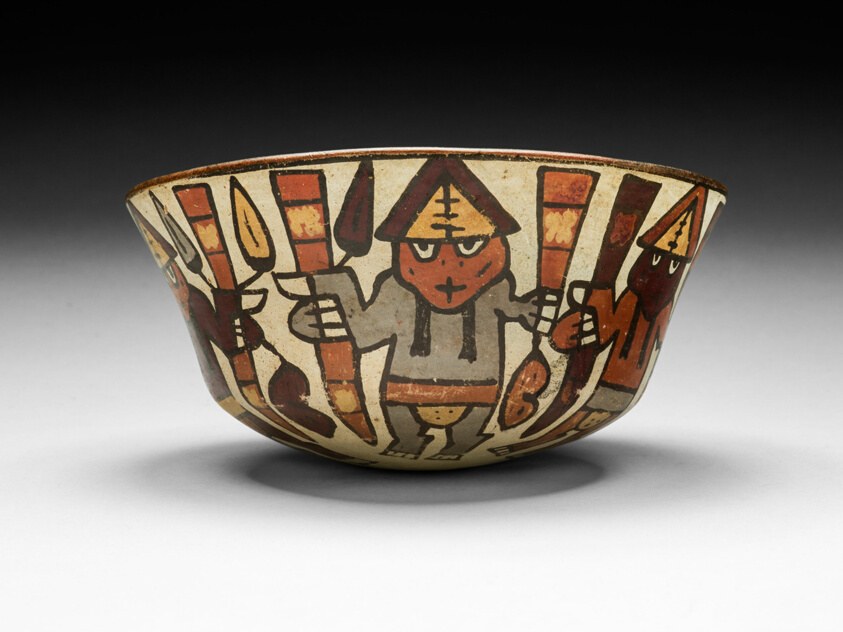
Bowl Depicting a Harvest Dance
Nasca
- Source:
- Art Institute of Chicago
- Rights:
- Public domain — free to use, share and adapt.
- Recorded as:
- CC0 (Public Domain)
This is one of the few surviving direct visual records of pre-Columbian Mesoamerican ceremonial dance. It demonstrates that harvest rituals were choreographed, communal performances led by priests or elders, and were significant enough to merit inclusion in the material culture of functional pottery. For dance historians, it provides material evidence of form, grouping, and ritual context otherwise known only through written sources and ethnographic reconstruction.
What you are looking at
A ceramic bowl depicts a harvest celebration rendered in the distinctive style of pre-Columbian Mesoamerican pottery. The composition is organized in horizontal registers around the vessel's interior. At the center stands a figure with a distinctive pointed or pyramidal headdress marked with a cross motif, rendered in terra cotta and dark brown pigment against a cream ground. This central figure holds objects in both hands—possibly tools, weapons, or ritual objects—and is flanked symmetrically by repeated motifs of geometric shapes, stepped forms, and abstract human figures in profile. The surrounding registers contain stylized figures rendered in a linear, hieroglyphic style, alternating with geometric patterns of rectangles, triangles, and parallel lines in orange-brown and dark brown. The entire interior surface is densely patterned, suggesting continuous narrative or ritual sequence rather than a single moment. The figures appear to move in procession or coordinated action around the bowl's circumference.
The dancing
The central figure stands upright with arms extended outward, holding what appear to be implements or ceremonial objects. The body is rendered frontally with a columnar torso and simplified anatomy typical of Mesoamerican conventions. Flanking figures are shown in profile with bent knees and dynamic postures suggestive of active movement—some appear to leap, stride, or crouch. The repeated human forms around the bowl's surface maintain consistent proportions and pose types, suggesting a choreographed group action rather than individualized dancers. The geometric forms interspersed among the figures may represent architectural elements, offerings, or abstract markers of sacred space.
The dance depicted
This appears to depict a ceremonial harvest or agricultural ritual dance, based on the title attribution and the organized, processive arrangement of figures around the vessel. Such ceremonies were central to Mesoamerican religious and seasonal practice, performed by communities to ensure crop fertility and give thanks. The symmetrical organization and repeated figure-types suggest a group performance with standardized movements, possibly performed by multiple dancers or a single dancer repeated in sequential poses. The central figure's distinctive headdress and ritual objects identify it as a leader or priest directing or embodying the ceremony. Without additional documentation, the specific style cannot be narrowed further, but the formal, processional arrangement and sacred context indicate this was a organized communal or priestly performance rather than social dance.
How it was made
This is a ceramic vessel, likely a drinking bowl or ceremonial container, made by hand-coiling and burnished. The decoration was applied after firing or during leather-hard stage using slip-painted or incised techniques in iron oxide pigments (creating the orange-brown and dark brown colors) on a cream or buff slip ground. The bold linear style and dense compositional packing are characteristic of Mesoamerican ceramic painting traditions, where narrative and symbolic content were encoded densely across vessel surfaces. The bowl's form and decoration suggest it was a functional object used in daily or ceremonial contexts, making it a primary source for understanding dance practices rather than a display piece.
About this work
This ceramic bowl preserves a direct visual record of pre-Columbian ceremonial dance, showing a harvest ritual organized around a central priest or leader figure surrounded by participant dancers in stylized, repeated poses. The dense, organized composition treats the vessel's interior surface as a continuous field for narrative, a convention in Mesoamerican pottery that allowed artists to depict group performances and ritual sequences. Such vessels, used in dining or ceremony, made dance imagery part of daily material culture and suggest that harvest celebrations were sufficiently important and formalized to warrant artistic documentation.
The work matters to dance history because it is among the very few surviving visual documents of pre-Columbian American dance practice. It shows that ceremonial dance was organized, repetitive, and led by figures in ritual regalia—providing concrete evidence for the structure and performance context of these practices, which otherwise survive only in fragmentary Colonial-era written accounts and ethnographic analogy.
How to look at it
Trace the central figure and observe how the surrounding figures mirror and repeat its pose and implement-holding gesture—this repetition conveys the choreographed nature of the ceremony. Notice the headdress and objects held by the central figure, which distinguish it as a leader or priest; the surrounding figures lack these markers and appear as participants or performers. The geometric patterns interspersed among the figures may represent architectural spaces, offerings, or abstract markers of sacred geography. The arrangement around the bowl's circumference creates a processional or circular movement pattern, suggesting the dance moved in continuous cycle around a space or ceremonial center.
The period
This bowl was made in the pre-Columbian era, most likely in the Classic or Post-Classic period of Mesoamerican civilization (roughly 300–1521 CE), when ceramic vessel painting reached high levels of sophistication and narrative complexity. Harvest ceremonies and agricultural fertility rituals were central to Mesoamerican religious practice, reflecting societies whose survival depended on maize cultivation. Such rituals involved coordinated group performance, often led by priests in elaborate costume and regalia, and were believed to maintain cosmic and agricultural order. The formalization and repetition visible in this image reflects the highly structured nature of Mesoamerican religious practice.
Where it lives
The bowl is held by the Art Institute of Chicago. It is recorded in the collection as a pre-Columbian ceramic vessel with the title 'Bowl Depicting a Harvest Dance,' though the specific archaeological provenance, culture, and date of creation are not documented in the available catalogue record.
Dance in this work
Questions about this work
How do we know this depicts a harvest dance and not another ritual?
The title attribution in the Art Institute of Chicago's record identifies it as a harvest dance. The formal, processional arrangement of figures and the central leader figure are consistent with documented harvest ceremonies in Mesoamerican cultures. However, without archaeological context, iconographic analysis, or comparative documentation, the specific ritual purpose cannot be confirmed from the image alone.
What culture made this bowl?
The catalogue record does not specify the culture or region of origin. The style is consistent with pre-Columbian Mesoamerican ceramic painting traditions, likely from central Mexico or the Maya region, but the exact origin cannot be determined from the image alone.
Was this bowl actually used, or was it made as an artwork?
The form and style suggest it was a functional vessel used for drinking or serving in daily or ceremonial contexts. In Mesoamerican cultures, the distinction between functional and decorative objects was fluid; vessels with complex narrative decoration were both used in ceremonies and served as permanent records of ritual practices.
How many dancers are shown, and are they the same person repeated?
The composition uses repeated figure-types arranged in registers around the bowl, which is characteristic of Mesoamerican narrative technique. It likely depicts either a single dancer shown in sequential poses, or multiple dancers performing coordinated, identical movements. The repetition conveys the standardized, choreographed nature of the ceremony rather than individualized performers.
More dance artwork