32 works in this view — arrow keys or swipe to move between them.
Dance in Art
Quadrille from The Green Bushes
Buckstone, J.B.
- Dance:
- Quadrille
- Source:
- Victoria and Albert Museum
- Rights:
- Rights vary by item — check the source record before reusing this image. Source record ↗
- Recorded as:
- Check V&A creditLine
While it contains no dance, this print is historically valuable as evidence of how 19th-century theatrical productions were marketed and consumed through illustrated prints, and as a record of a now-obscure but popular play. For dance historians, it exemplifies the theatrical context in which social dances like the quadrille were woven into dramatic narratives—though the dance itself is absent from this particular image.
What you are looking at
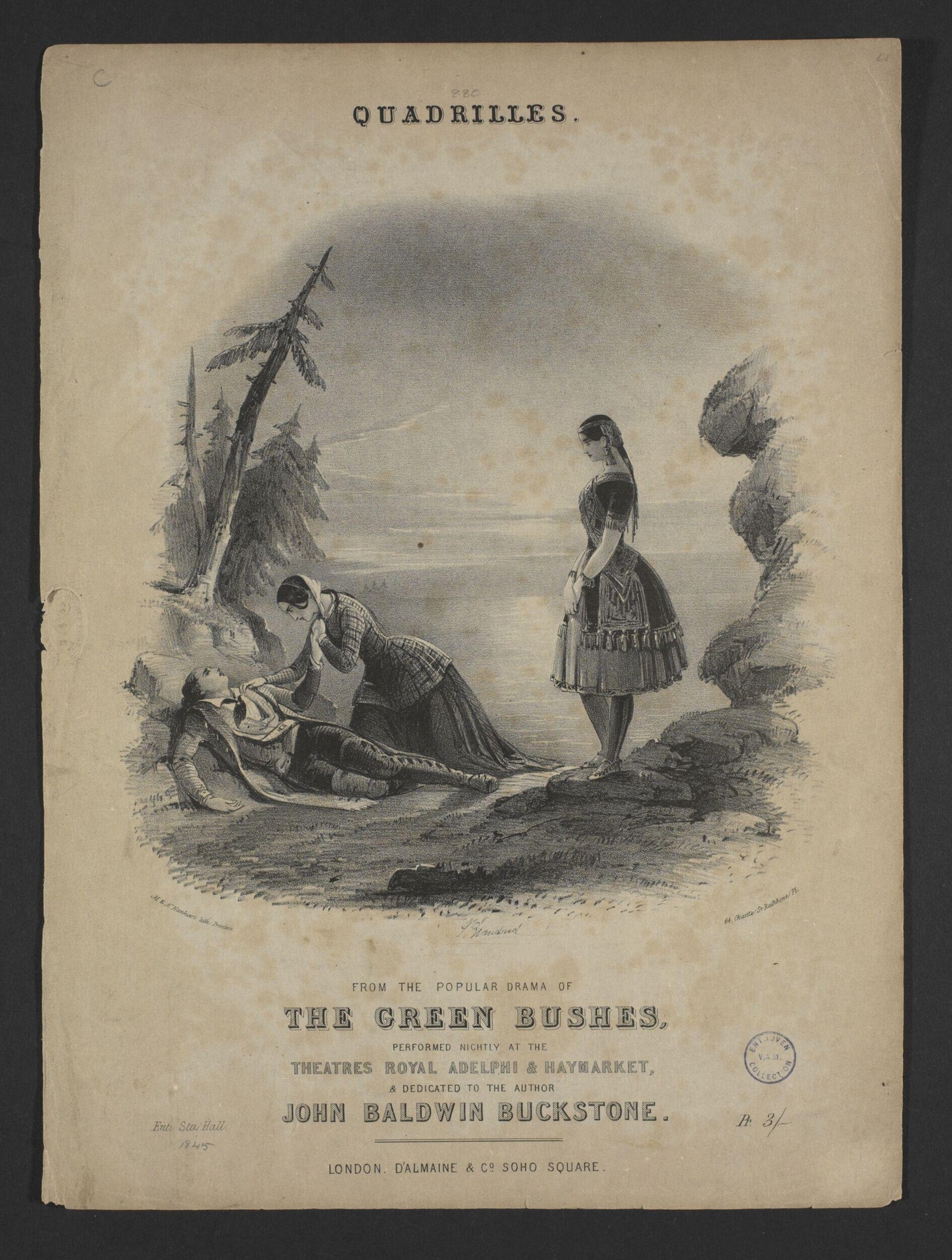
A dramatic woodland scene depicts a moment from *The Green Bushes*, a popular 19th-century theatrical melodrama. In the foreground, a woman in a dark dress kneels beside a recumbent male figure, cradling his head and upper body with evident concern. To the right stands a younger woman in a pale dress with an ornate, pleated skirt, observing the scene. The setting is framed by sparse trees and rocky outcrops rendered in soft shading; the background recedes into hazy distance. The lighting is naturalistic and diffuse, emphasizing the emotional intensity of the moment rather than theatrical spectacle. This is a narrative pause rather than a dance scene—a tableau vivant capturing the plot rather than the choreography.
The dancing
The kneeling woman's body forms a protective arc over the prone male figure, her posture expressing maternal or romantic solicitude. Her companion stands at a measured distance, her weight evenly distributed, her silhouette upright and watchful. Neither figure is in motion or dance position; both are oriented toward the human drama of the moment. The composition reads as theatrical pantomime—the vocabulary of gesture and stillness that communicates narrative to an audience—rather than social or theatrical dance.
The dance depicted
This engraving does not depict dance, despite its association with a theatrical work. It illustrates a plot moment from *The Green Bushes*, performed at the Theatres Royal Adelphi and Haymarket, likely during the 1840s–1850s when the play was in the London repertoire. The quadrille format listed in the title and catalogue is puzzling: it may refer to a decorative arrangement of theatrical images, or to a suite of prints from the play. No choreography, hold, or movement vocabulary of any ballroom dance is visible. The image captures the narrative vocabulary of Victorian melodrama—gesture, stillness, and spatial relationship as plot carriers—rather than the social or stage dances that might have featured in the original production.
How it was made
This is an engraving (or steel engraving), recognizable from the fine parallel and cross-hatched lines used to model form and shadow, the sharp linear detail, and the sepia-toned printing on laid paper typical of mid-19th-century theatrical illustration. The technique allowed for high-volume reproduction and distribution to theatregoers and the illustrated press, reaching middle-class audiences who wanted visual souvenirs of popular plays. The image bears a signature (possibly "H. Melville" or similar) and is published by Dalmaine & Co. of Soho Square, a London theatrical print house. The practice of printing scenes from successful plays was central to theatrical commerce and marketing in this period.
About this work
This engraving illustrates a dramatic moment from John Baldwin Buckstone's theatrical melodrama *The Green Bushes*, a play that achieved significant popularity in mid-19th-century London. Although catalogued as a quadrille—possibly as part of a multi-image suite—it does not depict dance but rather a narrative tableau from the plot: a moment of emotional crisis in which a woman tends to an injured or dying man while a companion watches. The work belongs to a large body of theatrical illustration created for popular consumption, functioning as advertisement and souvenir rather than artistic statement. It documents the conventions of Victorian melodramatic gesture and the visual language through which plots were communicated to stage and print audiences.
How to look at it
Read this as a theatrical scene-painting rather than a dance image: attend to the spatial arrangement of the three figures and the use of distance and landscape to frame emotional relationship. The kneeling woman's protective posture and the standing woman's witness create a narrative hierarchy. The artist has chosen a moment of stasis and revelation—the kind of 'pointed' tableau that Victorian theatre audiences recognized as a signal of emotional or plot significance. The engraving technique's fine detail allows the viewer to read the quality of cloth and emotion simultaneously.
The artist
John Baldwin Buckstone (1802–1879) was a prolific English playwright, actor, and theatre manager best known for melodramas and farces written for popular audiences. *The Green Bushes* (first performed 1835) was among his most successful works. The engraving itself is likely the work of a commercial print-shop engraver; the signature may indicate the designer or engraver but is not fully legible. Buckstone's plays were frequently illustrated in this manner for theatrical promotion and circulation.
The period
This print dates to the heyday of Victorian theatrical melodrama and the mass circulation of theatrical imagery through the illustrated press (c. 1840s–1850s). The quadrille, the Waltz, and the Polka were fashionable ballroom dances during this period, and often appeared as scenes in theatrical productions. However, this particular image captures narrative gesture rather than choreography, reflecting the dominance of plot and emotion in melodramatic theatre. The practice of publishing and selling theatrical prints was a major part of theatre's cultural economy, allowing plays to reach audiences beyond the playhouse and creating a secondary market in theatrical ephemera.
Where it lives
This print is held in the Victoria and Albert Museum collection. It is published by Dalmaine & Co., Soho Square, London, a mid-19th-century publisher specializing in theatrical prints. It belongs to a broader category of theatrical illustration—commercial prints created for actors, playgoers, and theatrical fans, functioning as advertisement, souvenir, and documentary record simultaneously.
Questions about this work
Why is this called a quadrille if it doesn't show a dance?
The catalogue title may refer to a four-part suite of theatrical prints from *The Green Bushes*, or it may be a cataloguing error. Quadrille could also indicate a decorative arrangement of images. The print itself depicts a narrative moment, not choreography.
What play is this from?
*The Green Bushes* (1835) is a melodrama by John Baldwin Buckstone, performed regularly at major London theatres through the mid-19th century. It was a popular but now largely forgotten work, preserved primarily through theatrical prints and playtexts.
Is there any actual dancing shown anywhere in this print?
No. The image captures a plot moment—a woman in distress tending to an injured or dying man—using the vocabulary of pantomime and theatrical gesture rather than dance. Any dances in *The Green Bushes* would have been separate scenes, not this one.
More Quadrille artwork