43 works in this view — arrow keys or swipe to move between them.
Dance in Art · 2019
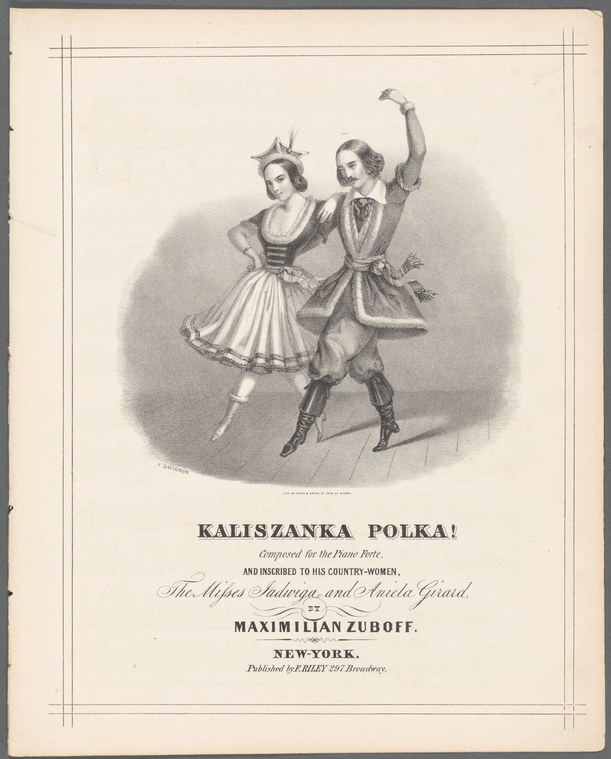
Kaliszanka polka!
Unknown artist
- Medium:
- Lithograph
- Dance:
- Polka
- Era:
- Late 1800s (Victorian Ballroom)
- Source:
- New York Public Library
- Rights:
- Public domain — free to use, share and adapt.
- Recorded as:
- public_domain
The Kaliszanka represents a specific regional Polish polka tradition and documents how such dances were performed, taught, and marketed to diaspora communities in America. The image preserves posture, costume, and partnership conventions that might otherwise be lost to verbal description alone. For historians of Polish-American culture, folk dance transmission, and the commercialization of ethnic performance in the 19th century, this lithograph is primary visual evidence.
What you are looking at
A lithographed promotional image for the Kaliszanka polka, a Polish regional dance. Two dancers occupy the center of the composition against a plain background with subtle shading that gives depth without spatial detail. The male dancer, on the right, wears a dark tailcoat with a decorative vest, tall boots, and what appears to be a military or formal jacket. He is captured mid-leap or mid-turn, his right arm raised high above his head in a flourish, his body angled dynamically. The female dancer, positioned to his left and slightly forward, wears a full-skirted white dress with horizontal decorative bands or trim at the hem, and a decorated headdress or crown. Her posture is more contained than his, her arms positioned in a ballroom frame, though she too appears to be turning. The composition emphasizes the contrast between the restrained elegance of her silhouette and the exuberant display of his movement. The lithographic technique creates soft tonal gradations in the background, while the figures are rendered in sharp detail.
The dancing
The male dancer dominates the image through his raised arm and lifted leg position, suggesting a moment of aerial projection or a decorative flourish characteristic of folk male display. The female dancer maintains a closed-position frame typical of ballroom partnership, her weight apparently centered, her skirt spread in the characteristic bell shape of the period. Their bodies are in contact or very close contact, suggesting a partner dance rather than a side-by-side progression. The gap between them and the contrast in their physical expression—his vertical exuberance, her more grounded demeanor—may reflect gender conventions in the performance of this regional dance.
The dance depicted
This is the Kaliszanka, a polka variant from the Kalisz region of Poland, documented here in a New York publication for immigrant or diaspora audiences. The inscription identifies it as performed or dedicated to country-women, suggesting this was a piece of ethnic cultural promotion aimed at Polish Americans in the late 1800s. The male figure's raised arm and dynamic posture align with the exuberant character of the polka family—a springing, bouncing step—while the female dancer's fuller skirt and more reserved frame reflect the ballroom conventions of the Victorian era. The dance would have been social or theatrical in context, likely performed in halls and public spaces where Polish-American communities gathered.
How it was made
The work is a lithograph, a technology that allowed rapid reproduction and mass distribution of popular dance images in the 19th century. The technique is evident in the soft gradations of gray tone in the background and the crisp rendering of the dancers' outlines and dress details. Lithography was the dominant method for producing promotional and instructional dance imagery in this period, cheaper and faster than engraving and suitable for commercial printing runs. The New York publisher (Riley at Broadway address) issued this as a piece of commercial sheet music or dance instruction material, making it a document of immigrant performance culture and the commodification of folk dance in American cities.
About this work
This is a promotional lithograph for the Kaliszanka polka, a Polish regional dance, issued in New York in the late 1800s for performance or instruction among Polish-American communities. The image records not only the dance itself—its posture, frame, and character—but also its place in the social and theatrical life of urban America. The inscription emphasizes the dance as belonging to 'country-women,' suggesting it carried ethnic and gender significance as a marker of Polish cultural identity. It sits at the intersection of folk tradition, diaspora culture, and the commercial entertainment industry that transformed regional European dances into ballroom and theatrical attractions in American cities.
The work belongs in a gallery of dance art as evidence of how immigrant communities maintained and performed their cultural practices, and how the popular music and dance industry documented and commodified those practices. The lithographic technique itself—rapid, reproducible, mass-market—reflects the machinery of 19th-century cultural distribution. A viewer today can see in this image not only a moment of physical performance but a moment in the long history of dance as a marker of national and ethnic identity.
How to look at it
Attend to the moment chosen: the male dancer at the apex of a jump or turn, his arm at the height of a flourish, while the female remains more grounded. This choice—freezing the male at a moment of maximum display—reflects both the character of the polka (a springing, bouncy dance) and the gender conventions of the period, in which male display and female restraint were culturally coded. Notice the dress: the female's full skirt caught mid-turn, the male's military-style tailcoat and tall boots, both marks of respectability and ethnic pride. The soft background and sharp rendering of the figures are typical of commercial lithography, designed to print clearly and multiply easily.
The artist
The artist is not recorded. The work was published by Riley at Broadway in New York, a commercial music and dance publisher serving the immigrant populations of the city. The inscription credits composition to Maximilian Zuboff, suggesting a composer (possibly Russian or Eastern European) writing for the American market. Zuboff's identity and other works are not established in available records.
The period
The polka was among the most popular couple dances of the 19th century, spreading from Central Europe across America and Europe in waves of enthusiasm. By the 1880s–1890s, regional variants like the Kaliszanka were being codified, named, and published for both instruction and entertainment. In New York, waves of Polish immigration created demand for performance and instruction in traditional dances, and commercial publishers like Riley capitalized on this market by issuing printed scores and promotional images. The lithographic technique and the format of the inscription—dedications to named dancers—suggest this was part of a larger apparatus of dance publicity and instruction that served both theatrical performance and social dance practice.
Where it lives
The work is held in the New York Public Library's collection, catalogued as a late-19th-century dance lithograph. It was issued by Riley (music and dance publisher) at a Broadway address in New York, indicating it was produced for the urban immigrant market.
Dance in this work
Questions about this work
What is a Kaliszanka?
The Kaliszanka is a regional polka variant from Kalisz, a city in Poland. Like other polkas, it is a springing, bouncy couple dance in 2/4 time. Regional variants of the polka were common across Central and Eastern Europe, each with local characteristics in footwork, arm position, and style. This particular variant was performed and promoted among Polish-American communities in cities like New York.
Who was Maximilian Zuboff?
Zuboff is credited as the composer of this piece. Beyond that, little is established: he may have been Russian, Polish, or another Eastern European nationality, writing for the American immigrant market. His other works and biography are not documented in readily available sources.
Why does the male dancer have his arm raised so high?
The raised arm is a display gesture, characteristic of the polka and other folk dances from Central and Eastern Europe. It emphasizes the bouncing, exuberant character of the dance and is a moment of masculine display within the partnership. The male's physical expression is more overtly energetic than the female's, reflecting both the dance's actual movement qualities and the gender conventions of Victorian ballroom performance.
Was this for dancing or for theatrical performance?
Likely both. The inscription suggests this was performed or dedicated to community members, and the publication as sheet music indicates it could be used for both social dance instruction and theatrical performance. In the 19th century, the boundary between social and theatrical dance was fluid, especially in immigrant communities where public performances often served social functions.
More Polka artwork