41 works in this view — arrow keys or swipe to move between them.
Dance in Art · 2019
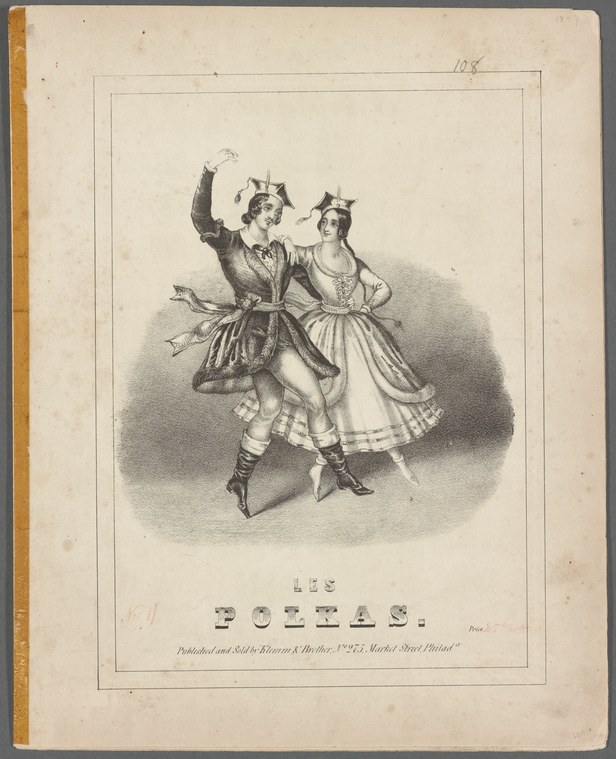
Les polkas
Unknown artist
- Medium:
- Lithograph
- Dance:
- Polka
- Era:
- Late 1800s (Victorian Ballroom)
- Source:
- New York Public Library
- Rights:
- Public domain — free to use, share and adapt.
- Recorded as:
- public_domain
The polka was a revolutionary dance in its time: faster, more playful, and more accessible than the formal court dances it challenged, and it marked a shift toward dances driven by a younger generation and middle-class participation rather than aristocratic tradition. This image captures that energy in the bodies and expressions of the dancers, making it a primary document of how the dance actually looked in practice, not merely how it was described in written dance manuals.
What you are looking at
A lithograph depicting two dancers in mid-performance, captured in a moment of energetic interaction. The figure on the left, wearing a dark jacket with a white collar and plaid or checked stockings, has one arm raised dramatically while the other gestures outward; the dancer leans into the movement with visible momentum. The figure on the right wears a lighter dress with a full skirt and a decorative headdress or crown, and meets the left figure in what appears to be a playful or flirtatious engagement. Both dancers wear heeled shoes suitable for the period. The composition is set against a soft, shadowed background that emphasizes the figures through subtle tonal variation. The lithographic technique creates a warm, slightly grainy surface that captures the energy of the moment without photographic detail.
The dancing
Both dancers are upright and energetically posed rather than in a formal closed hold. The left figure's raised arm and forward lean suggest vigorous movement or a turning gesture, while the right figure's more composed stance and angled posture suggest responsiveness to a partner's lead. The dancers' positioning and arm gestures indicate a spirited, playful interaction rather than the rigid posture of a formal ballroom frame. The heeled footwear visible on both figures is consistent with period dance shoes.
The dance depicted
This is identified as a polka, a central European dance that became enormously popular in Victorian ballrooms during the mid-to-late 1800s. The polka is characterized by quick, bouncing steps in 2/4 time, typically danced by couples in a closed or semi-closed hold with a characteristic hop-and-step rhythm. The energetic posture and animated gestures of both figures align with the liveliness of the dance, which was known for its exuberance and speed compared to the measured waltzes that dominated earlier in the century. The plaid or tartan-patterned stockings on the left figure may suggest a Scottish or Celtic variation or influence, though polka itself originated in Bohemia.
How it was made
This is a lithograph, a technique allowing the artist to work on a stone or metal plate with a greasy crayon or ink, creating an image that could be reproduced in quantity. Lithography was the dominant method for distributing popular imagery and theatrical scenes during the Victorian era, making polka dance prints accessible to middle-class households. The soft tonal gradations and ability to capture movement through varied line weight made lithography ideal for dance imagery. The technique's relative affordability meant such prints were produced in significant numbers and reached a wide audience.
About this work
This is a popular print documenting the polka, one of the defining social dances of the Victorian ballroom. The work captures the dance in a moment of evident joy and physical engagement, showing how it was performed by couples of the period. As a lithograph from the New York Public Library collection, it is part of the visual record of 19th-century American social dance and the European dances that shaped it. The print's very existence—and its survival in an institutional collection—attests to the polka's significance in the cultural life of the time, when such imagery was both entertainment and a form of instructional reference for those learning the dance.
How to look at it
Notice the moment the artist chose: not a static pose but a moment of dynamic exchange, with the left figure's raised arm and forward lean suggesting a turn or a lift into the air—characteristic of the polka's bouncing, hopping quality. The right figure's orientation toward the left figure and the slight tilt of their frame suggest responsiveness and play rather than the formal alignment required by a waltz. Look at the heeled shoes on both figures: these are not the flat shoes of everyday wear but the specialized footwear of ballroom dancing, which facilitated the ball-of-the-foot landing that gave the polka its distinctive rhythm.
The period
The polka emerged in Bohemia in the 1830s and spread rapidly through Europe and North America during the 1840s and 1850s, arriving in the United States just before the American Civil War. It coincided with a broader democratization of dance: the waltz had already broken ranks by allowing couples to embrace in a closed position, but the polka pushed further by celebrating speed, informality, and a kind of playful courtship rather than formal decorum. By the 1870s and 1880s, when this print was likely made, the polka was an established part of the Victorian ballroom repertoire, danced at public balls, private parties, and social gatherings. The period saw a flourishing of dance instruction manuals and popular prints depicting ballroom scenes, all aimed at the expanding middle class learning to navigate social dance.
Where it lives
The work is held by the New York Public Library, part of a broader collection of dance-related prints and imagery from the 19th century. Such prints were produced for commercial distribution and popular consumption, making them documents of mainstream taste and social practice rather than rare or elite artworks.
Dance in this work
Questions about this work
Why are the dancers wearing plaid stockings?
The plaid or tartan pattern may reflect the influence of Scottish or Celtic dance traditions, which were popular in Victorian culture, or it may simply be a fashionable pattern of the period. Alternatively, it may indicate a specific regional or theatrical version of the polka. The catalogue record does not specify, and the artist is not identified.
Is this a real couple or a staged scene?
The print is almost certainly a stylized or idealized representation rather than a portrait of actual dancers. The lithographic technique and the composition suggest it was created as a popular print for distribution, meant to represent the polka as a type or idea rather than to document a specific performance or moment.
How do I know this is a polka and not another dance?
The title reads 'Les Polkas' at the bottom of the print. The energetic, bouncing posture, the loose couple connection, and the visible joy in the figures' gestures all align with what we know of the polka's character from written sources and other dance imagery of the period, distinguishing it from the more formal frame of a waltz or the measured step of a quadrille.
Why is this print in a dance collection?
Popular dance prints like this one served multiple purposes in the 19th century: they were entertainment and decoration for the home, they functioned as instructional aids or visual references for those learning the dances, and they reflected the social values and leisure pursuits of the middle class. They are now primary historical documents of how people actually danced and what they valued about dance.
More Polka artwork