40 works in this view — arrow keys or swipe to move between them.
Dance in Art
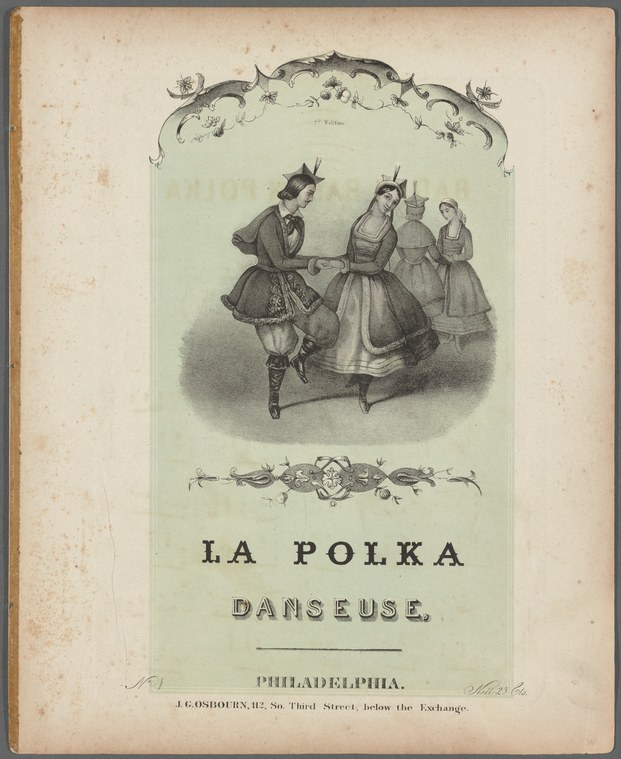
La polka danseuse
Unknown artist
- Medium:
- Lithograph
- Dance:
- Polka
- Era:
- Late 1800s (Victorian Ballroom)
- Source:
- New York Public Library
- Rights:
- Public domain — free to use, share and adapt.
- Recorded as:
- public_domain
For dancers and historians of nineteenth-century social dance, this print is primary evidence of how the polka was actually performed—the height and timing of the characteristic jump, the engagement and frame between partners, and the full participation of women as active dancers rather than ornamental figures. It also documents the print culture through which dance knowledge circulated in the era before film, showing that ballroom dance was considered worthy of the same mass-market publication as theatrical performance.
What you are looking at
A lithograph depicting a lively moment from a polka dance in what appears to be a Victorian-era ballroom or social gathering. In the foreground, a couple dominates the composition: a man in dark tailcoat and knee breeches executes an energetic leap or jump, his left leg extended high and bent at the knee, while a woman in an elaborate light-colored dress with a full skirt and decorative headdress faces him in an engaged posture. The woman wears her hair up with what appears to be a feathered ornament or tiara. Behind them, two additional female figures in similar period dress observe or wait to dance, creating a sense of social event and anticipation. The setting is rendered with soft tonal shading that creates depth; the figures emerge from a neutral background with careful attention to the volume and movement of the dancers' clothing. A decorative rococo-style frame with scrollwork and floral elements surrounds the central image, suggesting this is a published print or theatrical poster. The title "LA POLKA DANSEUSE" appears prominently below in serif capitals.
The dancing
The male dancer's body is in a clear aerial phase—both feet are off the ground in a high, energetic jump with knees bent and legs tucked, demonstrating the dynamic, bouncy characteristic of polka. His upper body leans slightly forward in an engaged posture toward his partner. The female dancer stands with her weight centered, her full skirt splayed outward, and her posture alert and receptive to her partner's movement. The couple appears to be in a close social hold or at least in immediate proximity, typical of couple dances of the period. The other two women are stationary, dressed identically, suggesting they are either next in the rotation or spectators to this display of energetic dancing.
The dance depicted
This is unquestionably a representation of the polka, the popular Central European couple dance that swept through ballrooms across Europe and North America in the mid-nineteenth century. The title confirms this, as does every visual element: the characteristic high bounce and bent-knee jump of the male dancer, the woman's full skirt responding to rotation and movement, the couple relationship, and the formal Victorian ballroom setting. The polka is distinguished by its 2/4 time signature and its lively, hopping character—precisely what the artist has captured in the freeze-frame of the male dancer's leap. The presence of waiting dancers suggests this is a social event where the polka was one dance among several offered in an evening's entertainment.
How it was made
This is a hand-colored or tinted lithograph, as indicated in the catalogue record. The soft tonal qualities visible in the shading of the figures and the background, along with the careful rendering of the rococo frame, are characteristic of lithographic printing. The technique allowed for the mass production of theatrical and social prints, making this an affordable image for domestic consumption, circulation as a popular print, or use as promotional material for dance instruction or social events. The decorative framing and title treatment suggest this was published as a standalone print or theatrical poster, likely from a music publisher or theatrical printer in Philadelphia, as noted in the imprint information.
About this work
This lithograph is a vivid document of Victorian social dance culture, specifically the polka craze that dominated ballrooms in the 1850s–1870s. It captures not merely the appearance of the dancers but the kinetic character of the dance itself—the explosive, bouncy energy that made the polka so popular and so modern for its time. The image serves both as a record of how the polka was performed and as a window into how dance was circulated, consumed, and celebrated in popular culture. Published as an affordable print, it would have reached both dancers seeking instruction and spectators curious about fashionable society.
The work belongs in a history of dance because it does something many dance images fail to do: it freezes a genuinely informative moment. The male dancer's body in mid-leap tells us something true about how the polka was danced—not a stylized or generalized gesture, but a specific, credible moment in the movement vocabulary.
How to look at it
Notice the precise moment the artist chose: not a generic ballroom scene, but the male dancer captured at the apex of his jump, legs bent, weight momentarily suspended. This is the moment of maximum energy and visibility—exactly the pose a dancing master would use to teach or promote the characteristic "hop" of the polka. Observe also how the artist has rendered the female dancer's skirt, with its full volume and the suggestion of motion even though her feet are grounded. This attention to how fabric moves with the body is characteristic of good dance illustration. The two waiting figures in the background establish the social context—this is not a private moment but a public performance within a ballroom event.
The period
The polka emerged in Bohemia in the 1830s and spread across Europe with extraordinary speed, reaching Paris by 1840 and London and New York by the mid-1840s. By the 1850s, when this print was likely made, it was the dominant couple dance of the ballroom, having largely displaced the waltz and quadrille in popularity among younger dancers. Its appeal lay in its relative simplicity, its energetic character, and its departure from the formality of earlier ballroom conventions. The mid-nineteenth century saw an explosion in the publication of dance prints, sheet music covers, and theatrical imagery; dance instruction was increasingly available through print media, and social dances were promoted and codified through commercial publication. In American cities like Philadelphia, where this print was published, the polka was a marker of fashionable society and was danced by all social classes, though this image targets the middle to upper-middle class viewer.
Where it lives
The print is held in the New York Public Library collection and was published in Philadelphia by J. Cosbourne, 113 North Third Street, below the Exchange. The imprint and format identify it as a commercial print product, likely sold through music publishers or print dealers and available for domestic purchase and display.
Dance in this work
Questions about this work
What is the polka and why was it so popular?
The polka is a lively couple dance in 2/4 time, originating in Bohemia in the 1830s. It became the dominant ballroom dance of the mid-nineteenth century because it was simpler than the waltz, more energetic, and offered more equal partnership between male and female dancers. Its bouncy, hopping character made it feel modern and fun—a departure from the formal, stately dances of earlier generations. It was danced at every level of society and was celebrated in prints, sheet music, and theatrical performances.
How do we know this is actually a polka and not some other dance?
The title tells us directly, but the image confirms it: the male dancer's characteristic high bounce and bent-knee jump is the signature of the polka. The 2/4 rhythm of the dance requires this hopping motion, distinguishing it from the waltz (3/4 time, smoother) or the quadrille (square formation, different vocabulary). The couple relationship and the woman's full skirt responding to the movement are also consistent with how the polka was danced in this era.
Who would have bought and looked at this print?
The print was affordable mass-market merchandise, so it would have been purchased by ballroom dancers wanting to improve their technique, by people interested in fashionable society and current trends, by dance teachers as promotional or instructional material, and by collectors of theatrical and social imagery. It circulated primarily in urban centers like Philadelphia and was part of a broader culture of dance instruction and promotion through print.
Why is the moment of the jump significant?
The jump is the most distinctive and energetic moment in the polka—it is where the dance's character and difficulty are most visible. By freezing the male dancer at the apex of his leap, the artist creates a dramatic, visually striking image that conveys both the technical skill and the joie de vivre of the dance. This was a deliberate choice: a static image of dancers in a closed hold would be less interesting and less informative about what made the polka special.
More Polka artwork