49 works in this view — arrow keys or swipe to move between them.
Dance in Art
Dancing of residents
Unknown artist
- Medium:
- Source:
- New York Public Library
- Rights:
- Public domain — free to use, share and adapt.
- Recorded as:
- public_domain
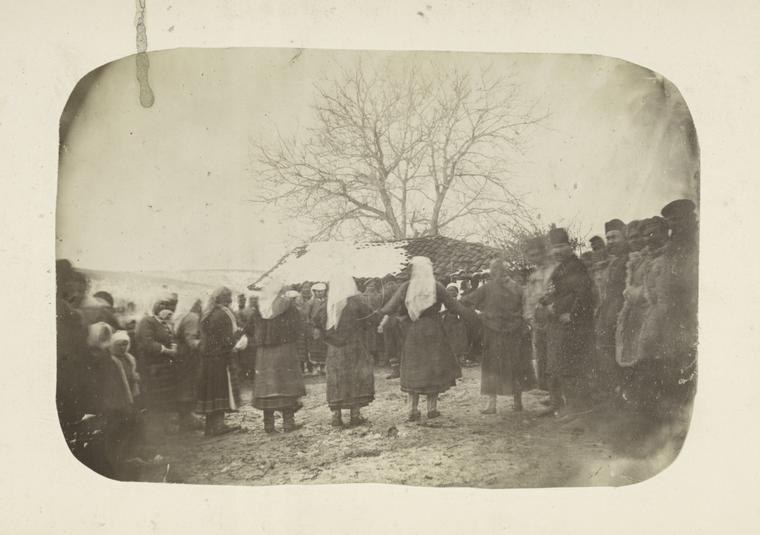
This image raises the question of what photographs of dance actually show: the assembly, the ritual, the social occasion, or the movement itself. For historians interested in how dance functioned in early twentieth-century community life, the mere fact of this gathering being photographed and titled 'Dancing of residents' testifies to dance as a notable social event worth documenting. The loss of clarity around what dance form and what specific movements were performed illustrates the limitations of photographic evidence for dance history.
What you are looking at
A large gathering of people stands outdoors in what appears to be winter or early spring, arranged in a loose semicircle or curved formation across bare ground. A bare tree with delicate branching stands prominently in the upper center of the composition. The figures are dressed in heavy coats, hats, and winter clothing typical of the early twentieth century. The photograph is taken from a distance that captures the full assembly but renders individual faces indistinct. The lighting is diffuse and pale, characteristic of overcast day or weak winter sun. The ground appears to be unpaved, possibly a village green, field, or communal space. The people's posture and loose arrangement suggest they are gathered for an event or ceremony rather than in motion.
The dancing
The assembled figures do not display the coordinated body positions, holds, or frames characteristic of formal dance. They stand largely upright and still, distributed across the space without the spatial relationships—paired positions, lines, circles—typical of structured dance formations. Some figures appear to have arms at their sides; others have indistinct arm positions due to the photograph's distance and resolution. There is no visible evidence of active movement, footwork, or the weight shifts that would indicate dancing in progress.
The dance depicted
The title 'Dancing of residents' and the formal assembly suggest this may document a community gathering with dance as a component, yet the photograph itself does not clearly show people dancing. The figures appear to be stationary or gathered, possibly before, after, or between dancing, or assembled for a different kind of social or ceremonial occasion. Without clearer evidence of movement, footwork, partnering, or the kinetic energy of dance, the specific dance form cannot be identified. The period dress and communal setting suggest early twentieth-century vernacular or folk practice, but the image does not provide sufficient visual evidence to distinguish the dance style.
How it was made
This is a gelatin silver print or similar photographic process, evidenced by the tonal range, the softness of detail, and the characteristic grain and contrast of early twentieth-century photography. The print has aged visibly, with creasing and tonal shifts. The distance of the camera from the subjects and the diffuse lighting produce an image in which individual figures lack clear definition, a limitation inherent to outdoor photography of large groups in weak light. The photograph appears to be documentary in purpose—recording an event for record rather than artistic composition—and circulated through institutional collections such as the New York Public Library.
About this work
This photograph documents an outdoor gathering of residents in heavy winter dress, arranged in a loose formation around a bare tree. The catalogue identifies it as depicting dancing, yet the photograph captures the assembly in a state of stillness or pause rather than active movement. The image belongs in a dance archive as a record of early twentieth-century community social practice, even though the specific dance action remains unclear from the visual evidence. It speaks to the role of dance in village and communal life, and to the difficulty of photographing social dance in its moment—cameras recorded the gathering, the dress, and the occasion more clearly than the movement itself.
How to look at it
Look at the spacing and stillness of the figures rather than searching for obvious movement. Notice the winter dress, the bare tree, and the unpaved communal space—these details locate the photograph in time and place. Observe that the photograph freezes a moment of gathering and ceremony, but whether this moment is the dance itself, a pause within it, or the assembly before or after remains ambiguous. This ambiguity is instructive: it shows how the camera sees community ritual differently than the body experiences it.
The period
This photograph dates to a period when photography was becoming a standard tool for documentary and ethnographic record-keeping. Early twentieth-century communities—whether villages, settlements, or immigrant neighborhoods—were increasingly subjects of photographic documentation. The formality of the assembly and the decision to photograph it suggest institutional interest in recording community life and social customs. Dance in this era remained largely participatory and local; formal documentation was rare, and photographs often captured the occasion and dress rather than the kinetic moment.
Where it lives
The photograph is held in the New York Public Library collection. It is catalogued only as 'Dancing of residents' with unknown date, artist, and location, indicating it is part of a larger documentary or archival collection rather than a known authored work. The minimal metadata suggests it may be part of a series or collection focused on community or village life.
Questions about this work
Are these people actually dancing in this photograph?
The photograph shows a large group assembled outdoors in formal dress, but does not clearly show people in motion or executing dance movements. They appear to be gathered or standing still. The catalogue title identifies the occasion as 'dancing,' but the visual evidence captures the assembly, the occasion, and the social gathering more clearly than the dance action itself.
What era is this photograph from?
The photograph dates to an unknown period, but the winter clothing styles, the bare tree, the unpaved ground, and the photographic process itself suggest the early twentieth century. The formal assembly and the decision to document it photographically point to a period when community life was becoming a subject of systematic visual record.
What kind of dance is shown here?
The specific dance form cannot be determined from the photograph. The assembly and the period dress suggest vernacular or folk practice in a village or community setting, but without evidence of footwork, partnering, movement quality, or other identifying features, the style remains unknown.
More dance artwork