37 works in this view — arrow keys or swipe to move between them.
Dance in Art
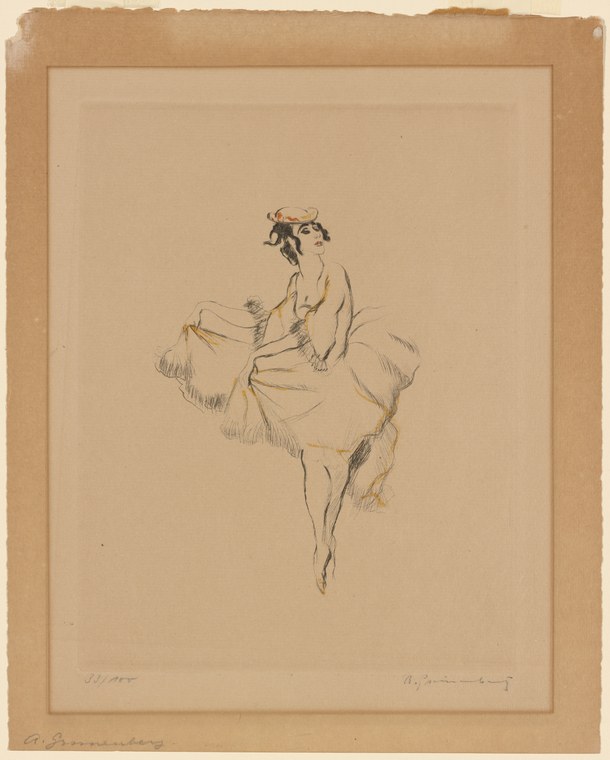
Tamara Karsavina in The Polka
Unknown artist
- Medium:
- Lithograph
- Dance:
- Polka
- Era:
- Late 1800s (Victorian Ballroom)
- Source:
- New York Public Library
- Rights:
- Public domain — free to use, share and adapt.
- Recorded as:
- public_domain
Karsavina was a principal dancer of the Imperial Ballet and a founder of the Ballets Russes, a figure of enormous historical importance. Yet this image shows her in a work—the polka—that belongs to the ballroom and popular theatre rather than classical ballet, expanding our understanding of her range and the cross-pollination between social and theatrical dance in the late nineteenth century. The lithograph is valuable evidence that even canonical figures of high dance engaged with vernacular forms.
What you are looking at
A single female figure is caught mid-movement against a plain background, her body lifted in a dynamic leap or hop characteristic of the polka. She wears a light, gossamer dress with a full skirt that billows and catches the motion, and her arms are raised in a gesture of exuberance. The drawing captures her in a moment of suspension—one leg extended, the other bent—with her upper body animated and engaged. The artist has rendered her with fluid, gestural linework that emphasizes the speed and lightness of the movement rather than anatomical precision. The lithograph's pale tone and sketchy execution give the impression of a quick study from life or a theatrical rehearsal, preserving the spontaneity of the dancer's frame.
The dancing
A single dancer is shown in profile-to-three-quarter view, her weight lifted clear of the ground in a moment of ascent. Her arms are raised—one higher than the other—in a posture of joy and release. The skirt is rendered with downward hatching strokes that suggest its weight and volume as it moves, contrasting with the relative delicacy of the limbs. The artist captures a sense of unstable equilibrium, the body in a state between positions, which is the hallmark of a quick, bouncing step rather than a sustained pose.
The dance depicted
This is a portrait of the polka, a dance that reached the height of European and American fashion in the mid-nineteenth century. The polka is a lively couple dance in 2/4 time, but this image shows the dancer isolated in a moment of solo exuberance—likely a theatrical solo or a study of the characteristic step itself rather than a full dance scene. The high, skipping leap and the exuberant arm gesture are consistent with the polka's energetic, bouncing quality. The figure's isolation and the focus on a single moment of lift suggest this may document a specific performance or a dancer known for her particular style of executing the step.
How it was made
This is a lithograph, a printmaking technique that allows for swift, fluid linework and tonal variation through the properties of grease and water on stone. The medium is recorded in the catalogue but the artist is not. The sketch-like quality of the execution—the loose hatching on the dress, the gestural definition of the limbs, the absence of heavy outline—suggests this may be a reproduction of a drawing made from observation, possibly in a theatre or rehearsal context. Lithography was the dominant commercial medium for theatrical portraiture and dance imagery in the nineteenth century, enabling wide circulation and affordable editions.
About this work
This lithograph documents a moment from the polka, the dance that defined European ballroom fashion from the 1840s onward. The image preserves not a formal composition but a caught moment of movement—a single dancer suspended in mid-leap, her dress and gesture animated by the energy of the step. The work belongs to a vast archive of nineteenth-century theatrical and social dance imagery created for popular consumption, recording both the steps themselves and the personas of celebrated dancers. The identity of the performer is recorded (Tamara Karsavina), though the artist and precise date remain unconfirmed, placing the work in the documentary tradition of theatre lithography.
How to look at it
Attend to the moment the artist chose to freeze: not the beginning of the step or its conclusion, but the apex of the leap—the instant of maximum suspension and exuberance. This is the moment that communicates the polka's essential character: buoyant, weightless, joyful. Notice how the dress is rendered: the artist uses downward hatching to suggest gravity and weight, creating a dynamic contrast with the lifted, weightless body. The raised arms and open posture convey not technical precision but abandon and performance—the theatrical polka as distinct from the social version.
The period
The polka was at the peak of fashion in European and American ballrooms from roughly 1840 to 1900, though it remained in the repertoire longer on the theatrical stage. The dance came from Bohemia and spread rapidly through central Europe to Paris and London, becoming a fixture of court balls and society dancing by mid-century. By the time this lithograph was produced, the polka had become so associated with theatricality and spectacle that it was danced in operatic and musical contexts as well as in the ballroom. The late nineteenth century saw a particular flourishing of dance lithography—hand-drawn theatrical portraits and dance studies circulated as affordable prints, reaching audiences far beyond those who attended live performances.
Where it lives
This work is held in the New York Public Library collection. It is a lithographic print, possibly one of a series of theatrical dance studies or portraits. The catalogue record provides minimal information on provenance or original publication.
Dance in this work
Questions about this work
Who was Tamara Karsavina?
Karsavina (1885–1978) was a principal dancer of the Imperial Ballet in St. Petersburg and co-founder of Sergei Diaghilev's Ballets Russes, for which she created roles in *Le Spectre de la rose*, *Petrouchka*, and other landmarks of modern choreography. She performed across Europe and America and was renowned for her dramatic power and technical brilliance. She also danced in lighter theatrical works, including social dances like the polka shown here.
What is a polka?
The polka is a couple dance in rapid 2/4 time, originating in Bohemia in the 1830s. It is built on a hop-step pattern that is quick, bouncy, and energetic. The dance became enormously popular in ballrooms across Europe and America by the 1840s. In theatrical contexts it was often danced as a solo or ensemble number, with stylized movements and elevated technique.
Why was this printed as a lithograph?
Lithography was the dominant medium for theatrical publicity and portraiture in the nineteenth century. It allowed artists to work with fluid, expressive linework and to produce many copies from a single stone, making images affordable and accessible to the theatre-going public. Dance lithographs were collected and traded much as photographs later would be.
More Polka artwork