36 works in this view — arrow keys or swipe to move between them.
Dance in Art · 2019
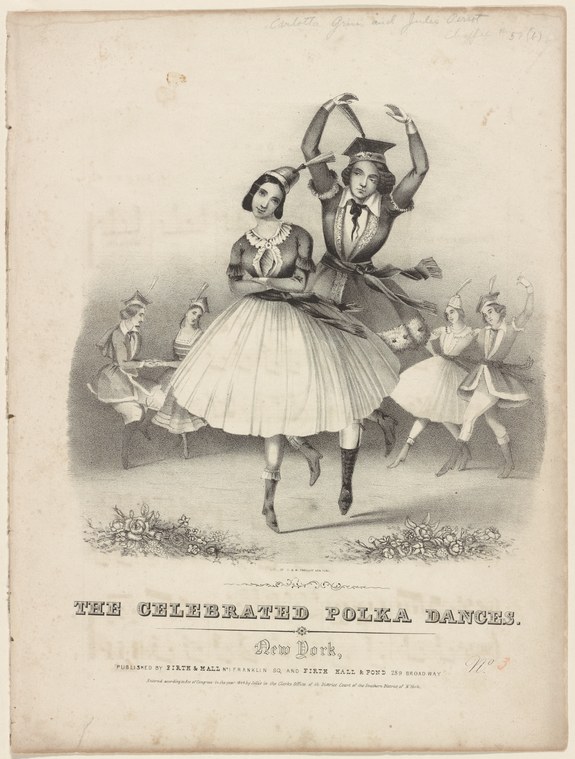
The celebrated polka dances
Unknown artist
- Medium:
- Lithograph
- Dance:
- Polka
- Era:
- Late 1800s (Victorian Ballroom)
- Source:
- New York Public Library
- Rights:
- Public domain — free to use, share and adapt.
- Recorded as:
- public_domain
This image is evidence of the polka's place in nineteenth-century social life and of how dance imagery was circulated to promote and teach popular steps. For a dancer or historian, it preserves details of costume, hold, and body configuration that might otherwise survive only in written description or choreographic notation.
What you are looking at
A lithograph depicting a lively ballroom scene centered on a polka in progress. In the foreground, a couple dominates the composition: the woman wears a pale, full-skirted dress with dark trim and a small dark hat or headdress, while the man in formal dress with a tall hat holds her aloft, their bodies captured mid-lift or spin. Her skirt billows outward in a wide bell shape, emphasizing the energy of the movement. Around them, additional couples in similar formal attire continue dancing, visible in softer focus in the background. The setting is plainly a ballroom or dance hall, suggested by the sparse background and the concentration of figures. The lithographic technique renders the figures with delicate hatching and soft gradations of tone, creating an impression of movement and festivity without sharp outlines. The overall mood is one of exuberant social dancing, with the figures arranged to guide the eye toward the central couple's dramatic lift.
The dancing
The central couple displays the characteristic polka hold: the man grips the woman's waist and one hand while his other arm extends, their bodies close and coordinated. The woman's weight appears lifted or suspended, with her full skirt spread wide—a moment captured mid-turn or mid-rise. Her posture is upright but dynamic; his frame is square and controlling. The background couples maintain closed ballroom holds and are shown in various phases of the step pattern, suggesting the synchronized, repetitive nature of the polka. All figures are dressed formally: women in full skirts with cinched waists, men in tailcoats or jackets with top hats.
The dance depicted
This is a polka, one of the most popular social dances of the mid-to-late Victorian era. The polka originated in Bohemia in the 1830s and had become a fixture of European and American ballroom culture by the 1850s–1890s. The image captures the polka's characteristic features: the energetic, bouncing quality; the closed couple position; the woman's full skirt in motion; and the sense of rapid, rhythmic stepping. The lithograph's title, 'The Celebrated Polka Dances,' suggests this is a commemorative or promotional image, possibly tied to a specific famous performance or dancer. The multiple couples shown dancing in unison reflect how the polka was danced socially—as a group activity in ballrooms rather than as a staged solo.
How it was made
This is a lithograph, a printmaking technique that allowed for relatively rapid and inexpensive reproduction for mass circulation. The soft modeling of the figures and the subtle tonal gradations are characteristic of lithographic stone work; the artist drew directly on stone or on transfer paper, and the image was then printed. For a social dance image with a commercial title, lithography was ideal—it could reach audiences in ballrooms, dance studios, and homes, serving as both documentation and promotion of the polka craze. The technique's accessibility and reproducibility meant that images like this helped popularize dance fashions and steps.
About this work
This lithograph documents the polka as a social ballroom dance at its height of popularity in the Victorian era. The image is both a snapshot of a specific moment—the exuberant lift of the central couple—and a broader record of how the polka was danced in formal settings. The work belongs in a dance gallery because it captures not just the costume and setting of Victorian ballroom culture, but the actual physical vocabulary of the dance: the lift, the closed hold, the full-skirted silhouette in motion, and the social participation of multiple couples. It is a primary historical document of how the polka looked when performed.
How to look at it
Observe the moment the artist chose: not a static pose, but a dynamic lift or spin, with the woman's skirt caught mid-flight. The fullness of her skirt and the lift of her body convey the bounciness and energy that defined the polka as distinct from the more flowing waltz. Notice how the background couples, though less detailed, all maintain the same closed-hold position and posture, emphasizing that the polka was a standardized social form danced by many at once. The formal dress of both men and women—tailcoats, top hats, full gowns with trim—places this squarely in the Victorian ballroom world and tells you who danced the polka and where.
The period
The polka emerged as a popular dance in the 1830s–1840s and became a craze across Europe and America from the 1840s onward. It represented a shift from the formal, geometric dances of the Regency era (such as the quadrille) toward something livelier, more physically exuberant, and more accessible to the rising middle class. The polka was danced in ballrooms, at public dance halls, and at social gatherings, and it inspired an enormous output of printed ephemera—sheet music covers, dance instruction books, and promotional images like this one. By the time this lithograph was produced (mid-to-late 1800s, likely 1850s–1890s), the polka was an established part of ballroom repertoire, often danced alongside waltzes and other couple dances. Lithography as a medium was perfectly suited to this market, enabling publishers in major cities like New York to produce affordable, widely distributed images of fashionable dances.
Where it lives
The image is held in the New York Public Library collection. It is a published lithograph, likely a commercially printed dance instruction or promotional image, designed for circulation to a broad urban audience interested in current ballroom fashions and steps.
Dance in this work
Questions about this work
What is the polka and why was it so popular?
The polka is a lively couple dance that originated in Bohemia in the 1830s and became an international craze from the 1840s onward. It appealed to the rising middle class because it was energetic, relatively easy to learn, and could be danced socially in ballrooms and at parties. Unlike the formal, complex quadrille, the polka required only that a couple maintain a closed hold and execute a simple hopping, bouncing step pattern in 2/4 time. By the Victorian era, it was as standard in the ballroom repertoire as the waltz.
Why is the woman's skirt so full and flying?
The full, bell-shaped skirt was standard for mid-to-late Victorian women's ballroom dress and was amplified by the polka's energetic, bouncing movements and frequent spins. The crinoline or hoop petticoat beneath created the volume. As the woman danced, her skirt would swing and billow with each turn and lift—exactly the moment captured in this image. The skirt became part of the visual spectacle of the dance and was celebrated in dance images and promotional materials.
Is this a record of an actual performance or a generic ballroom scene?
The title, 'The Celebrated Polka Dances,' suggests it may commemorate a specific famous dance or dancer, though the image itself does not provide enough information to confirm this. It functions both as a generic representation of how the polka was danced socially and as promotional material—the kind of image that would have been sold separately or bound into dance instruction manuals and fashion magazines to teach people the steps and inspire them to dance.
More Polka artwork