35 works in this view — arrow keys or swipe to move between them.
Dance in Art
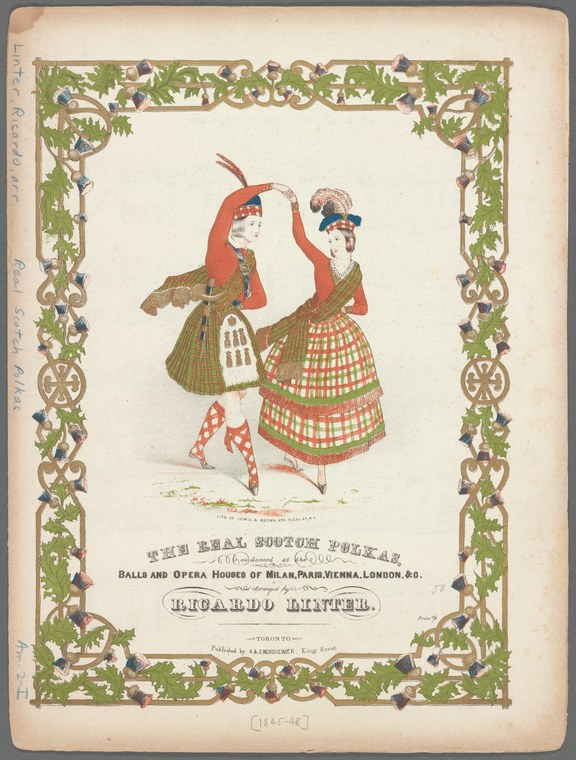
The The real Scotch polkas
Unknown artist
- Medium:
- Lithograph
- Dance:
- Polka
- Era:
- Late 1800s (Victorian Ballroom)
- Source:
- New York Public Library
- Rights:
- Public domain — free to use, share and adapt.
- Recorded as:
- public_domain
The image captures the moment when folk-inflected regional dances became commercialized and standardized as ballroom entertainment, with explicit documentation of the footwork and costume that defined them. For historians of social dance and Victorian culture, this print is primary evidence of how women actually moved in this period and what was considered lively, respectable, and danceable in the ballroom.
What you are looking at
Two women in fashionable mid-Victorian dress dominate this colored lithograph, set against a plain background within an ornate decorative border of intertwining green vines and small blue flowers. The figure on the left wears a rust-red silk cloak or cape thrown dramatically over one shoulder, its hem swinging outward to suggest rapid motion. Beneath it she wears a brown plaid dress with vertical pleating. Her partner on the right is dressed in a green tartan skirt with a fitted bodice and red plaid shawl draped across her shoulders. Both women wear small bonnets and have their hair styled in the ringlets typical of the 1860s. Their legs are extended in energetic scissor-like positions, with one woman's calf exposed, suggesting a high-kicking step. The poses are playful and exuberant rather than graceful—their bodies are angled toward each other in a moment of spirited social dancing, not formal ballet.
The dancing
Both dancers are captured mid-step with their weight clearly on one leg while the other extends in a sharp kick or scissors motion. Neither maintains the vertical alignment of classical ballet; instead, their torsos lean forward with abandon, and their arms are raised and gestural rather than positioned in formal ports de bras. The dancer on the left reaches her arm high, while the one on the right's arm extends outward. Their relative positioning and energetic leg action suggest they are partners in a brisk, turning figure rather than opposing or mirroring in a set formation.
The dance depicted
The title explicitly names this as a Scottish polka, a social dance of the Victorian ballroom that combined the quick triple-meter bounce of the polka with regional Scottish character and dress. The image shows the vigor and informality of this hybrid form: polkas were popular couple dances performed in ballrooms and public assemblies, usually with partners in closed or semi-closed hold, and were known for their lively stepping and playful spirit. The exposed legs and swinging skirts here document how the high-kicking footwork of the polka was executed and what dancers' movement looked like in the 1860s. The Scottish dress cues (tartans, plaids) mark this as a regionalized variant that drew on folk tradition.
How it was made
This is a hand-colored lithograph, a technique that allowed for mass production of popular entertainment imagery. The image was drawn on stone, inked, and printed, then hand-colored with watercolor or similar pigment—a labor-intensive but economical method for producing sheet music covers and entertainment prints. The ornate decorative border is printed in the stone, while the figures were likely colored afterward. Lithography was the dominant medium for distributing dance instruction, ballroom guides, and social documentation in the Victorian era, making such prints the primary visual record of how middle-class ballroom dancing was performed and imagined.
About this work
This is a Victorian-era promotional print for a Scottish polka, a couple dance that fused the rapid, bouncing character of the European polka with Scottish regional identity through costume and styling. The colored lithograph documents both the kinetic reality of the dance—the high kicks, the swinging of fabric, the forward lean of the body—and the social context in which it was performed: as fashionable entertainment for the Victorian ballroom, executed by well-dressed women of respectable station. The print serves as a record of what dancers actually did with their bodies in this period, at a moment when Scottish-themed social dances were in vogue across Britain and North America. It belongs in a dance archive both as evidence of a specific dance form and as testimony to how movement was captured, marketed, and disseminated to the dancing public.
How to look at it
Attend first to the diagonal thrust of the bodies and the height of the kicks: neither is restrained or classical. The artist has chosen the moment of maximum extension and swing, capturing the dance at its most visually emphatic. The swinging hems and the exposure of the lower leg were considered daring and exciting in this period; the lithographer emphasizes them to convey the liveliness and novelty of the polka. Notice also how the artist has tilted the figures slightly forward and toward each other—not in a formal closed hold, but in the spirited engagement typical of a turning couple dance. The decorative border, with its pastoral vines and flowers, frames the image as fine art rather than mere instruction, suggesting that ballroom dancing had cultural status worth celebrating.
The artist
The artist is not recorded. The print was published by J. Blockley, King Street, London, and likely issued as sheet music cover or a separate dance instruction print. It was common for Victorian dance publishers to commission lithographers without identifying them by name; the focus was on the dance and the publisher's brand rather than the artist's reputation.
The period
The Scottish polka emerged in the 1850s–1860s as one of many hybrid social dances that competed for favor in the Victorian ballroom. The polka itself, imported from Bohemia, had swept European and North American ballrooms in the 1840s; by mid-century, dancers and composers were creating regional variants—Spanish polkas, Irish polkas, country polkas—that asserted local identity through costume and musical inflection. This coincided with the broader Victorian fascination with folk culture, tartanry, and 'authentic' regional performance. The waltz still dominated the most formal balls, but polkas and their cousins were the energetic, slightly risqué dances of smaller assemblies and public dancing spaces, danced by younger people and the emerging middle classes.
Where it lives
The work is held in the New York Public Library collection and was sourced from their digital collections. It is a commercial print, likely issued as a separate item or as a cover for sheet music, and reflects the standard practices of Victorian dance publishing in London.
Dance in this work
Questions about this work
What is the Scottish polka?
A social couple dance that combined the quick, bouncy triple-meter character of the central European polka with Scottish regional styling—tartan dress, Scottish music—creating a hybrid form popular in Victorian ballrooms in the mid-nineteenth century. It was one of many polka variants created to give the imported dance local flavor and appeal.
Why are the women's legs so visible?
The high-kicking footwork of the polka naturally lifted skirts and exposed the lower leg—something that was thrilling and slightly scandalous by Victorian standards. The artist emphasizes this not just to document the dance accurately, but to convey its energy and novelty. Ballroom dances like the waltz kept the body more enclosed; the polka broke that convention.
How do we know what social dances looked like in this period?
Prints like this are among the best evidence we have. Dance instruction books used images to convey foot positions and body angles; sheet music was often sold with covers showing dancers in movement; and promotional prints celebrated new or fashionable dances. Lithography made such images cheap enough to circulate widely, making them a visual record of ballroom culture.
More Polka artwork