34 works in this view — arrow keys or swipe to move between them.
Dance in Art
Les polkas
Unknown artist
- Medium:
- Lithograph
- Dance:
- Polka
- Era:
- Late 1800s (Victorian Ballroom)
- Source:
- New York Public Library
- Rights:
- Public domain — free to use, share and adapt.
- Recorded as:
- public_domain
For dancers and historians, this image is evidence of the polka's enormous social presence and the aesthetic conventions that governed its performance in the Victorian ballroom. The print circulated in the same period and markets where dancers actually learned the dance, making it a document of pedagogy and fashion as much as choreography.
What you are looking at
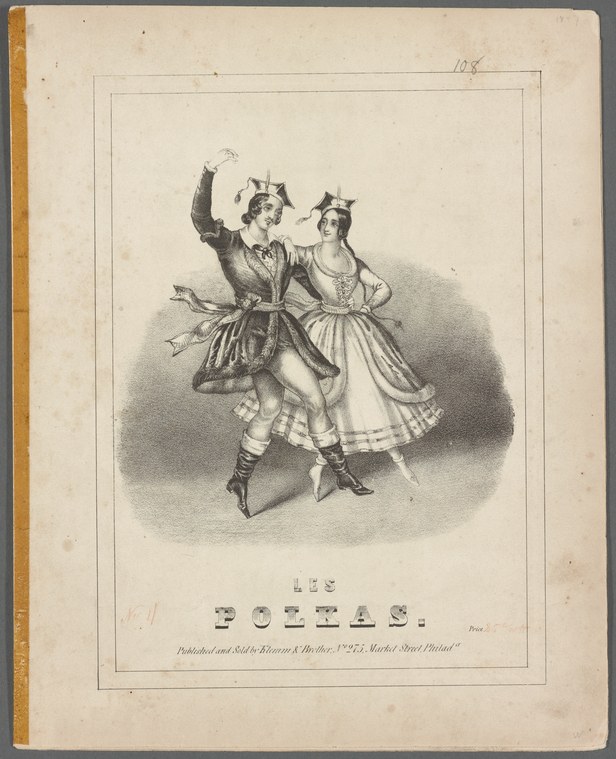
A lithograph depicting two figures in mid-polka, their bodies caught in an energetic moment of the dance. The figure on the left, dressed in a dark jacket with white stockings and black shoes, has one arm raised expressively while the other gestures outward; their body leans into the movement with considerable verve. The figure on the right wears a white dress with a full skirt and decorative headpiece, their posture responsive to their partner's lead. The composition is tight and intimate, set against a soft gray background with no architectural setting or floor indicated—the focus is entirely on the dancers themselves. The lithographic medium creates subtle tonal gradations that emphasize the figures' volume and the texture of their clothing, particularly the gathered fabric of the white skirt.
The dancing
The dancers appear to be in a closed or semi-closed ballroom hold, with their bodies oriented toward each other. The left figure's raised arm and forward lean suggest the characteristic springy, bouncing energy of the polka, while the right figure's stance indicates responsiveness to the lead. Both dancers have their weight forward and appear to be captured mid-stride, with bent knees suggesting the characteristic hop-step action of the dance. The contrast between the dark-clothed male figure and the light-clothed female figure creates visual balance and emphasizes the gendered partnership convention of ballroom dance.
The dance depicted
This is unmistakably a polka, one of the most popular couple dances of the mid-to-late nineteenth century. The title 'Les Polkas' (The Polkas, in French) and the energetic bodily vocabulary—the bounce, the forward progression, the lively arm carriage—all confirm this identification. The polka originated in Bohemia in the 1830s and became a sensation across Europe and America by the 1840s, dominating ballroom culture through the Victorian era. The image captures the dance's characteristic exuberance: the sprung posture, the quick traveling steps, and the playful, social nature that made it beloved by dancers of all skill levels, from grand ballrooms to local assemblies.
How it was made
This is a lithograph, a planographic printing process that allowed artists to draw directly onto a stone or metal plate with a greasy crayon or ink, then print the image through chemical means. The technique produced relatively economical prints suitable for mass distribution, making images like this accessible to a broad middle-class audience interested in dance instruction, entertainment, or fashion. The soft modeling of tone visible here—the graduated shading that gives the figures dimension—is characteristic of skillful lithographic work. The French publication credit at bottom indicates this was produced for a Parisian or French market, likely as a pattern or instructional illustration for dancers learning the polka's steps and style.
About this work
This is a dance instruction or fashion print documenting the polka as it was danced in the mid-nineteenth century. The lithograph freezes a moment of social partner dancing at its height of popularity, showing not just the steps but the attitude and dress code of polka dancers: the man in dark formal jacket and the woman in a full-skirted white dress, both animated and engaged. The work belongs in a dance gallery because it is a primary visual record of how the polka was actually performed and presented to its contemporary audience—not as a stage spectacle but as a social practice, energetic and intimate, that defined an era of ballroom culture.
How to look at it
Notice the angle of the dancers' bodies and their bent knees: this is the spring and bob that makes the polka distinctive, caught at the moment of upward impulse. The man's raised arm and the woman's responsive posture show the playful, improvisational quality of the dance—not rigid or hieratic, but alive and conversational. The artist has chosen a close, intimate framing that emphasizes the partnership and the vitality of the movement rather than the grand ballroom setting. The clothing tells you as much as the bodies: the woman's fashionable white dress and headdress, the man's dark formal wear, and their intimate proximity all confirm this is a scene of respectable, fashionable social dancing.
The period
The polka erupted into European and American consciousness in the 1840s and dominated ballroom culture through the 1890s. It was democratizing: faster-paced, more fun, and less formally prescribed than the waltz or quadrille, it appealed to younger dancers and to the aspiring middle classes. The mid-nineteenth century saw an explosion of cheap printed instructional materials, fashion plates, and dance scenes for a newly literate, dance-hungry market. Lithography made this proliferation possible, allowing artists and publishers to meet demand for images of current dances and dancers. By the time this print was made—likely the 1870s or 1880s, though the record says 'late 1800s'—the polka was already nostalgic in some circles, but it remained deeply embedded in ballroom practice and in the visual culture of dance.
Where it lives
This lithograph is held in the New York Public Library collections. It was published in France (the imprint credits 'Published and Sold by Rhémond & Medley, 27 Markt Street Phibad', suggesting a London location, though the French title and context suggest French publication or a Franco-British market). It is one of many such dance prints circulating in the nineteenth century as both instructional and entertaining material.
Dance in this work
Questions about this work
What is a polka and why was it so popular?
The polka is a lively couple dance in 2/4 time that originated in Bohemia in the 1830s and swept across Europe and America by the 1840s. It was faster and more playful than the stately waltz, easier to learn, and less formally prescribed, making it accessible to a broad social spectrum. Dancers loved its energy and its social intimacy; it dominated ballrooms for decades and remained popular into the twentieth century.
How do we know this is specifically a polka and not another Victorian dance?
The image is titled 'Les Polkas' and the visual evidence confirms it: the characteristic springy, bouncing posture with bent knees; the forward lean and energetic arm carriage; the quick-paced attitude of the movement. All of these are hallmarks of the polka's style. The dress and ballroom setting also match the polka's social context as a respectable couple dance of the Victorian middle classes.
Who made this print and when?
The artist is not recorded. The catalogue record dates it to 'Late 1800s' based on style. The publication credit at the bottom credits 'Rhémond & Medley,' suggesting a London or Franco-British publication, but the French title and context suggest it was made for a French or French-speaking audience. Such prints were produced in very large numbers by dozens of publishers and printers across Europe.
What is a lithograph and why would a publisher use this technique for a dance image?
A lithograph is a print made from a stone or metal plate using the chemical principle that grease and water repel each other. It allowed artists to create images more cheaply and in larger quantities than engraving or etching, making it ideal for distributing instructional and entertainment materials to a broad audience. For dance images, lithography was the technology that made it possible to meet the Victorian appetite for pictures of current fashions and dances.
More Polka artwork