49 works in this view — arrow keys or swipe to move between them.
Dance in Art · 2019
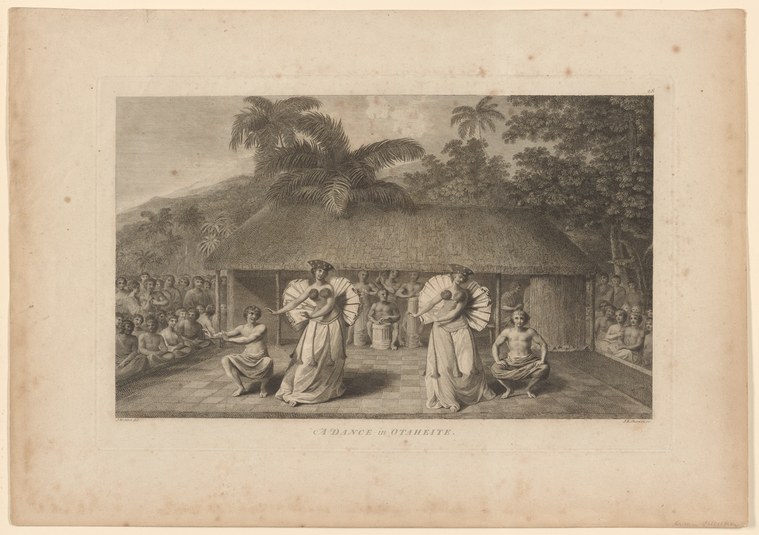
A dance in Otaheite
Unknown artist
- Medium:
- Source:
- New York Public Library
- Rights:
- Public domain — free to use, share and adapt.
- Recorded as:
- public_domain
This engraving is among the earliest European visual records of Tahitian ceremony and provides rare evidence of how ritual display and formality operated in Pacific island culture. For dance historians, it challenges European assumptions about Pacific dance as purely recreational or erotic—this image shows ceremony as an ordered, watched, and formal affair in which stillness and dress mattered as much as movement. The work documents how colonial-era artists understood and rendered non-European bodies and ritual, making it essential for understanding both Pacific dance history and the history of ethnographic representation.
What you are looking at
A ceremonial gathering in Tahitian settlement, depicted in an 18th-century engraving. The composition centers on two figures of high status wearing elaborate white bark-cloth garments with flared, fan-like shapes that extend outward from their bodies—likely *tapa* cloth or formal dress regalia. They occupy the middle ground of a large thatched-roof structure, open-sided in the typical Pacific style, with palm trees visible beyond. Dozens of seated spectators line both sides of the space, watching intently. The two central figures are posed upright and stationary rather than actively dancing; their dress and positioning suggest a ritual presentation or formal display rather than energetic movement. A smaller figure without the elaborate dress appears to the right. The engraving employs fine cross-hatching to render volume and shadow, creating atmospheric depth that carries the eye from the foreground figures back through the crowd to the landscape beyond.
The dancing
The two principal figures stand erect and frontal, their bodies symmetrical and formal. Their most striking feature is the enormous fan-like or sail-like projections of white cloth extending from their torsos—these appear to be held or worn as part of their regalia rather than moving freely. No visible arm movement or dynamic lower-body positioning suggests active dancing; the posture is static and presentational. The seated crowd around them maintains attentive, watching postures, their bodies angled toward the center. The scale and stillness of the central figures, combined with their exceptional dress, suggest they are being gazed upon rather than leading movement.
The dance depicted
This image likely depicts a formal presentation or ceremonial display from Tahitian culture, possibly related to the *'otea* (a standing dance) or a ritual display of rank and status rather than a fully choreographed social dance. The elaborate white cloth regalia and the formal, frontal presentation suggest a ceremony in which display and viewing were primary—common in Pacific island cultures where dress, bearing, and the gaze of witnesses conveyed meaning. The stillness of the figures and the attentive posture of the crowd indicate this is a moment of formal presentation rather than active rhythmic movement, though it undoubtedly occurred within a dance or ceremonial context. Without clearer evidence of footwork, arm choreography, or movement sequences, precise identification of a specific dance style is uncertain.
How it was made
This is an engraving—identifiable by the fine parallel line work (cross-hatching) used to build tone and volume, and the clearly delineated outlines typical of hand-engraved work. The technique allows precise detail in the figures' dress and the crowd composition while permitting atmospheric effects in the landscape. Engravings of this style and subject matter were produced for European illustrated books and periodicals in the 18th century, circulating among educated readers interested in accounts of Pacific exploration. The formal composition and careful rendering suggest this was made from a drawn or painted original, possibly derived from an explorer's account or sketch made during contact with Tahitian people.
About this work
This is an 18th-century engraving depicting a ceremonial gathering in Tahiti, likely recorded during or shortly after European contact with the Pacific islands. It shows two high-status figures in elaborate white regalia standing before a large crowd in a communal structure, presented in a formal, observational pose rather than active dance movement. The work belongs to a tradition of European visual documentation of Pacific cultures—part travel narrative, part ethnographic record—that shaped Western understanding of island life and ceremony. The image is valuable precisely because it captures a moment of formal ritual display: it shows how dress, architecture, and the arrangement of bodies in space conveyed authority and cultural meaning in Tahitian society.
How to look at it
Attend first to the dress: the enormous white cloth projections are the visual center and convey status and formality. Note how the two central figures are presented not in mid-movement but in a posed, frontal arrangement—this is not action frozen but presentation itself. Observe the crowd: their seated, attentive postures frame the central figures and emphasize that this is a moment of ceremonial witnessing. Look at the architectural setting—the open-sided structure and landscape beyond situate this within a specific place and way of life. The engraving technique, with its careful cross-hatching, creates a sense of careful observation and documentation, inviting the viewer to see this as a record of an actual moment rather than an imagined scene.
The artist
The artist is not recorded, but the engraving's style, execution, and subject matter are consistent with 18th-century European travel-book illustration. Works of this type were typically made by London or Paris engravers working from sketches or paintings brought back by explorers, naturalists, and ship's artists. The precision and composition suggest a trained engraver working within established conventions for rendering exotic lands and peoples—a genre that was commercially successful and influential in shaping European views of the wider world.
The period
This engraving dates to the age of European Pacific exploration (mid-to-late 18th century), when accounts of Tahitian life circulated widely in illustrated books and journals. The image participates in a broader European fascination with Pacific island cultures, both romanticized and ethnographically curious. In Europe, formal court dances (minuets, gavotte, quadrille) still dominated elite culture, making the sight of non-European ceremony and dress novel and arresting to viewers. For Tahitian society itself, the moment of encounter with European ships and artists marked a pivotal shift; indigenous ceremonial and dance practices were being recorded, reinterpreted, and transmitted through European visual media even as contact began to alter those practices.
Where it lives
The work is held in the New York Public Library collection. It derives from the library's holdings of illustrated travel narratives and printed works documenting European exploration and encounter with Pacific peoples, a major collecting area for libraries in the 19th and 20th centuries.
Dance in this work
Questions about this work
Is this a dance or a ceremony?
It is both. In Tahitian culture, formal ceremony and dance were often inseparable—ritual movement, dress, and display were integrated. This image appears to capture a moment of formal presentation within a broader ceremonial context. The stillness of the figures and the attentiveness of the crowd suggest this is a moment emphasizing display and observation rather than active rhythmic movement, but it would have occurred as part of a dance or ceremonial performance.
What is the white cloth the central figures are wearing?
This is likely *tapa* (bark cloth), one of the most valued and symbolically important materials in Pacific island cultures. Tapa was laboriously made by hand, and large pieces of it signified wealth and status. The enormous fan-like projections visible here may represent elaborate tapa regalia worn for ceremonial occasions, or possibly constructed frames holding or displaying tapa cloth as part of the formal presentation.
Who made this engraving, and when?
The artist is not recorded in available documentation. The style and subject matter are consistent with 18th-century European travel-book illustration, likely made in London or Paris from sketches or paintings brought back by explorers. Many such engravings were produced anonymously or with only the draughtsman credited, not the engraver.
What can we trust about this image as a record of Tahitian practice?
The image is a European interpretation of a Tahitian ceremony, filtered through the conventions and visual language of 18th-century European engraving. While the dress, setting, and gathering likely reflect actual Tahitian practice, the composition, framing, and emphasis on formal presentation reflect European artistic choices and assumptions about how to render unfamiliar cultures. It is most reliable as evidence of what the artist saw and how the European audience expected such scenes to be presented.
More dance artwork