49 works in this view — arrow keys or swipe to move between them.
Dance in Art
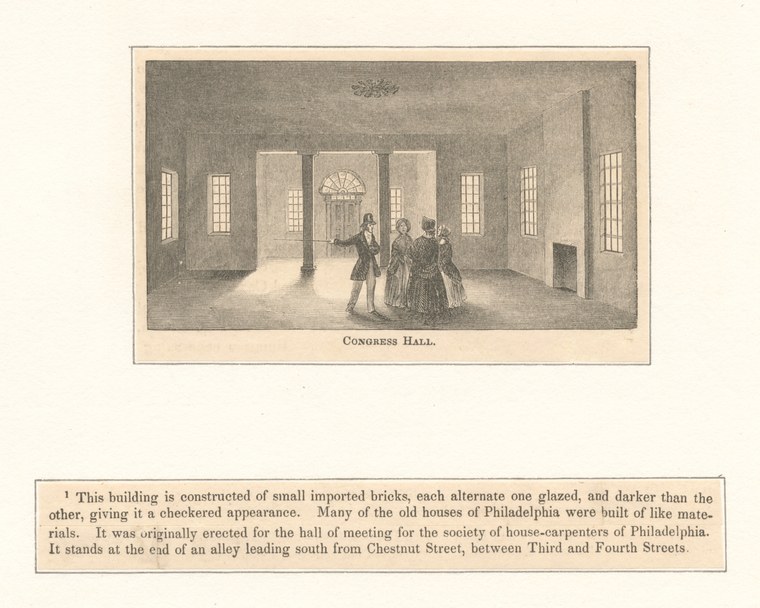
Carpenters' Hall ; Congress Hall.
Unknown artist
- Source:
- New York Public Library
- Rights:
- Public domain — free to use, share and adapt.
- Recorded as:
- public_domain
For a dance audience, this work is instructive precisely because it contains no dance. It documents the formal, static bearing of bodies in official space—the antithesis of the movement and play that characterized social dancing of the same era. It provides visual evidence of how differently bodies were held and arranged when civic protocol rather than sociability governed the scene.
What you are looking at
This engraving depicts the interior of Congress Hall in Philadelphia, a neoclassical space with a soaring coffered ceiling and tall rectangular windows admitting strong light from the left. The room is austere and geometric: fluted columns rise at intervals, and a semicircular fanlight window occupies the far wall above a central doorway. In the middle distance, three figures in late 18th-century dress stand in conversation or formal arrangement. The two outer figures wear long coats; the central figure wears a dress with a full skirt. Their poses are upright and dignified rather than animated. The light streaming through the windows casts strong diagonal shadows across the floor, emphasizing the architectural severity of the space. The composition is one of civic formality rather than social ease.
The dancing
The three figures stand in an upright, static posture typical of formal assembly or presentation rather than active dance. Their bodies are aligned vertically with minimal flexion; there is no suggestion of swaying, turning, or weight transfer. The woman's skirt hangs full but straight, without the billowing or caught-mid-movement quality that would indicate motion. The overall frame is one of composed, stiff protocol—the bearing of public officials or dignitaries in an official setting.
The dance depicted
This image does not depict dance. The figures' stance and setting are those of civic or diplomatic assembly, not choreography. The Hall served as a meeting place for governmental bodies (hence the name Congress Hall), and the scene captures a moment of formal address or negotiation rather than any social or theatrical dance. The rigid postures and official context rule out even the informal court dances or social assembly that might appear in other 18th-century interiors.
How it was made
This is an engraving, identifiable by the fine parallel lines (hatching and cross-hatching) used to model light, shadow, and texture throughout the image. The technique allowed precise architectural rendering and the reproduction of the image in multiple copies for circulation as a print. The monochromatic, linear method is characteristic of 18th-century topographical and architectural engravings, which were common vehicles for documenting public buildings and civic spaces in North America.
About this work
This engraving is a documentary print recording the interior of Congress Hall in Philadelphia, a neoclassical public building completed in the 1790s. The image emphasizes architectural grandeur and civic order. The three figures serve primarily as human scale markers within the space rather than as the focus of dramatic or social action. The work is an artifact of early American architectural documentation and civic pride, circulated as a print to showcase the young republic's public institutions.
How to look at it
Attend to the geometry: the way the columns, windows, and ceiling lines direct the eye, and how small the human figures appear in this ordered space. Notice the quality of light—sharp and architectural rather than warm and intimate. The stillness of the three figures is the point; their rigid posture and formal dress record a moment of official business, not leisure or pleasure. The engraver has chosen to emphasize the building itself, not the people in it.
The artist
The artist is not recorded in the catalogue. The style and subject matter are consistent with the work of Philadelphia's architectural engravers in the 1790s–1800s, a period when such prints were commissioned to celebrate the city's new federal and civic buildings. The technique and composition suggest professional training in the tradition of topographical engraving.
The period
Congress Hall was completed in 1789 and served as the meeting place of the U.S. Congress from 1790 to 1800. The engraving likely dates to the 1790s or early 1800s, when Philadelphia was the seat of federal government. This was simultaneously an era of great sophistication in American social dancing—minuets, cotillions, and country dances flourished in the parlors of the same city—yet civic and governmental spaces maintained strict formal decorum. The contrast between the liveliness of private assembly rooms and the austere geometry of public halls is a defining feature of late 18th-century American spatial culture.
Where it lives
The work is held by the New York Public Library. It is catalogued as a print (likely from a series on Philadelphia's public buildings) but the artist, date, and edition information are not recorded in the current catalogue entry.
Questions about this work
Is this a dance image?
No. The figures are static and formally posed in an official civic setting. Congress Hall was a seat of government, not a dance venue. The image documents the interior of the building and the formal protocol observed there.
What is Congress Hall?
Congress Hall in Philadelphia was built in 1789 and served as the meeting place of the U.S. Congress from 1790 to 1800, during the early years of the federal government. It is a neoclassical building designed to convey civic order and republican virtue.
Why is this in a dance collection?
It provides important context for understanding the social world in which 18th-century American dance took place. While not itself a dance image, it documents a formal interior from the same period and city where social dancing flourished in private spaces.
More dance artwork