33 works in this view — arrow keys or swipe to move between them.
Dance in Art
La polka
Unknown artist
- Medium:
- Lithograph
- Dance:
- Polka
- Era:
- Late 1800s (Victorian Ballroom)
- Source:
- New York Public Library
- Rights:
- Public domain — free to use, share and adapt.
- Recorded as:
- public_domain
For historians of ballroom dance, this image is crucial evidence of how the polka was formalized and domesticated in the Victorian era—transformed from a peasant and military dance into a drawing-room staple. For dancers and teachers, it shows the hold, frame, and deportment expected in the period, making it a reference for historically informed performance. The work also illustrates how lithography made dance instruction and aspiration visible to the middle classes, circulating idealized images of proper technique through households and studios.
What you are looking at
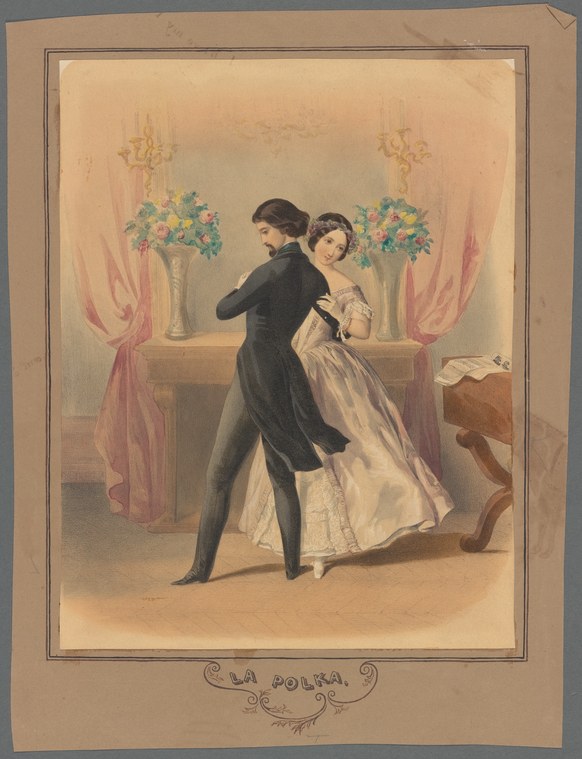
A man in formal black tailcoat and white shirt guides a woman in an elegant white ball gown through a polka step. The pair occupy the center of an ornate interior: tall floral arrangements in classical urns flank them on either side, and draped pink silk curtains frame the scene. The setting suggests a ballroom or drawing room of the mid-to-late nineteenth century. The man faces away from the viewer in three-quarter profile, his posture attentive and controlled; the woman, shown in three-quarter view facing toward him, wears a low-necked gown with short sleeves, her dark hair arranged in the fashion of the 1870s or 1880s. The lithograph's warm ochre and cream tones, heightened with subtle color, convey the gaslit intimacy of an indoor evening. The composition freezes a moment mid-dance, the figures suspended in elegant partnered motion.
The dancing
The pair is in a closed ballroom hold: the man's left hand (viewer's right) guides the woman's right hand at shoulder height, while his right arm (viewer's left) supports her back. Both figures lean slightly forward into the dance frame, their bodies aligned vertically in the upright posture characteristic of Victorian-era ballroom technique. The woman's weight appears centered, her stance poised and receptive; the man's shoulders are squared and his frame commanding. The moment suggests the traveling or rotational movement phase of the polka—neither figure is caught mid-hop, but rather in the gliding, weighted step that connects the hop motions.
The dance depicted
The title *La Polka* and the costume, setting, and partnered frame all confirm this as a representation of the polka as danced in fashionable ballrooms of the 1870s–1890s. The polka was a favorite of the Victorian ballroom, faster and more playful than the waltz, and this image captures the formal, restrained elegance with which educated classes performed it indoors. The closed hold, upright frame, and the woman's passive-receptive posture are all consistent with the period's ballroom conventions. The artist has chosen a moment of smooth traveling rather than the characteristic hop, suggesting either a stylization for aesthetic effect or a depiction of the slower, more controlled ballroom variant preferred in drawing rooms.
How it was made
This is a hand-colored lithograph, a process that allowed rapid reproduction of designs with color applied by hand or stencil. Lithography was the dominant medium for popular dance imagery in the nineteenth century, enabling affordable distribution to middle-class households and dance studios. The soft, warm palette and delicate rendering of drapery and skin tone are characteristic of chromolithographic production for the ballroom dance market. The technique's facility with gradation and tone made it ideal for suggesting gaslit interior space and the refined elegance of formal dress.
About this work
This lithograph documents the polka as a Victorian ballroom dance—not the energetic folk dance of its origins, but the formalized, partner-centered drawing-room version that dominated European and American high society from the 1850s onward. The image is a period artifact of dance pedagogy and social aspiration: it shows viewers not merely that the polka was danced, but *how* it should be danced among the respectable classes—with upright posture, precise partnering, and restrained grace. The title in French script and the refined interior setting confirm this as a representation aimed at an educated, probably urban, francophone audience. It belongs in a dance gallery both as ethnographic evidence of Victorian ballroom practice and as a window onto how dance was taught, distributed, and understood as an accomplishment of gentility.
How to look at it
Observe the closed hold and the vertical alignment of the partners' bodies—this is the ballroom frame, and it tells you immediately that this is not a folk polka but a socialized, rule-governed version. Note how the artist has frozen the moment in the smooth traveling section rather than capturing the characteristic hop-step; this choice reflects both the conventions of elegant portraiture (movement frozen in repose) and the Victorian preference for controlled, dignified motion over exuberant folk energy. The ornate interior, the careful dress, and the formal posture of the woman all work together to communicate that this dance belongs to a world of social ritual and approved conduct—this is dance as a mark of class and education.
The period
The polka emerged in Bohemia in the 1830s and spread rapidly across Europe and America as a fashionable ballroom dance. By the 1870s–1880s (the probable date of this work), it had been fully assimilated into Victorian ballroom culture and had lost much of its original vigor and informality. The period saw intense codification of ballroom technique: dancing masters published instructional manuals, and lithographic imagery circulated idealized versions of proper form to amateur dancers. The polka remained popular throughout the Victorian era and into the Edwardian period, though it was gradually eclipsed by the waltz as the signature ballroom dance. This image reflects that moment of refinement and standardization, when dance technique had become a matter of printed instruction and distributed imagery rather than oral tradition or live example.
Where it lives
The work is held in the New York Public Library's collections. It is a popular lithograph, likely distributed as an inexpensive print for domestic or commercial circulation—the sort of image found in dance studios, households, and periodicals of the period.
Dance in this work
Questions about this work
Is this how the polka was actually danced?
Yes and no. The frame, hold, and upright posture shown here represent the ballroom polka as codified and taught in Victorian society. The original folk polka, danced in taverns and military circles, was far more energetic and informal. This image shows the refined, socially approved version—what dancing masters taught and what respectable people performed in drawing rooms.
When and where would people have danced this?
In ballrooms, private homes, and public assembly rooms of Europe and America, principally from the 1850s through the early twentieth century. This image dates to the Victorian era (likely 1870s–1890s) and probably reflects French or European ballroom practice, given the French title.
What does the lithograph technique tell us?
Lithography was the dominant medium for reproducing dance images in the nineteenth century. It was fast, affordable, and allowed hand-coloring, making it possible to circulate idealized images of proper technique to dance studios and middle-class homes. This image was likely distributed as an instructional or aspirational print, helping to standardize and popularize ballroom technique.
Why is the woman's role so passive?
The passive, receptive posture of the woman reflects Victorian dance conventions and gender ideology. In ballroom dancing of this era, the man led decisively and the woman followed, her role understood as responsive and receptive. This was not unique to the polka but was the standard frame across most ballroom dances.
More Polka artwork