32 works in this view — arrow keys or swipe to move between them.
Dance in Art · 2019
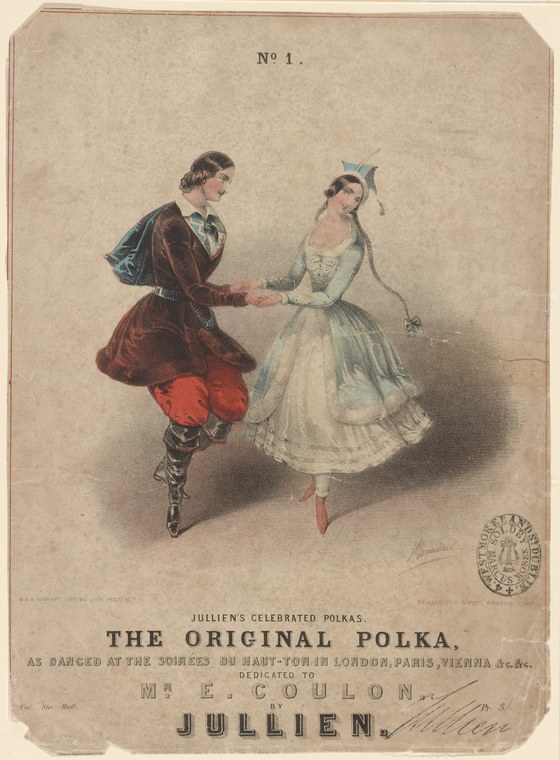
Jullien's celebrated polkas.
Unknown artist
- Medium:
- Lithograph
- Dance:
- Polka
- Era:
- Late 1800s (Victorian Ballroom)
- Source:
- New York Public Library
- Rights:
- Public domain — free to use, share and adapt.
- Recorded as:
- public_domain
This lithograph is a primary document of 19th-century ballroom culture and commercial dance publishing. It shows not a trained dancer in a theatrical setting but the polka as a social practice—accessible, courteous, and bound by rules of etiquette that the image silently enforces. For historians and dancers, it is evidence of how dance knowledge circulated: not through video or film, but through printed sheets, instruction manuals, and visual models that taught the dance as much through fashion and demeanor as through footwork.
What you are looking at
A lithographed cover sheet for a polka dance instruction or music publication shows two dancers in a formal ballroom setting, rendered in soft hand-colored tones. The male dancer on the left wears a deep burgundy coat with contrasting bright red breeches, white stockings, and dark shoes; he leans forward in a posture of courtly attention. The female dancer on the right wears a pale green bodice with a voluminous white skirt caught mid-motion, her posture upright and graceful. The two face each other at close quarters in what appears to be the opening moment of a dance encounter. The background is plain and neutral, focusing all attention on the figures. A publisher's mark and date line appear at the bottom, identifying this as "Jullien's Celebrated Polkas" and noting dedication to "Mademoiselle Apollon" by the artist Jullien. The work is signed in the lower right.
The dancing
The two dancers are positioned in a face-to-face frame, close enough for a formal hold though neither figure's hands are clearly joined in the image. The male dancer's weight is forward and his torso inclines toward his partner in a gesture of invitation or greeting; the female dancer stands more upright with her weight centered. Her right leg appears to carry weight while her left suggests a potential step forward or a pause in movement. The male's arms are positioned at his sides with hands visible; the female's arms are held naturally. Both dancers are shown mid-gesture rather than in a locked ballroom frame, suggesting a moment of approach or the opening figure of the polka.
The dance depicted
This is demonstrably a polka, as stated in the title and confirmed by the fashionable dress of the 1880s–1890s era and the close-frame positioning typical of that couple dance. The polka was a favorite of Victorian ballrooms and remained popular through the late 19th century, especially as a social dance for mixed couples. The image captures not an advanced figure but a moment of courtship and social greeting—the instant before or after a turn, when partners acknowledge each other. Jullien was a well-known composer and dance instructor of the mid-to-late 19th century; his publications were widely circulated in Europe and North America, making this work evidence of how the polka was taught and promoted to amateur dancers.
How it was made
This is a hand-colored lithograph, a commercial reproductive process that allowed rapid printing for sheet music covers and dance instruction sheets. Lithography's capacity for soft tonal gradation is visible in the careful modeling of the dancers' faces and the subtle shadows that give the figures volume and dimension. The technique was economical enough for wide distribution, making such prints a primary source for understanding how popular dances were marketed and visualized for amateur dancers. The inclusion of color—achieved by hand-tinting after printing—added appeal and helped distinguish fashionable dance publications from plain text.
About this work
This is a cover sheet for a published polka composition or instruction manual from the late 19th century, created by Jullien, a prominent composer and dance pedagogue. It serves as both a commercial product and a historical document of how ballroom dance was taught, promoted, and visualized during the Victorian era. The image captures the polka not in its most dynamic moment but in a carefully posed, socially legible moment of greeting and courtship—the instant when a gentleman invites a lady to dance. In this respect, it is a document not only of the dance itself but of the social ritual and gender conventions that framed it. The work belongs in a dance gallery because it is visual evidence of how a specific dance form was understood, packaged, and consumed by its contemporary audience.
How to look at it
Observe the precise moment the artist chose to freeze: not the turning or spinning motion that the polka is known for, but the moment of encounter and greeting. Notice how the male dancer's forward lean and the female dancer's upright posture embody the social choreography of the polka as much as its physical steps—deference, attention, and mutual acknowledgment. The formal dress and the plain background remove all distraction, making the social act of the dance itself the primary subject. This is how the polka was marketed to the respectable middle classes: not as spectacle or exotic display, but as a refined, orderly social practice.
The artist
Jullien (full name: Louis Antoine Jullien, 1812–1860, though this print dates later and may reference works published under his name or by his students and successors) was a celebrated composer, bandmaster, and dance instructor whose polkas, quadrilles, and waltzes were internationally popular. His name became synonymous with fashionable dance composition in the 19th century, and his publications extended well beyond his death through posthumous editions and works by followers. He was instrumental in bringing dance music into the commercial mainstream, and his publications are now primary sources for understanding ballroom culture across Europe and America.
The period
The polka rose to prominence in the 1840s and remained a staple of ballrooms through the 1890s and beyond. In the Victorian era depicted here, ballroom dance was highly codified: it was a primary site of courtship, social ritual, and the display of gentility. At the same time, dance was becoming a commercial enterprise—published music, instruction manuals, and visual guides made it possible for the middle classes to learn the dances of the ballroom without a private teacher. The rise of lithography and commercial printing allowed publishers like Jullien to reach a vast audience of amateur dancers, transforming folk and courtly dances into standardized, branded social practices.
Where it lives
This print comes from the New York Public Library collection and is catalogued as part of a broader body of late 19th-century dance and music ephemera. It is a commercial publication—a cover sheet for a polka composition or instruction manual—rather than a unique work of fine art, and its significance lies in its status as a mass-produced educational and promotional object.
Dance in this work
Questions about this work
Who was Jullien?
Louis Antoine Jullien (1812–1860) was a renowned French composer and bandmaster whose polkas, quadrilles, and other ballroom dances were hugely popular across Europe and America. His name became synonymous with fashionable dance music, and his publications made ballroom dances accessible to amateur dancers. His works were reprinted and circulated long after his death, making him one of the most influential dance composers of the 19th century.
What is a polka?
The polka is a couple dance in 2/4 time that originated in Bohemia in the 1840s and spread rapidly through Europe and America, becoming a standard ballroom dance. It is characterized by a distinctive hop-step rhythm and is typically danced in a closed or semi-closed frame. By the Victorian era shown in this print, it was one of the most popular and respectable dances in middle-class ballrooms.
What does this image tell us about how people learned to dance?
This cover sheet is evidence that by the late 19th century, ballroom dance was learned from published materials—sheet music, instruction manuals, and visual guides—not only from live teachers. The polka was standardized and branded, sold as a commercial product to middle-class amateurs. The careful attention to dress, posture, and moment of greeting shows that published dance images taught etiquette and social conduct as much as steps.
Is this a lithograph or an engraving?
This is a hand-colored lithograph, a printing process that allowed for soft tones and rapid reproduction. Lithography was ideal for commercial publications like dance covers because it was cheaper than engraving and could be printed in quantity. The hand-coloring added appeal and visual distinction to the printed sheet.
More Polka artwork