31 works in this view — arrow keys or swipe to move between them.
Dance in Art · 2019
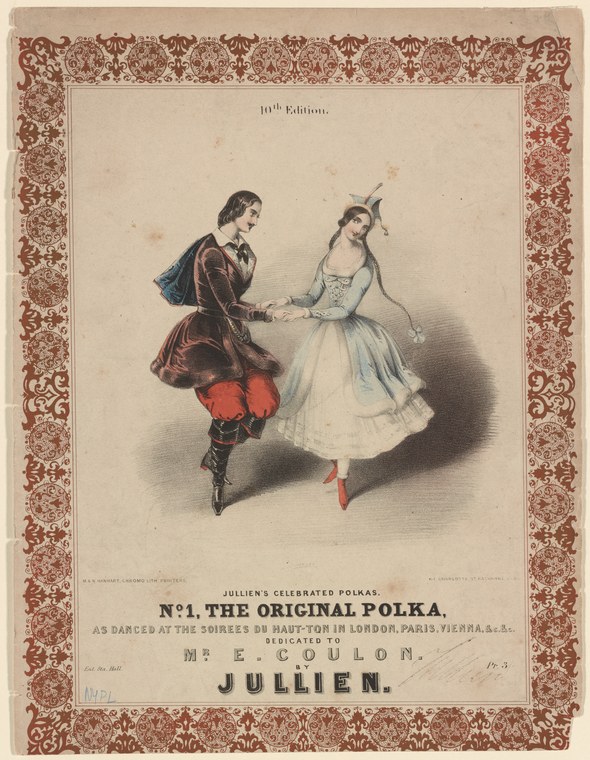
Jullien's celebrated polkas.
Unknown artist
- Medium:
- Lithograph
- Dance:
- Polka
- Era:
- Late 1800s (Victorian Ballroom)
- Source:
- New York Public Library
- Rights:
- Public domain — free to use, share and adapt.
- Recorded as:
- public_domain
This image documents the polka at a specific historical moment when it was transitioning from pure social dance to theatrical spectacle, and it shows how the dance was understood by both performers and their audiences. The repeated reprinting (14 editions) testifies to the hunger for ballroom imagery in the late 19th century—evidence of how central dance was to Victorian visual culture.
What you are looking at
A lithograph depicting a couple in mid-dance, likely from a ballroom performance or instructional context. The man wears a deep burgundy or maroon jacket with matching fitted hose or breeches, topped with a blue-toned doublet or upper garment; his legs are notably muscular and his posture strongly forward-leaning, almost pouncing. The woman wears a pale tulle or gauze skirt with a fitted bodice, and notably has horns or a fantastical headdress protruding from her head, suggesting she may be costumed as a supernatural or theatrical creature. The two figures are in close proximity—his hand appears to guide or support her at the waist or hip—and her body is tilted or lifted, her weight appearing to shift toward or away from him. The composition is set against a neutral ground with dramatic shadow beneath them, emphasizing the moment of lift or turn. A decorative Victorian border of dark red filigree frames the entire composition.
The dancing
The male dancer leans forward at the torso with one leg extended in a lunge or advance, his body expressing aggressive forward momentum. The female figure appears lifted or in flight, with her upper body reclined and her lower body in a different plane from his, creating a stark contrast in line and direction. Their positioning suggests either a supported lift or a moment where she has been spun away from him—her head and torso tip backward while her legs remain closer to the vertical. The theatrical headdress on the female figure is immobile and substantial, adding weight and visual drama to her silhouette.
The dance depicted
This is almost certainly a polka, as stated in the title and catalogue description. The polka is a lively, bouncing couple dance in 2/4 time that became enormously popular across Europe and America in the mid-to-late 19th century. The forward lunge of the male figure and the lifted, spinning quality of the female figure are consistent with polka movement vocabulary, which emphasizes rapid weight changes, forward propulsion, and rotational figures. The elaborate costume—particularly the theatrical headdress on the woman—suggests this was not social-dance polka but a theatrical or variety-hall performance, which aligns with the title's reference to Jullien, likely the famous dance impresario and composer Joseph Jullien or his family's celebrated polka compositions and performances.
How it was made
This is a lithograph, a process that allowed for colored or toned prints to reach a mass audience in the Victorian era. The technique involved drawing on a prepared stone surface, which could then be printed multiple times. The notation '14th Edition' at the top of the print indicates this was a popular and commercially successful image, reprinted in multiple editions—a marker of its circulation among dancers, dance teachers, and the general public interested in ballroom fashions and performance. The hand-coloring or chromolithographic printing required to achieve the detailed dress and flesh tones suggests a print house of some quality, and the elaborate decorative border implies this was marketed as a collectible or decorative item as well as instructional material.
About this work
This is a hand-colored lithograph of a polka performance, titled in reference to Jullien's celebrated polkas. The work dates to the late Victorian era (the 1870s–1890s) and represents a moment when ballroom dance was not only a social practice but also a theatrical spectacle. The coupling of a male dancer in aggressive forward momentum with a female dancer in a lifted, spinning position captures the dynamic, energetic character of the polka as it was performed on the stage. The 14th Edition notation indicates this print was one of many copies distributed among dancers and dance enthusiasts, making it both a record of performance practice and a pedagogical tool. The theatrical costume—the male's jewel-toned hose and the female's fantastical headdress—signals that this was not a depiction of parlor dancing but of polka as popular entertainment, likely a published promotional image for a known performance or choreography.
How to look at it
Notice the exaggerated forward tilt of the male dancer's torso and the extreme lift of the female figure—these are not naturalistic poses but rather a moment of peak action, frozen to show off the vitality and lift of the dance. The horned headdress is the key to reading this as theatrical rather than social: this is performance costume, not ballroom fashion. Observe how the artist has rendered the muscular definition of the male dancer's legs to emphasize power and propulsion, while the female's delicate tulle skirt and floating quality emphasize lightness and elevation. The shadow cast beneath them grounds the figures and emphasizes the moment of lift.
The period
The polka emerged in Bohemia in the 1830s and rapidly spread across Europe and North America, becoming one of the defining dances of the mid-19th century. By the 1870s–1890s, when this print was made, the polka had settled into both social and theatrical contexts. Joseph Jullien (1808–1860) was a celebrated dancer and composer famous for his polka compositions; if this print references his work, it may be posthumous marketing or tribute. The late Victorian era saw an explosion of printed ephemera devoted to dance—instructional prints, fashion plates, theatrical souvenirs—all aimed at a growing middle-class audience eager to participate in or observe fashionable movement. The hand-coloring and decorative border place this squarely in that commercial ecosystem.
Where it lives
This is a hand-colored lithograph held by the New York Public Library, from their collection of 19th-century dance ephemera. The presence of printed text at the base (which also references performances at the Salle de Hart-Toir in London, Paris, Vienna, and other cities) indicates this was a commercial, mass-produced promotional print, likely one of many designed to advertise performances or to sell to dance enthusiasts.
Dance in this work
Questions about this work
What is a polka?
A polka is a lively couples dance in 2/4 time that originated in Bohemia in the 1830s. It is characterized by rapid hops, quick weight changes, and rotational figures. It became enormously popular across Europe and America in the 19th century, and was danced both socially and on the theatrical stage.
Who was Jullien?
Joseph Jullien (1808–1860) was a renowned French dancer and composer famous for his polka compositions and performances. The title of this print references his celebrated polkas, though it is unclear whether this is a contemporary image of his performance or a later tribute. His name became associated with high-quality ballroom music and choreography.
Why does the woman have horns?
The horned headdress indicates this is a theatrical, costumed performance rather than social dancing. The fantastical costume suggests the female dancer may be portraying a supernatural or mythical character, adding narrative or comic interest to the dance performance.
What does '14th Edition' mean?
The notation indicates this print was reprinted at least 14 times, making it a commercially successful design. The multiple editions suggest strong demand among dancers and dance enthusiasts, and the print likely served both as a memento of a popular performance and as a fashion or instructional reference.
More Polka artwork