49 works in this view — arrow keys or swipe to move between them.
Dance in Art
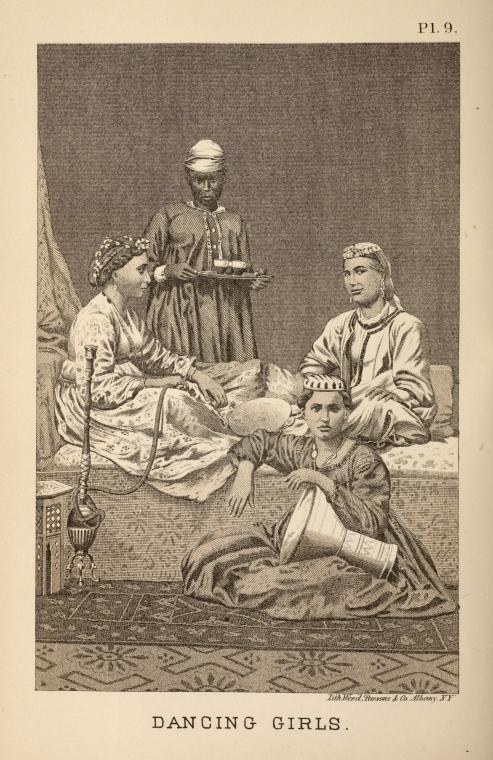
Dancing girls.
Unknown artist
- Medium:
- Source:
- New York Public Library
- Rights:
- Public domain — free to use, share and adapt.
- Recorded as:
- public_domain
The image documents how European audiences of the early 19th century visualised 'Eastern' female performance and entertainment, filtered through Orientalist fantasy rather than ethnographic observation. It reveals the social framing of dance as domestic entertainment for private consumption, and the centrality of costume and setting to the appeal of such scenes.
What you are looking at
A parlour scene depicting four figures in early 19th-century dress arranged around a richly patterned carpet. Three women occupy the foreground: two seated on the floor or low cushions in elaborate muslin gowns with long sleeves, their hair dressed in fashionable ringlets and ornamental bands, and a third standing behind them in similar dress, holding what appears to be a serving tray. A fourth figure, a man in a turban and draped garments, stands slightly apart. The women are arranged in relaxed, informal postures suggesting music and entertainment rather than formal dance instruction. The setting is interior, with drapery and furnishings visible at the left, and the floor decorated with an ornamental geometric border typical of Orientalist aesthetics of the period. The engraving captures a moment of social leisure—likely a private concert or entertainment—rendered with careful attention to textile pattern and the studied informality of polite domestic life.
The dancing
The two seated women display relaxed, receptive postures with arms and torsos angled toward one another in conversational ease. Their bodies sit low, with skirts spread in full profusion around them; neither adopts a posture of active dancing or formal performance. The standing woman holds her body upright, servant-like, rather than as a participant. No closed holds, partnering, or coordinated movement between figures is evident. The poses suggest observation and participation in entertainment rather than structured social dancing or choreographed steps.
The dance depicted
The scene does not depict active dancing. Instead it shows the social context in which music and dance entertainment occurred in European drawing rooms of the early 19th century. The domestic leisure setting, the presence of an attendant (likely representing a servant or musician), and the receptive postures of the women suggest a music-listening or conversation scene. If dance is present, it is anticipated or performed elsewhere rather than captured in action. The Orientalist dress and furnishings may suggest a fashionable fantasy of 'Eastern' entertainment popular in Regency and early 19th-century European taste.
How it was made
This is an engraving, likely hand-coloured or printed in sepia ink on cream paper, made from a copper or steel plate. The technique allows fine linear detail in the drapery, carpet pattern, and facial features, with tonal work achieved through parallel line hatching. The clear composition and controlled tonal range suggest a European engraving of the early 19th century, possibly after a drawing or painting. The even quality and small scale indicate circulation as a print for collectors or illustration in a book or journal—a form intended for domestic parlours much like the one depicted.
About this work
This engraving shows a scene of social entertainment and leisure in the early 19th-century European drawing room, arranged around the fashionable Orientalist aesthetics of the Regency period. The women's dress, the interior furnishings, and the figure of a turbaned attendant all reflect the taste for 'Eastern' exoticism that permeated European high society at this moment. Though titled 'Dancing Girls,' the work does not depict active choreographed dancing but rather the social and domestic context in which such entertainment was consumed—a drawing-room scene of music, conversation, and fashionable leisure. The print belongs to a wider tradition of Orientalist genre engraving popular with collectors in the early 19th century.
How to look at it
Attend first to the postures of the women: none of them stands in a pose readied for dance, nor do they relate to one another as dancing partners would. The seated arrangement, the angled gaze, the relaxed line of the spine all suggest listening or conversation rather than active performance. The title 'Dancing Girls' invites the viewer to expect choreographed movement, but the artist has chosen instead to depict the moment before or after dance, or perhaps the social role of the entertainer in a private setting. This gap between title and image is deliberate: the appeal lies in the fantasy of access to a private leisure scene, not in the capture of movement.
The period
The engraving dates to the early 19th century, a period of intense European fascination with the Ottoman East, Egypt, and Asia Minor following the Napoleonic Wars and increased colonial travel. Orientalist imagery flooded the artistic market—paintings, engravings, decorative objects—feeding a appetite for luxury, exoticism, and fantasies of despotism and sensuality. In dance history, this period saw the rise of Romantic ballet and the Orient as a privileged setting for the ballerina: works such as La Bayadère (1877) would later crystallise this vision. Genre engravings of 'dancing girls' and harem scenes were mass-produced for the middle-class drawing room, where they satisfied curiosity about non-European women and performance while reinforcing racial and sexual hierarchies.
Where it lives
The print is held in the New York Public Library collection. Its catalogue record provides no artist attribution, date, or publication information, suggesting it was registered as part of a larger collection of engravings or a miscellaneous group. Such works often circulated widely and were frequently bound into volumes or sold individually without careful attribution.
Questions about this work
Is this a depiction of a real dance form?
The engraving does not depict active dancing or a recognisable dance technique. It represents a European fantasy of 'Eastern' entertainment set in a domestic interior. The fashionable dress and Orientalist furnishings are markers of early 19th-century European taste rather than ethnographic documentation.
Why does the title say 'Dancing Girls' if they are not dancing?
The title reflects the commercial marketing of the print: 'dancing girls' was an alluring phrase for contemporary audiences and conjured fantasies of exotic female performance. Artists and publishers used such titles to appeal to buyers' desires for access to private, sensual scenes. The actual content—a scene of social leisure and entertainment—was often secondary to the appeal of the subject matter.
What does the turbaned figure represent?
The figure is almost certainly a servant or attendant, rendered in 'Turkish' or 'Eastern' dress to reinforce the Orientalist fantasy. The tray or vessel he holds suggests he is serving refreshment. His presence frames the scene as one of luxury and leisure, with the women as objects of aesthetic pleasure attended by subordinate figures.
When and where was this engraving made?
The style of dress, the quality of line, and the Orientalist subject matter all point to the early 19th century, likely between 1800 and 1830. The print was likely made in Europe—possibly England, France, or Germany—and circulated as a collectible engraving for middle-class households.
More dance artwork