49 works in this view — arrow keys or swipe to move between them.
Dance in Art · 2019
Scottish dancing
Unknown artist
- Medium:
- Source:
- New York Public Library
- Rights:
- Public domain — free to use, share and adapt.
- Recorded as:
- public_domain
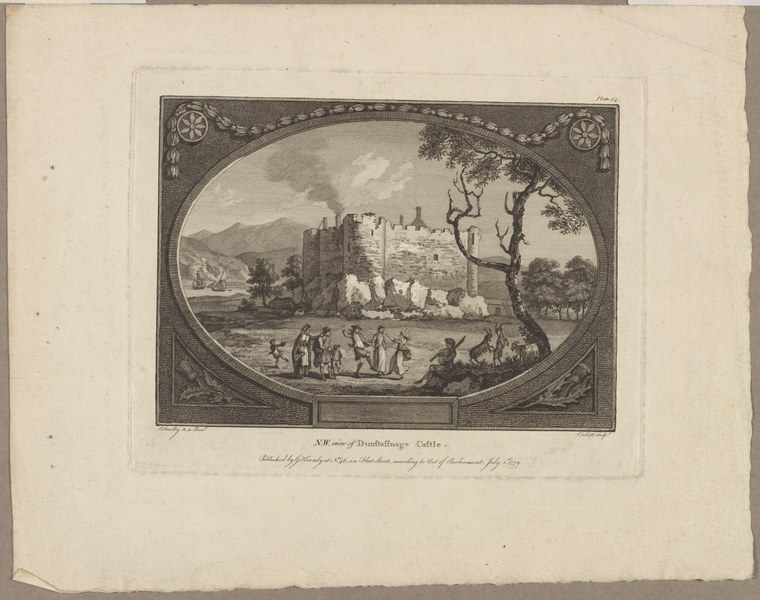
The image is rare evidence of how Scottish regional dances were actually performed in the 18th century: outdoors, socially, in the loose formations and relaxed dress of living practice rather than the formalized court contexts that dominate surviving dance documentation. It also reveals the moment when Scottish dance and landscape became objects of Romantic interest to printmakers and collectors, marking the beginning of the transformation of folk dance into cultural heritage.
What you are looking at
An 18th-century engraving depicts a group of figures dancing and socializing before a ruined castle on the banks of a river valley. The castle, with its crenellated towers and weathered stonework, dominates the middle distance on a slight elevation; mountains rise beyond. In the foreground, a scattered assembly of at least a dozen figures in period dress occupy the grassy ground. Several couples are engaged in dance or courtship; others stand in conversation or gesture expansively. The figures wear long coats and breeches typical of the 1700s, with women in long skirts. The composition is framed by a decorative oval border with ornamental corner devices, and the entire scene is rendered in the clear, precise tonal gradations characteristic of engraving. The moment is one of leisure and pleasure—a outdoor assembly where dance mingles with socializing against a landscape of Romantic ruin.
The dancing
The dancers occupy scattered positions rather than formal rows. A central couple appears to be in the midst of a social dance, their bodies angled toward one another in the relaxed posture of courtship dancing rather than the rigid geometry of court forms. Other figures nearby gesture with arms extended, suggesting the animated movement of country or regional dance. The dress—full skirts for the women, long coats and breeches for the men—allows for the larger, less constrained movement typical of folk or regional dances performed outdoors rather than in the ballroom. The overall impression is of spontaneous movement arising from the occasion rather than formally choreographed steps.
The dance depicted
The title identifies this as Scottish dancing, and the outdoor setting, the Romantic ruin, and the informality of the assembly all support a Scottish regional context. The clothing and body language suggest a style of social dance less formal than court dances: likely a country reel, strathspey, or similar Scottish folk form of the period. The presence of multiple couples in loose spatial arrangement rather than tight formation, and the apparent energy of the gestures, is consistent with Scottish reels and strathspeys as they were danced in the 18th century. The engraving likely documents a type of outdoor social dancing—at a gathering or fair—rather than a theatrical presentation.
How it was made
This is an engraving, a relief printing process in which an image is incised into a metal plate, inked, and printed. The catalogue record does not identify the artist. From the style—the fine parallel lines used to create tone and shadow, the precision of the architecture, the decorative frame—this appears to be 18th-century work, likely made for circulation as a print in a series or collection. The oval composition and ornamental border are typical of the period. Engravings were the primary means of distributing images widely before photography, making this likely a popular record of a picturesque or culturally significant scene.
About this work
This is an 18th-century engraving documenting Scottish social dance in an outdoor setting, inscribed as occurring before 'Dundalough Castle' (likely Dundalough or a similar ruin in the Highlands). The work sits at the intersection of Romantic landscape aesthetics, ethnographic interest in regional dance practices, and the tradition of the picturesque print. For a gallery of dance in art, it represents the documentation of folk and regional dance forms at a moment when they were becoming subjects of cultural and aesthetic interest to polite society. The engraving records not a theatrical performance but a social occasion where dance was woven into leisure and courtship—a moment of vernacular practice captured for circulation and consumption.
How to look at it
Attend to the spatial arrangement of the dancers: they are scattered and informal rather than arranged in the geometric patterns of court dance or the tight lines of a formal ball. Look at the energy in the raised arms and the bodies angled toward partners—this is movement that arises from the social occasion rather than from learned choreography executed in unison. Note how the artist has chosen to freeze the moment not at a climactic pose but in the midst of gesture and conversation, capturing the lived texture of dance as social practice. The oval frame and decorative border mark this as a work made for collectors and homes, not as a performance document—it is landscape and cultural curiosity as much as dance.
The period
The 18th century saw a growing aesthetic interest in the 'picturesque'—the marriage of landscape, history, and human activity—and in the regional and folk practices of Britain and Scotland in particular. This print belongs to a broader tradition of landscape prints and topographical engravings that combined views of ruins or remarkable sites with scenes of local life. At the same time, Scottish dance was being codified and recorded, particularly in collections of strathspeys and reels published in Edinburgh and London. The engraving sits at this cultural moment: landscape print, ethnographic document, and celebration of Scottish identity all in one.
Where it lives
The work is held by the New York Public Library. It is catalogued as a print without artist attribution; the inscription on the print itself provides the title and references to the site depicted.
Dance in this work
Questions about this work
What is Dundalough Castle?
The inscription identifies the location as 'Dundalough Castle,' likely a ruin in the Scottish Highlands. The precise identification is uncertain, but the site was significant enough in the 18th century to merit inclusion in a picturesque print—a common way for landscape artists and engravers to commemorate ruins, historical sites, and notable scenery.
Is this a real event or an imagined scene?
The print appears to document a real or plausible social occasion—a gathering for dancing and socializing at or near a notable ruin—rather than a purely invented scene. However, it is a work of art, not a photograph, and the composition is arranged for aesthetic and narrative effect. The figures may be idealized or composite rather than portraits of specific people.
What dances are being performed?
The title identifies the dance as Scottish, and the informal outdoor setting and loose spatial arrangement suggest country dances such as reels or strathspeys rather than formal court dances. The actual steps are not recoverable from the engraving, but the body language and grouping are consistent with the social, participatory nature of Scottish folk dance.
Why would an engraver make a print of this scene?
Picturesque landscape prints combining historical ruins with scenes of local life or leisure were popular in the 18th century, particularly for Scottish subjects. These prints appealed to collectors and travelers interested in landscape, history, and the romantic appeal of Scotland. They also served as a form of cultural documentation, recording regional practices and identities for a broader audience.
More dance artwork