29 works in this view — arrow keys or swipe to move between them.
Dance in Art
The celebrated polka dance
Unknown artist
- Medium:
- Lithograph
- Dance:
- Polka
- Era:
- Late 1800s (Victorian Ballroom)
- Source:
- New York Public Library
- Rights:
- Public domain — free to use, share and adapt.
- Recorded as:
- public_domain
The polka was one of the first dances to cross class and national boundaries globally in the nineteenth century, and this cover image is a direct artifact of that circulation. For historians of dance and material culture, it evidences how dance was advertised, consumed, and remembered in the ballroom's commercial ecosystem. The image shows how the polka's visual signature—the woman's flung skirt and partners' united rotational motion—was instantly recognizable and marketable.
What you are looking at
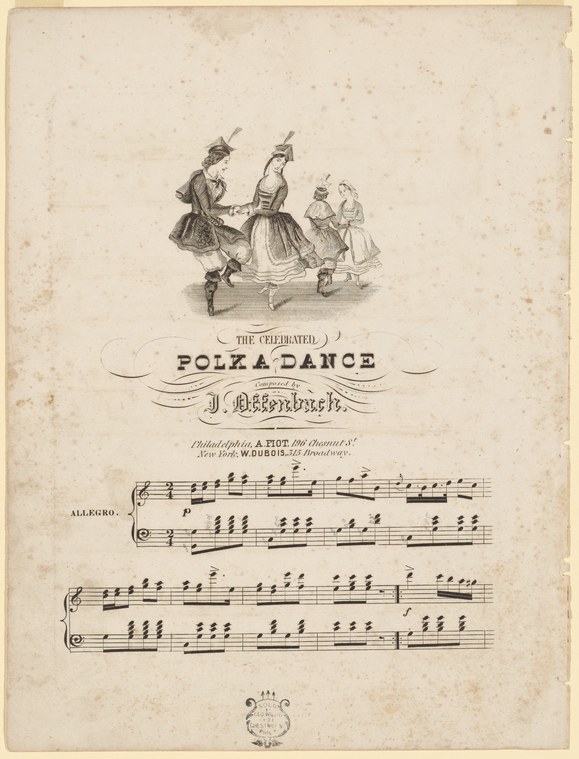
A lithograph sheet music cover depicting three couples in the midst of a lively polka. The figures occupy the center of the composition against a plain background, their clothing and positioning frozen in mid-motion. Two women in the foreground wear full-skirted dresses with corseted waists, their skirts billowed outward as though caught mid-spin; both have feathered headdresses. The men wear dark tailcoats and decorative hats. In the background, a third couple is smaller and less distinct. The moment captured is one of energetic rotation: the nearest woman's skirt is dramatically lifted and spread, her body angled away from her partner in a characteristic polka turn. The composition emphasizes the rotational momentum and social pleasure of the dance—this is the joyful, rapid spinning action that defined the polka's appeal to ballroom dancers of the period. The figures are arranged in a compact group that reads as a single unified dance moment rather than a sequence.
The dancing
The primary couple in sharp focus shows the polka's signature closed or semi-closed ballroom hold, with partners facing each other at a distance that permits rapid turning. The woman's body is tilted away from vertical, her weight carried on one leg as the other extends in the turning step; her skirt flares dramatically outward. The man's posture is upright and controlling, his frame supporting the rotation. The arm lines are not rendered in complete detail, but the proximity and orientation of the partners is unmistakable—this is partner dance, not solo or line work. The second couple echoes the composition and dynamic; all four visible dancers are locked into turning motion. The artist has captured the characteristic 'rise and fall' and rotational spring of the polka hold.
The dance depicted
This is unambiguously a polka, as stated in the title. The polka was a Bohemian dance that swept through European and American ballrooms from the 1840s onward, becoming one of the defining social dances of the mid-to-late nineteenth century. It is a couple dance in 2/4 time, performed in a closed ballroom hold, characterized by rapid rotational figures and a bouncy, springing step. The image captures the dance's most visually distinctive feature: the rapid, dizzying turn with the woman's skirt flung outward, which was thrilling to both performers and onlookers. The costume and lithographic style place this in the late nineteenth century, when the polka remained a staple of ballroom repertoire alongside the waltz and quadrille. The feathered headdresses and elaborate dress are consistent with formal ballroom practice of the 1880s–1890s.
How it was made
This is a lithograph, a planographic printing technique that allowed mass production of sheet music covers and dance instruction imagery. The technique enabled fine detail and tonal gradation, as visible here in the careful rendering of fabric texture, the feathered headdresses, and the delicate linework of the musical notation below. Lithographs were the standard medium for illustrated sheet music covers in this era, making the work affordable and widely circulated. The print shows evidence of hand-finishing or color separation (indicated by the tonal work across the figures), though the present copy is monochrome. The combination of title, engraver attribution, publisher information (A. Huff, 186 Chatham St., New York; W. Dubois, 385 Broadway), and musical notation below establishes this as a commercial music publication, not a fine art print—its audience was ballroom dancers and music-makers, not galleries.
About this work
This is a mid-nineteenth-century lithographic sheet music cover for a polka, a dance that defined the social ballroom world of the Victorian era. The image captures the essential visual spectacle of the polka: the rapid turning motion, the flaring skirts, and the close ballroom partnership between man and woman that made the dance simultaneously thrilling and scandalous to contemporary observers. As a printed artifact, it circulated among dancers, musicians, and music retailers in New York and beyond, serving as both advertisement and instruction. The work belongs in a dance archive not for its artistic sophistication but for what it documents—the lived visual culture of a specific moment in ballroom history, when the polka represented modernity, pleasure, and social energy.
How to look at it
Observe the angle and position of the nearest woman's body: she is tilted away from vertical, her weight on one foot, her skirt lifted and spread outward by centrifugal force. This tilt is not a departure from balance but the essential figure of the polka turn—the artist has frozen the exact moment when the rotational energy is visible in the body's inclination. Notice how the feathered headdress catches this tilting motion; the hat, too, seems lifted by the spin. The composition places this moment at the center of the frame, making it the apex of visual interest—the artist understood that the polka's appeal lay in this dizzying, visible rotation, not in footwork or technique.
The artist
The engraver and artist are not recorded in the catalogue. The work was published by A. Huff and W. Dubois, both New York music retailers operating in the mid-nineteenth century. This was a commercial publishing house practice: sheet music covers were commissioned from house lithographers or engravers whose names rarely appeared on the cover or were quickly forgotten. The quality of the figure drawing and the competent lithographic technique suggest a professional shop used to dance and ballroom imagery.
The period
The polka emerged in Bohemia in the 1830s and reached Paris, Vienna, and London by the 1840s; by mid-century it was a dominant feature of ballroom life across the European and American ballrooms. The 1880s–1890s (the likely date of this print based on costume and style) represent the polka's mature phase in American society: no longer scandalously new, but fully domesticated as a respectable ballroom standard alongside the waltz and quadrille. In this period, the polka was taught in dancing schools, featured in ballroom assemblies and private parties, and heavily documented in sheet music, instruction manuals, and popular imagery. The lithograph's bright, cheerful rendering reflects the dance's association with pleasure and sociability rather than the stiffness of earlier formal dances.
Where it lives
The work is held in the New York Public Library collection. It is a commercial sheet music cover, not a unique work; multiple copies likely survive. The Library's holding suggests it was collected as part of the institution's documentation of American popular music and dance culture.
Dance in this work
Questions about this work
Why do the women's skirts flare out like that?
The polka is a rapid turning dance performed in a closed ballroom hold. As the partners rotate, centrifugal force lifts the woman's full skirt outward—this dramatic flare was one of the dance's most visually striking and memorable features. Spectators came to ballrooms partly to see this effect, and artists of the period consistently emphasized it.
When was the polka popular?
The polka emerged as a fashionable ballroom dance in the 1840s in Vienna and Paris, and spread rapidly to London, New York, and other major cities. It remained a staple of ballroom repertoire throughout the nineteenth century. This print dates to the late 1800s, when the polka was well-established but still actively danced.
What is the music below the image?
This is sheet music for the polka tune. The cover combines title, publisher information, and the opening bars of the musical composition, allowing musicians to see what they were purchasing and dancers to imagine the tempo and character of the piece.
Who would have bought this sheet music?
Professional musicians preparing for ballroom events, amateur pianists playing at home, dancing masters teaching the steps, and affluent households maintaining a collection of fashionable dance music. It was a commercial product aimed at the middle and upper classes engaged in ballroom dancing.
More Polka artwork